Friday, January 21, 2011

Two Of A Lost Kind


STORY 165: DALEK


There was a suspicion that The Doctor's most famous enemy would not be appearing in the revived Doctor Who. This situation was further exacerbated when we have the revival explain that the Doctor is the last surviving Time Lord, his people being destroyed along with all the Daleks at the end of the Time War. How could the Daleks come back if all of them had been destroyed along with all Time Lords? As far as we could see, the Daleks were finally themselves exterminated. However, now we find in Dalek that at least ONE Dalek survived...


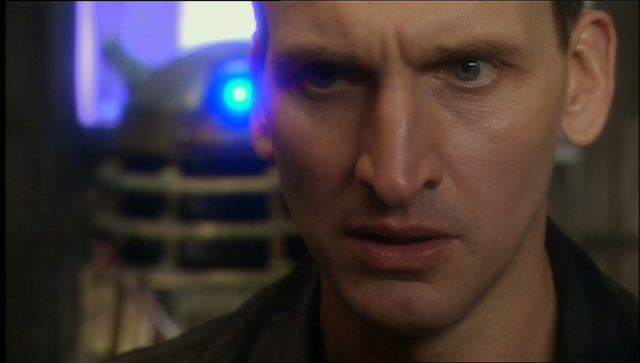
The Doctor (Christopher Eccleston) and his Companion Rose Tyler (Billie Piper) receive a distress signal that leads them to the deep bowels of an underground museum in Utah, United States. There, they discover a hidden museum full of alien artifacts. Quickly discovered, they are taken to Mr. Van Statten (Corey Johnson), a billionaire genius who "owns the Internet" and has been collecting space artifacts in order to gain profit from them. He has his own scientific advisor, a British kid named Adam Mitchell (Bruno Langley), whose main job is to find the artifacts and figure out their uses. There is one piece in his collection that is Van Statten's pride and joy: a mysterious object he calls the Metaltron. The reason the Metaltron is so important is because unlike the others, it is alive. Van Statten forces the Doctor to have a look at it, and the Doctor realizes that it is the Metaltron that has been sending the distress signal. He also realizes that it is in fact, a Dalek--the Last of the Daleks who somehow survived the Time War between the Daleks and the Time Lords.


This Dalek cannot fight back, but Van Statten realizes that the Doctor himself must be alien and takes him prisoner. Meanwhile, Adam and Rose are bonding, and she persuades him to show him the Metaltron. She feels genuine sorrow for it, especially when the Dalek tells her that he "feels pain". She reaches out and touches it, and soon the Dalek transfers her DNA to himself, allowing him to free himself and strike back at those who've been torturing him. With the Dalek now loose and causing death and destruction, the Doctor gets Van Statten to release him and attempt to seal the Dalek off. They do manage that, but while Adam manages to save himself, Rose is left behind to face extermination. The Dalek, however, cannot bring himself to kill her. Her DNA, it appears, not only brought him back to full power, but has altered his own nature to where he takes on emotions unknown to Daleks: such things compassion and mercy. The Doctor is now hell-bent on rescuing Rose and killing off the Last of The Daleks, but in the end Rose makes him see that the Dalek isn't the one putting her in danger...it's The Doctor. Once the crisis is over, Van Statten gets what's coming to him and a reluctant Doctor takes Adam in the TARDIS.


Dalek is brilliant to tackle some of the criticisms the iconic monsters have had thrown at them since 1963-64. The most famous of the criticisms is the fact that its shape makes it difficult to move anywhere that doesn't have a flat surface. I think writer Robert Shearman put in that scene specifically to answer the charge that the best way to escape a Dalek is to run up a flight of stairs. The ensuing revelation of how a Dalek can move makes the moment even more terrifying, and it's a credit to The Mill that now we have the technology, we have the capability to create the world's first fully-flying Dalek (to misquote another program) to realize the full potential of the Daleks. We also get a nod to their distinctive design. Near the middle of Dalek, the monster lifts its plunger-shaped arm. The armed guard working at it scoffs. "What you gonna do? Sucker me to death?" Bad question to taunt the Dalek with.


Beyond the special effects aspects in Dalek, director Joe Ahearne created some especially sharp visual moments. When the Doctor first enters the Metaltron's chamber, we don't see much. Ahearne builds the tension by introducing elements slowly in the scene: that humming, that single blue light hovering, that staccatto voice.


Shearman and Ahearne also tap into the unresolved war between the Doctor and the Dalek. As the last of their kind, they find themselves continuing the war that brought an end to both their civilizations. However, we see an evolution in both the characters: the Dalek (thanks to Rose's DNA) is becoming more conflicted and even with individual longings of its own, while the Doctor is becoming more aggressive, more vengeful. Dalek does a fine job of maintaining the tension between these two aggressors who for most of the episode are actually kept apart. In fact, in Dalek they never actually fight each other.


Both leads are in top form in Dalek. Eccleston conveys both the anger and pain he feels as the last of the Time Lords, raging to where he literally spits out when screaming at the Dalek, and also showing something rare for this Doctor: sheer terror when he realizes he's in a locked chamber with a Dalek. He goes through so many emotions within Dalek, and Eccleston manages to maintain the range without going over-the-top either in the pathos or the fury. The best performance, however, is that of Piper. She has a soft vulnerability as Rose and conveys such tenderness to a big pepper pot that it becomes almost a tragedy. It is Rose that is the true heart of Dalek, because Piper projects the full sadness of destroying life, either physically or in an emotional sense. When she confronts the Doctor at the end, the scene is quite moving.


Langley does a good job coming off as a bit of a twit and a coward in Dalek, which is what the character of Adam was. In a smaller role, Jana Carpenter as soldier DeMaggio has a great scene guarding Rose and Adam. It is curious to see anyone tell a Dalek to surrender, but she in her brief scene creates both a strong and scared woman. Great credit should also go to Nicholas Briggs' voice work as the Dalek in Dalek. His Dalek voice is called to show more emotion due to the cross-pollination, and he manages to do that. When Briggs as the Dalek tells the Doctor, "You would have made a good Dalek", it's quite chilling. My only complaint in terms of performance is with Johnson's Van Statten. I kept wondering if he was suppose to be a bit campy and more comedic than straight. Johnson's grinning and excessive self-confidence didn't play like he was a real person but more a parody of a billionaire.


I also have an issue with the Money Motive. This is the third time (The End of the World and ALIENS OF LONDON being the first two) where financial gain is at the heart of the crisis. Granted, I,'m an unashamed capitalist, so I may be on the opposite side of the issue, but I do hope to have another reason for the villain's motives. Finally, how I detest the stubborn refusal to even suggest that other Time Lords may have survived. I don't know why they keep locking that door. Would it have killed them to say that, yes, perhaps, just as this Dalek survived, maybe some Time Lords did as well.


A curious note. According to Dalek, the Dalek crashed on Earth fifty years ago. The date given for Dalek is 2012, which meant that the Dalek came in 1962, which is one year before The First Doctor met the Daleks in the seven-part story collectively known as The Daleks. If one took a too-nerdy approach to all this, it would mean that Gallifrey was destroyed a year before the First Doctor came to London with his granddaughter Susan. It is far too much to think about trying to make sense of it all, so we'll just let it go.


Dalek is a strong story where the Dalek is shown to be the real terror it always could be rather than an object of ridicule. Eccleston and especially Piper brought moving performances to Dalek, showing that in war, there truly are no real victors. There were some light moments that didn't overwhelm the story, and on the whole, Dalek will not be exterminated from any Best Of Collection.


8/10


Next Story: The Long Game

Wednesday, January 5, 2011

Doctor Who Story 014: The Crusade


Image result for doctor who the crusade


STORY 014: THE CRUSADE

Crosses to Bear...

As it stands, the four-part story collectively called The Crusade is incomplete. The pessimist says, "Half the story is lost". The optimist says, "Half the story survives". Episodes Two & Four (The Knight of Jaffa and The Warlords) are the lost episodes, while Episodes One & Three (The Lion and The Wheel of Fortune) still exist. However, all four episodes (in fact, all episodes of Doctor Who) survive in audio form. That being the case, we can reconstruct The Crusade in a roundabout way. The VHS release had William Russell reprise his role as Ian Chesterton to narrate the missing episodes and thus provide continuity. The DVD release of the Lost In Time collection released the audio tracks to Episodes Two and Four, so we could listen to them like we would a radio play. Therefore, in a sense, we have the complete story with us. That is why I've elected to review The Crusade as a full story as opposed to merely reviewing the surviving episodes.

A curious historic footnote to this historic story: in the Arab world, the story that followed The Web Planet was NOT The Crusade but instead The Space Museum. The actual Crusades are still a touchy subject in the Arab/Islamic world, so this four-parter did not air in the Middle East. As a personal aside I find that rather curious given that A.) the Muslims did WIN the wars, and B.) The Crusade portrayed the Islamic leader Saladin (Bernard Kay) in a positive light. It appears to be a consistent portrayal in Western films of The Crusades: Saladin is always a wise and (most of the time) benevolent warrior king. Well, as it stands The Crusade is incomplete no matter how you look at it, and it is a real shame because it is for the most part a well-crafted, well-acted story, although with a few issues.

The Doctor (William Hartnell), along with his Companions Ian Chesterton (William Russell), Barbara Wright (Jacqueline Hill), and Vicki (Maureen O'Brian) land just as a raiding party of Saracens have taken a group of Crusaders by surprise. They seize one of them believing it is Malek Ric, better known to us as King Richard I the Lion-Heart, and take Barbara as well in the confusion of battle. The real King Richard (Julian Glover) escapes, while of his courtiers, William De Tornebu (Bruce Wightman) is injured. The Doctor, Vicki, and Ian take De Tornebu back to Jaffa and the King. The captured man is William De Preaux (John Flint), but while Saladin's vassal El Akir (Walter Randall) is fooled into thinking William is the King and Barbara is the King's sister Princess Joanna, both Saladin and his brother Saphadim (Roger Avon) quickly see through the ruse. King Richard is determined to both get William back and win the war, but the TARDIS crew just want to get Barbara and then get out of there. Richard makes Ian a Knight in order to be an emissary and attempt a rescue, as well as making an indecent proposal: a marriage between Saphadim and the real Princess Joanna (Jean Marsh).

Barbara, believing she is being helped in an escape, is really taken by El Akir, but she manages to escape him and finds shelter with Haroun ed-Din (George Little), a victim of El Akir's tyranny. His wife and son were executed by El Akir, and one of his daughters was taken from him, leaving only his other daughter, Safiyah (Petra Markham). Barbara, in an effort to spare Safiyah from El Akir's men, allows herself to be captured, and soon she is taken to El Akir. Before he can kill her, Barbara escapes into the harem, where she discovers Haroun's daughter Maimuna (Sandra Hampton) is alive. Ian, having escaped bandits, gets to the harem and fights El Akir, who is about to win when Haroun comes and kills El Akir, thus reuniting with his lost daughter. Meanwhile, back in Jaffa, Joanna is infuriated at the prospect of being traded like a bag of flour and will not consent to marriage. At first, Richard believes the Doctor has betrayed his plans, but soon discovers he is mistaken. The Doctor and Vicki, wishing to avoid more court intrigue, are given freedom to leave, and soon all four are reunited. The Earl of Leicester (John Bay), believing The Doctor to be Saladin's spy, captures them and threatens death, but Ian (in his role as Knight of Jaffa), convinces him that HE will be the executioner. Fooling Leicester, the group flees into the TARDIS.

The Crusade faces that difficulty of being a story with missing episodes, but the handling of this situation is brilliant. Russell reprising his role as Ian, links the missing parts so well that the narration flows beautifully, almost as if they were always intended to be there. What is truly incredible about The Crusade is how well it works vocally. David Whitaker's script is so well-tuned that at times it reads like both a stage play and a radio play. For example, in Episode Three (The Wheel of Fortune) The Doctor whispers to Vicki, "Here comes the King", as you would when the character makes an entrance on the stage. In the lost Episode Four, the bandit holding Ian prisoner gives a description of the torture he plans on him in such a way that it almost appears that the loss of The Warlords was anticipated and it was spoken like it would be on radio.

It isn't just how the dialogue was spoken, but the actual dialogue itself is quite poetic. Haroun's monologue in Episode Three about the loss of his family to El Akim is beautiful and quite moving, as is the intrigue in the King's Chamber in the same episode. This doesn't mean that Whitaker doesn't know how to lighten the mood: there is an ample bit of comedy thanks to the character of Ben Daheer (Reg Pritchard), a shifty merchant who is almost always on the losing end of the deal. There is even a bit of Vicki/Victor/Victoria action when, to protect his youngest Companion, the Doctor has Vicki pretend to be a boy...right down to being in drag, confusing the Chamberlain (Robert Lankesheer) to no end when he first mistakes the 'girl' for a 'boy' then when the 'boy' is revealed as a girl.

The performances are also quite strong and intelligent. Whatever personality conflicts Hartnell and O'Brien may have had off-screen, there is no hint of it in The Crusade. Rather, there is warmth and tenderness between The Doctor and Vicki, making their scenes together quite beautiful and sweet. Marsh is excellent as Princess Joanna, being both imperious and tenderhearted in turns. Her best scene comes when she confronts her brother about his plans to marry her off to an infidel. She is on full cylinders, expressing an uncontrolled fury to defy her King. Glover matches her in this scene, and throughout The Crusade he shows Richard to be both petty, almost child-like in his anger, as well as desperate to win the war. Randall's El Akim is what you might call a standard stock villain--all that was needed was for him to twirl his mustache, but since he didn't have one the scar across his face will have to do. Pritchard should also be singled out for his excellent comedy work, and Markham's Safiyah, although in one episode, also gives a beautiful performance.

The success of The Crusade as a story goes to Douglas Camfield's direction. He manages to keep the story going over three episodes and guides the leads and the guest stars without shifting the balance to one or the other. I do note that I said "three episodes" because by the time we get to the fourth episode, the story has lost a bit of steam and is unfortunately becoming a bit repetitive. Take for example the characters of Barbara and Ian. Neither of them are allowed to go beyond what they've done before. Ian is the dashing daring-do type, with action sequences in Episode One (The Lion) and Episode Four. Other than to rescue Barbara, he isn't integral to the story. Babs is the one that suffers most in The Crusade: she is held hostage by one Saracen or another throughout the story, and she's taken prisoner/abducted at least three times. One begins to wonder if it is becoming a running theme in Doctor Who: Barbara abducted/held prisoner and Ian having to go in and rescue her.

Another issue is that by Episode Four, the story starts wandering off a bit. We are no longer with Saladin or Richard the Lionheart; now the focus is on rescuing Barbara--which if one thinks about it was the focus of Episode One before they wandered into Richard's Court. It is curious that in The Crusade the actual Crusades are by this point secondary. Now that whatever Court intrigue (which wasn't that much to begin with) either with the Muslim or the Christian are gone, we have another 'rescue' story. It is a positive that loose ends of the story are tied by the time we leave, but somehow in Episode Four we've shifted the focus from the war between Richard and Saladin to a fight with El Akim.

Given that we no longer have Episodes Two and Four, I am surprised that there was no attempt to reconstruct these episodes for the DVD release. The seven-part Marco Polo had a condensed version recreated with photographs mixed with the audio, and the eight-part The Invasion had the missing episodes animated. For the Lost In Time release we only had one picture throughout the half-hour or so of the presentation of Episodes Two and Four of The Crusade. At the time, it seems no one had the imaginative leap to use photographs or animation to reconstruct the episodes, or at least to give the audience an idea of how it looked when first broadcast. It's a strange thing that you can find reconstructions in places like YouTube but not from the BBC. Of course, it does leave the possibility that a future official restoration of The Crusade is possible, and I would love to have an animated version a la The Invasion released. The chances of that, granted, are small, but given that only half the story is lost (unlike say, the four-part The Myth Makers or single-episode Mission to the Unknown to something like Fury From The Deep or The Power of the Daleks, both six-part stories where all episodes are lost), a full restoration is always technically possible. I Hope.

The Crusade is a good, strong, historic story, with beautiful dialogue and some wonderful performances. The lack of visuals as well as a bit of meandering at the end bring it down a bit, but on the whole it holds up extremely well, especially given that we don't have it complete. We should do our best to both preserve and restore what we have of early Doctor Who, and The Crusade may be our Call to Arms for this noble endeavour.

6/10

Next Story: The Space Museum

Sunday, October 3, 2010

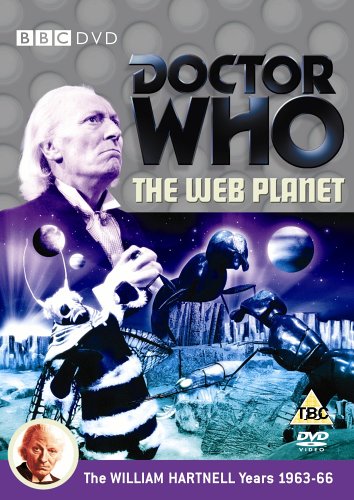
Doctor Who Story 014: The Web Planet

STORY 014: THE WEB PLANET
Image result for doctor who the web planet


Who's Zarbi Now?

We've left ancient Rome and are now on another planet. This is where Doctor Who excels: the sci-fi aspects, where all sorts of fantastic alien creatures wreak havoc on our travellers. At least, that was the case until The Web Planet.

The Doctor (William Hartnell) and his Companions Ian Chesterton (William Russell), Barbara Wright (Jacqueline Hill), and Vicki (Maureen O'Sullivan), are taken to a mysterious planet, later learned to be Vortis. Here, the ant-like Zarbi have taken over, pushing out the moth-like Menoptra, who are planning a counter-invasion. Soon the travellers are caught up in the situation, with the Animus, a strange being who is using the Zarbi to take over Vordis.

In the six episodes (The Web Planet, The Zarbi, Escape to Danger, Crater of Needles, Invasion, and The Centre), we endured a continuing series of worse and worse aliens. It was as if there was a contest to see who could come up with the worst creature in a single story. The Zarbi at first I thought were among the worst Doctor Who monsters. They looked like men inside ant costumes, with their forearms (or forelegs) being totally useless. Then I saw the Menoptra. With their exotic moments (choreographed by Rosalyn de Winter) and odd speech pattern, I kept wondering if they had asthma. Finally, once I thought we'd hit the low point of silliness, we were treated to the Optera, whom I kept calling the Grub People. Given that we had a planet inhabited by ants and moths, slugs would then be almost natural. However, they just looked people in really, really silly costumes made up of blankets, slippers, and Rastafarian extensions. Their leader sounded like Animal from The Muppet Show, and I just thought the whole thing silly.

I think that on some level the actors must have thought Bill Strutton's story silly as well. This came to me in Episode Three, when the Doctor wants to speak to the Animus via its communication method. "Drop this hair dryer or whatever it is," he says. Now, there's nothing wrong in having the Doctor be a bit cheeky when facing against his enemies, but who exactly was he speaking to when he spoke this quip? If he can't take the story seriously, we can't either.

The Web Planet also suffers from a bit of repetition from previous stories, which I think were unintentional. In Episode One, the Doctor and Ian come close to being killed by what appears to be water but which is really poisonous. That seems similar to what they faced in Episode One of The Keys of Marinus. The travellers being used as slaves before leading the revolution? We've covered something almost exactly like that in The Dalek Invasion of Earth. It seems so strange that at only fourteen stories there is already a repetitiveness to Doctor Who.

Richard Martin's direction is quite contradictory as well. Visually it is quite artistic, but that artistry also creates difficulties. There is this gauze whenever they are on the surface (perhaps to hid the weakness of the sets) but twice the gauze inadvertedly covered the actor's faces, making them blurry. It almost looked as if Martin INTENDED Hartnell to be virtually masked in The Web Planet. The ants marching (thanks, Dave Matthews Band) look so amusing and comical, as does the Larvae Gun. In Episode Four Barbara looks like she's pumping a Larvae Gun like one would pump water.

Episode Three also has one of the most notorious flubs in Doctor Who history: one of the Zarbi crashes with a camera with such force we not only see the camera jerk back and up but HEAR it as well. The nature of 60s BBC television made a retake impossible, and it does add its own charm, but it does make the already unintentionally hilarious goings-on even more hilarious.

In short, not much in The Web Planet is either good or intelligent or interesting. It isn't to say there aren't good things in it. Some of Strutton's lines are quite beautiful, almost poetic. "History doesn't mean anything when you travel through space and time," the Doctor snaps at Ian. In Episode Five, one of the Menoptra says, "Light was our god, and we existed in light, flying above thought". We also have Catherine Fleming's performance as the Animus...or rather, her voice. She has a calm tone to this villain, making her both soothing and even more menacing. The actual costumes for the Menoptra are quite beautiful.

However, too much in The Web Planet was just so laughable that one wonders why the story was commissioned at all. Granted they made a good effort to try something new, but it didn't pan out. At six episodes, it was four episodes too long. Oh, what a tangled Web Planet they've weaved...

2/10

Next Story: The Crusade

Friday, September 10, 2010

Fat Chance

STORY 164: ALIENS OF LONDON (Aliens of London/World War III)


This is the first two-parter of the revived Doctor Who, and while I might have stated this before I take this opportunity to say that when we have two-part stories I will adopt one title since it makes it easier for me.


The Doctor (Christopher Eccleston) and his Companion Rose Tyler (Billie Piper) have gone through time and space, but now they have returned to Rose's time, or at least they think it's her time. The Doctor's calculations were off... by only a year, a year where Rose's mom Jackie (Camile Coduri) searches for her and where Rose's boyfriend Mickey (Noel Clarke) is suspected of murdering one Rose Tyler. However, whatever private issues Rose faces are drowned out by a spaceship crashing into the River Thames at that moment, right down to clipping the Clock Tower of the Houses of Parliament.

In this emergency 10 Downing Street we have no news from the Prime Minister and the entrance of MP Joseph Green (David Verrey) and General Asquith (Rupert Vansittart). They are met by Ministry of Defence Junior Secretary Indra Ganesh (Navil Chowdhry), MI5 operative Margaret Blane (Annette Badland) and Transport Liason Oliver Charles (Eric Potts). With the exception of Ganesh and Harriet Jones, MP for Flydale North (Penelope Wilton) who was at Number 10 before the crisis began, all the others share a common trait: they all are rather fat. Coincidence? Not in Russell T. Davies' script. As Aliens of London progressed into its second part, I believe NOTHING in his script was coincidental, but I'm getting ahead of myself.


The Doctor is eventually called in to help, as is UNIT (United Nations Intelligence Taskforce). However, our three fat friends have a trick up their sleeves...they are not human. They are the Slitheen, a family who have plans for Earth. At first you think the Slitheen are here for conquest, but we get another twist. After a Slitheen nearly kills Jackie, she and Mickey join forces on the outside while The Doctor, Rose, and MP Jones (whose name the Doctor recalls but doesn't know from where) are trapped inside Number 10. The Slitheen wish to unleash a nuclear war on the planet so as to destroy all humanity and create a barren world, one which the Slitheen can sell at a profit. Green, now the Acting Prime Minister, tells the population that the aliens are above them and have "massive weapons of destruction capable of being deployed within 45 seconds", and ask the United Nations to give them the nuclear codes. If the UN gives the authority to have a 'preemptive strike', the Slitheen will destroy the world. The Doctor has a way out of all this, but it means risking Rose's life, a situation Jackie cannot tolerate. Still, there is simply too much at stake. Rose and Jones push the Doctor to take the step to stop the Slitheen, and with the help of "Mickey the Idiot" (the Doctor's nickname for Mickey Smith), he launches a strike of his own.

Is it me, or was Aliens of London a lot of things: a two-hour "Bush/Blair lied us into war" advert, a juvenile comedy, an anti-capitalist episode, but not a good two-parter Doctor Who? It may just be coincidence, but this is the second episode (after The End of the World) where the motive for all this murder was PROFIT. I'm beginning to suspect Davies is a bit to the left. The Slitheen aren't even a species, but a family, no different than say the Rockefellers, the Vandervilts or the Astors. This was a bit confusing in that when we learn what planet they are from, does that mean that instead of Slitheen they should be called "Raxacoricofallapatorians"? (Side note: Eccleston deserves a bonus just for being able to pronounce Raxacoricofallapatorius). The Slitheen, away from their human disguise, were a curious creature: both cuddly and monstrous. They were good monsters, but something was off, and I think I know what it was.

It was the farting. It isn't until Part Two (World War III) where we got an explanation for the farting, but to my mind Davies wanted a funny episode, and that's what he got. I couldn't take it seriously because all that farting was done in Part One for humorous effect, or at least that's how it came out (pun intended). If that wasn't bad enough, the Pig Thing. When in Part One you see the alien is a PIG, you start to wonder if we're suppose to take ANY of it seriously. Yes, we got an explanation as to WHY it looked like a pig, but Davies and director Keith Boak can't possible throw a pig at us and not expect us to laugh. All I could hear in my mind was "PIGS...IN... SPACE..." and wouldn't blame anyone else for doing the same. Going back to the farting, I put in my notes "wonder if the farting is to appeal to the children" who I figure would like that sort of bathroom humor. It wasn't to my liking because it did become a little distracting.

You also have things that I didn't follow. You introduce UNIT, which would be great for longtime fans but whom revived fans will know little to nothing about, then you kill them off before they do anything. I wonder why bother having them there in the first place...unless it's some sort of bait-and-switch. What also makes me think this was more a comedy than a straight science-fiction was "Harriet Jones, MP for Flydale North". Every time someone asked who she was, MP Jones would flash her ID and state everything but her serial number (having already given us her name and rank). Adding to my criticisms of Aliens of London, I am surprised that being overweight was a major plot point. You'd think that Davies (who is by no means svelte) would not be so quick to take shots at fat people...right down to the farts.

One thing in the script did surprise me above all else. It was in Episode One where Rose tells the Doctor how silly he was being for being so sensitive about Jackie slapping him (the slap was in itself a fine moment). "You're so gay", she tells him, and while it makes sense for that common saying (in every sense of the word) to be said by someone of Rose's background, I wonder why an openly-gay man like Davies (who also created the original and still-controversial Queer As Folk) would use that specific phrase. Will it lead kids to think it's acceptable to dismiss people by saying "you're so gay"? I found that quite troubling.

I don't deny the extraordinary talent of Davies--he's a brilliant writer who puts his ideas on paper and knows how to show them. Of course, his ideas appear to be about his subconscious desire to assassinate Tony Blair. Part of me kept thinking as that missile headed toward Number 10 that he was thinking as he typed, 'Here you go, Tony, for betraying all of us who voted Labour, for becoming that bastard Bush's poodle, for lying about weapons of mass destruction you both KNEW didn't exist, for illegally invading Iraq, which had peace and beauty and whose people were watched over by a benevolent leader until you lied to the UN and the world to get your hands on their oil. Take this, Ha Ha Ha". Of course, this could all be in my head (the unnamed Prime Minister was already dead when the crisis began), but it's the things about the weapons of destruction line that lead me to this conclusion: Aliens of London expresses the producer/writer's view on the Iraq Intervention. It's even more curious in that when the spaceship clipped the Clock Tower, to this American, echoes of September 11th played in my mind. Perhaps then, this makes Aliens of London the ultimate in 9/11 conspiracies: "they" created a crisis to bring about a war for profit.

As a writer, Davies brings a great deal of himself into his work. I digress to say that the episodes of Queer as Folk that I've seen, I couldn't help but think the three characters were aspects of himself (real or imagined), right down to the Doctor Who-loving Vince Tyler (how curious that Vince & Rose share the same last name. Curious, that). Therefore, I don't think it's beyond the realm of possibility that Davies' political views, specifically in regards with the Iraq Intervention, played a significant part in the overall story of Aliens of London.

In fairness to Davies, I cannot read his mind or know his thoughts; however, I can only express mine. It would be foolish not to think that Aliens of London is Davies' (and by extention, the Left's) response to how we ended up in Iraq, and contrary to what people might think, I think this is a brilliant example of what science-fiction can do: express current-day issues in the guise of a fantastical story. Therein lies Davies' high intelligence (even though as a viewer I've never been fond of stories being written to create a certain viewpoint, whether I agree with it or not). And thus ends my reading of politics into a two-part Doctor Who.

If we focus on the acting, I think Wilton's Jones did a great job balancing comedy with fear. For the most part, she was comedic but in the Cabinet Room, you got that there could be steel beneath her natural insecurity. Coduri showed throughout the story a genuine love for her daughter--in her loss when Rose disappeared, when the Doctor tells her that Rose may die, right down when she waits those 'ten seconds'. In fact, near the end there is quite a sad and touching moment between Coduri and Piper when Rose opts to leave again. Eccleston kept his manic, almost giddy sense of his Doctor, but he still managed to be frightening in his seriousness when called for. His Doctor isn't all goofy grins but a growing sense that the fun he has in exploring comes with a cost.

I'm going to wrap up with this: at two episodes I think the story was too long. Part One: Aliens of London was quick, sharp, funny (minus the pig and the farting). Part Two: World War III just seemed to drag a bit, to the point that I wonder if we couldn't wrapped all this up in one episode. It's as if the second part couldn't hold my interest as the first one did, as if Part Two collapsed from all the energy of Part One.

If I were to score them separately, Aliens of London would get 8/10 while World War III would get a 4/10. However, I have to score them together because they are ONE story, so I might have to balance it out. In the final analysis, this story, ironically, carries little weight.

6/10

Next Story: Dalek

Saturday, August 28, 2010

Our Friend From The North


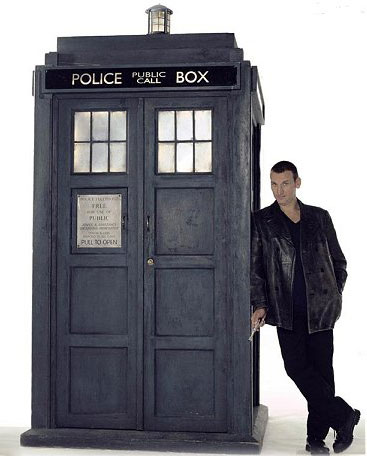
That's a remarkably nice-looking, almost pleasant fellow by the TARDIS, a bloke you could go to the pub with. Given his reputation for being cantankerous (a trait also familiar to The First Doctor William Hartnell) it isn't a giant surprise Eccleston stayed on Doctor Who for only one season. With the exception of Paul McGann, who appeared only once as The Doctor, this will make Eccleston the shortest-serving Doctor in the franchise's history*, and he left by choice. Granted, I think it's an odd choice, but it's his career. If he thought G.I. Joe: The Rise of Cobra was a better use of his talents, more power to him.

Given that, he still WAS a Doctor, and as such should be accorded all respects and honors due to him. I've reviewed a few of his stories and will write on all of them, not just Eccleston's but his successors David Tennant and Matt Smith. The next review will be for Story 164: ALIENS OF LONDON (Aliens of London/World War III).


* Eccleston's Doctor had 10 televised stories while Sixth Doctor Colin Baker had 11 stories. Since I count two-episode stories as ONE story, the two-part stories ALIENS OF LONDON (Aliens of London/World War III), THE EMPTY CHILD (The Empty Child/The Doctor Dances), and BAD WOLF (Bad Wolf/The Parting of the Ways)count as one and knocks the total from 13 episodes from Eccleston's Era. Also, while many count Colin Baker's season-long The Trial of A Time Lord as ONE STORY with 14 episodes, I count them as FOUR STORIES (The Mysterious Planet, Mindwarp, Terror of the Vervoids, and The Ultimate Foe). Even going by individual stories, Colin Baker lasted longer than Christopher Eccleston, so in either count it would make the latter the shortest-serving Doctor. McGann's reign was shorter, but it was not for a season but for one television movie, so his case is unique.

Friday, August 27, 2010

A One and A Nine and An Eleven


Here at Gallifrey Exile, we've set ourselves a simple goal: watch and review every Doctor Who story available on DVD. This will encompass nearly 50 years of programs, some of which are alas, lost, probably forever. Being methodical, we will begin at the beginning with Story 001: An Unearthly Child, and then go from the surviving DVD released stories from Doctor Number 1: William Hartnell (the gentleman above) right down to Doctor Number 8: Paul McGann with Story 160: Doctor Who: The Movie (aka The Enemy Within).


Of course, as it stands many people believe Doctor Who began with this man, Doctor Number 9: Christopher Eccleston. As far as they are concerned, while all that went on before is important in terms of backstory, it's the revived version that they see. In a sense, it's a new beginning, a regeneration, if you will. Being that the case, I've opted to jump around a bit and also review these stories apart from the original series countdown, starting from Story 161: Rose, right down to Story 206: The End of Time.


Which leave us with this young man, Doctor Number 11: Matt Smith. I'm faced with a conundrum: his is the most recent series, and if I wait to get around to him I'll be more than FIVE Series/Seasons behind. Besides, I've spent this season already reviewing Story 207: The Eleventh Hour up to Story 216: THE BIG BANG * (The Pandorica Opens/The Big Bang). Therefore, I'll skip yet again, and keep rolling with the reviews.

In short, I'll be taking Gallifrey Exile to three directions: Original Series, Revived Series, Matt Smith Era. At the end of every review, I'll let you know the next story in its chronological order. For example, the most recent Hartnell story reviewed was Story 012: The Romans and the next one will be Story 013: The Web Planet. I've already written three reviews from the Eccleston period--Rose, The End of the World, and The Unquiet Dead. A link will be put up soon, and the next story will be Story 164: ALIENS OF LONDON * (Aliens of London/World War III). As for Smith, once I post the review for THE BIG BANG I'll have a quick link to all those from Series/Season Five. I hope that will sort everything out.

* When it comes to two-part stories, I have adopted the policy of counting them as ONE story with two episodes as opposed to two distinct episodes. I also give it an overall title instead of calling it by both titles. Usually I'll use one of the two titles but on occassion will give it my own title.

Monday, August 16, 2010

Doctor Who Story 012: The Romans


STORY 012: THE ROMANS

A Funny Thing Happened On the Way to the TARDIS...

Something appealing, something appalling, something for everyone: A COMEDY, TONIGHT!

It might have come as a shock to Doctor Who fans to see the four-part story collectively known as The Romans (individual episodes The Slave Trades, All Roads Lead to Rome, Conspiracy, and Inferno--not to be confused with the Third Doctor story also called Inferno). It isn't because it's a historic piece: we've had two already (Marco Polo and The Aztecs). Rather, it's the fact that it veered toward comedy...a Roman farce, if you will. After ten adventures that, while having some humor in them were mostly adventures, and some quite dark, The Romans is remarkably light and comedic (especially given some of the elements within The Romans). That isn't to say the crew: The Doctor (William Hartnell), Ian Chesterton (William Russell), Barbara Wright (Jacqueline Hill), or the newest companion, Vicki (Maureen O'Sullivan) didn't face dangers. On the contrary: most of The Romans involve them either getting into or out of threats to their lives, but they for the most part are done in such a deliberately funny way one can't help getting swept into the funny form The Romans takes.

The travelers, after having survived the TARDIS falling off a cliff, have been enjoying a respite in a Roman villa for about a month. While Ian and Barbara have been enjoying staying put for a spell the Doctor and Vicki want to go beyond their villa (which they are temporarily occupying while the real owners are away). The new visitors attract the attention of a couple of slavers, who become intrigued with these people from 'Londinium' in far-off Britannia. The Doctor, reverting to his short-tempered, irritable, and crotchety manner, decides to go to Rome and agrees to take Vicki with him. Thus they leave before the slavers seize Ian and Barbara, who themselves are split up respectively between a slave galley and, after a slave auction, at the Court of Emperor Nero himself (Derek Francis). As it turns out, The Doctor is mistaken for Maximus Pettulian, a noted lyre player who has been summoned to entertain at Nero's Court. Tavius (Michael Peake) who bought Barbara to be a handmaid to the Empress Poppaea (Kay Patrick), is overjoyed to see Maximus/Doctor at Court, since he is involved in a conspiracy of which The Doctor is clueless about, as he is about playing the lyre. Ian, having escaped with fellow prisoner Delos (Peter Diamond) when their ship is destroyed in a storm, decides to make for Rome to rescue Barbara. He is recaptured and made to train as a gladiator, and after the Emperor and Empress become displeased by the antics of the travellers, they decide to take revenge, but not before the Doctor gets inadvertently involved with the Great Fire of Rome and after a lot (and I MEAN a lot) of near misses the two groups manage to reunite with their travelling partner and return to their villa without knowing of the other pair's adventures.

The Romans starts off with comedy and never really lets up. The source of the comedy comes primarily through the dialogue of Dennis Spooner's script. Take, for example, in Episode 1. The Doctor goes back to mangling Ian's last name. This is the dialogue:
The Doctor: Chesterfield...
Barbara: Chester-TON.
The Doctor (to Ian): Oh, Barbara's calling you.
Same episode, when the Centurion (Dennis Edwards) questions the Doctor while he and Vicki are travelling to Rome:
The Centurion (pointing to the lyre the Doctor is holding): Is that your lyre?
The Doctor: Why? Have you lost one?

Finally, when referring to Vicki, the Doctor informs the Centurion, "She keeps her eye on all the lyres", much to her somewhat suppressed laughter. There's more pun-fun in Episode 4. The Doctor discovers Nero's plans to throw him to the lions (literally), and instead of showing fear, he shows his wit. He tells Nero that he expects his 'concert' at the Coliseum to be a "roaring success", even if it is to be his "farewell performance". He continues teasing Nero (who has no idea that The Doctor is aware of his scheme) by telling him he "always wanted to be considered as an artist of some taste" and be "generally regarded as, well, palatable" (emphasis mine and his).

It's this word-play that keeps the lightness going, as does the antics in Episode 3. Here, we have the classic 'chasing down the halls' bit, where the lascivious Nero pursues Barbara with naked abandon, right down to chasing her round and around his bed. In the same episode, as Barbara & Nero run around the halls, the Doctor and Vicki keep missing her, and there's more hilarity with the Doctor and Nero while in a steam room and at Nero's banquet. All the comedy bits don't distract or weaken the more serious aspects of The Romans. We get glints of this in the slave auction and the imprisonment of Barbara and Ian. When the story requires a more serious tone, it delivers, and it's a credit to director Christopher Barry that we never get short-changed. When, for example, the minor character of Tigilinus (Brian Proudfoot) is killed, it would have been quite shocking, but since it was done in a somewhat light-hearted way, we aren't as horrified as we should be.

The guest stars are excellent. Throughout the story, we wonder if Tavius is villain or hero, and Peake, with his gravelly voice and stern face, has us guessing all the way to the conclusion. The best performance is that of Francis as Nero. As I understand it, Francis was known to British audiences as a comic, and here he is quite hilarious, as when he attempts to make Barbara his newest mistress. However, he also brings quite a menace to Nero, whenever he threatens or acts upon his violent desires with no sense of guilt. Take for example Episode 4, when he stabs one of his guards for being 'too slow'. Nero is quite a monster, and Francis manages to show him as both childish and deadly. Patrick's Poppaea is by no means comic, but rather sinister mixed with a bit of irritation and vanity, though she also has some humor to her, as when she can't quite decide which bracelet to wear.

This is the first full story with O'Sullivan's Vicki, and here, she's not the central figure as she was in The Rescue. She at times did irritate with her gleeful jumping at the prospects of going to Rome or meeting Nero himself, but given that she was playing someone with a more innocent worldview that can be forgiven. Russell has to continue to be an action hero, and while he doesn't disappoint (both as a galley slave and a gladiator) he almost seems an afterthought. This probably is because he is separated from the others for three episodes. Hill has fun being chased about by Nero, but she manages the darkness of being sold with great grace and dignity, as also when she tends an ill fellow prisoner. Hartnell, I think, has the most fun. Here, he has a bit of the crankiness in Episode 1, but for the rest of the story he has an almost constant maniacal laugh, especially when he reflects that he may be partially responsible for seeing Rome go up in smoke. A side note: the part with Nero ends with the image of the Emperor playing his lyre while Rome goes up in flames, which may not be strictly speaking historically correct but which is beautifully filmed. A final credit should be given to Raymond Jones' score, which clues you in that this Doctor Who is lighter, funnier than was the usual fare.

From what I understand, there are Who fans who object to The Romans BECAUSE it is more comic. I disagree: I think there is nothing wrong with taking Doctor Who to a more comic turn, and given that we've gone through some very dark/sad stories (The Daleks, The Dalek Invasion of Earth), it's a nice change of pace. In short, there's nothing wrong with being able to have a laugh, to have FUN. The fact that The Romans manages to get a lot of humor and to hold up logically makes for good, solid entertainment. To all Roman haters, I say Viva La Roma!

Next story: The Web Planet


9/10