Thursday, April 21, 2011

Sarah Jane, Standing Great And Tall

ELISABETH SLADEN
1946-2011

Cancer did what the Sontarans, Cybermen and Daleks could never do: take our beloved Sarah Jane.  Less than a couple of months after the death of The Brigadier (Nicholas Courtney) comes the news of the death of Elisabeth Sladen, better known to Doctor Who fans as Companion Sarah Jane Smith.  It's even more shocking when you consider that at 65 she was still rather young, which makes the news all the more sad.  Sladen and Sarah Jane had some firsts and onlys:
  • She was the first Companion to ever be in a Doctor Who spin-off (K-9 and Company)
  • She was the first and only Companion to have more than one spin-off built around her (the aforementioned K-9 & Company and The Sarah Jane Adventures)
  • She was the first and (at the time of her death) only Companion from the classic series to guest star in the revived series
  • She was the only Companion to have had The Doctor guest star on HER program 
It's interesting that Sladen's tenure as Sarah Jane Smith was actually longer than some of the Doctors.  Starting in 1973 in The Time Warrior with Third Doctor Jon Pertwee, she stayed on through the end of his time and went on to work with Tom Baker's Fourth Doctor, leaving in 1976 at the end of The Hand of Fear.  In an interesting bit of history, Sladen has the honor of being the Companion to have worked with the most Doctors as a Companion from both the classic and revived series: a total of Four Doctors (Pertwee, Baker, David Tennant, and Matt Smith), that is if you don't count her appearance in The Five Doctors, which would bump her Doctor Count to seven.  (Side note: in The Five Doctors, how could you NOT have had an anniversary special without Sarah Jane Smith?  Sadly, she will not be here for the 50th Anniversary in 2013.  Breaks my heart). 

As stated, Sladen is the only (so far) Companion to have returned to Doctor Who itself after the show's revival.  It would make sense since her job as an investigative journalist would put her in a position to uncover secrets.  In fact, her character Sarah Jane Smith was something quite different when she came on the scene.  The intent was to make this Companion stronger, less of a screamer.  Sarah Jane is very open about being a feminist, a person who won't stand by helplessly as previous Companions might have.  In The Time Warrior, if memory serves correct, she seems rather appalled at how the characters, particularly the women, appear to not take stands against the Sontarans.  Sarah Jane was different than previous Companions in that she wasn't going to be patronized by The Doctor.  The fact that he was a male was not a reason to be talked down to or put aside 'for her own protection'.  In later years Sladen may have thought her character was very 'cardboard', but I never got that impression when she was performing.  I got Sarah Jane's intelligence, strength, and warmth both in the classic and revived series, and it's a credit to her acting ability that those qualities came through even when the scripts didn't quite measure up or when she was placed in ridiculous situations (prime example, her 'rescue' from a gentle slope as writer Terrance Dicks put it in The Five Doctors--not to mention her terrible costume in the same episode). 

In a Doctor Who Magazine poll in 2009, Sarah Jane Smith was voted Favourite Companion, and it is an interesting result given how vast the history of the show is.  She was the clear winner with 22.51%, putting her 7% higher than the second choice (Donna Noble, Companion to the Tenth Doctor--I personally feel that Catherine Tate's second-place win was due more to the fact that she was THE Companion at the time of the polling than to her overall effectiveness as a Companion, so she may have been better remembered, but I digress).   It wasn't as if she didn't have some stiff competition: some of the Doctor's Companions have been simply wonderful: from Jamie McCrimmon to Jo Grant to Leela and both Romanas right down to Ace and Rose Tyler, there have been some truly brilliant characters that were not alien.

Still, why was it that Sarah Jane Smith, a character that had not appeared on Doctor Who since 1976 (barring The Five Doctors and Dimensions in Time) and that many of the revived Doctor Who viewers were not even alive to have seen her on the show, ended up the winner?  I think that it was because Sarah Jane Smith was a perfect combination of strength and vulnerability.  She was tough, she was fearless, but she also knew the dangers involved.  Someone like Jamie or Leela would go rushing into a fight, while other Companions like Susan Foreman or Peri would be more wary.  Sarah Jane could do it, and do it well, but she wasn't belligerent.  Sarah Jane knew enough to understand fighting was necessary, but that there was a cost to it.

Also, there was something likeable about Sarah Jane Smith and Elisabeth Sladen.  I'll say it if no one else will: she was pretty, and she had a genuine sweetness to her.  However, there was more: we saw a caring nature to Sarah Jane, both for The Doctor and her own adopted family on The Sarah Jane Adventures.   The genuine affection she had came through, and I think that was the case not just for Sarah Jane Smith but for Elisabeth Sladen.  There didn't seem to be a drop of maliciousness in her.  She seems a likeable person, witty, pretty, and highly intelligent.   

It is difficult to identify with some Companions: the aristocratic Romana or the aggressive Leela or the Queen of Scream Mel Bush for example.  There was never that problem with Sarah Jane; she was someone we could relate to: a mix of fighter and mother (she did adopt Luke in The Sarah Jane Adventures), a person whom you could rely to protect you and fight alongside you.  In short, we LIKED Sarah Jane: we liked her when she was putting up with The Doctor, we liked her when she mocked The Doctor (as she did when sharing stories with Rose Tyler in School Reunion).  It's that likeability (both of Sarah Jane and Elisabeth Sladen) that made her such a hit with fans. 

I figure The Sarah Jane Adventures, as well as Sarah Jane's Alien Files, will come to an end if they hadn't already.  That's the technical aspects of Sladen's death.  The emotional one is more daunting: a woman who appeared pleasant and warm, joyful and brave, one who didn't shrink from a fight--it could describe both character and actress.  It pains Doctor Who fans to know that she is gone, and it is one of those curious notes of history that both The Brigadier and Sarah Jane Smith (two of the most iconic humans in the Doctor Who canon) both left us within such a short span of time. 
 
I freely admit that when I heard the news, I was overwhelmed and did what I don't remember doing for any actor: I cried when I heard that Elisabeth Sladen died.  I cried deep tears of sorrow, and felt so sad that I had to go into the bathroom to collect myself. 

The Eye of Harmony, having been dimmed for The Brigadier, now dims in tribute to Elisabeth Sladen.  Fare thee well, Our Sarah Jane Smith. 


The Reasons We Love The Smiths.

IN MEMORIAM

Monday, April 11, 2011

Doctor Who Story 016: The Chase

STORY 016: THE CHASE

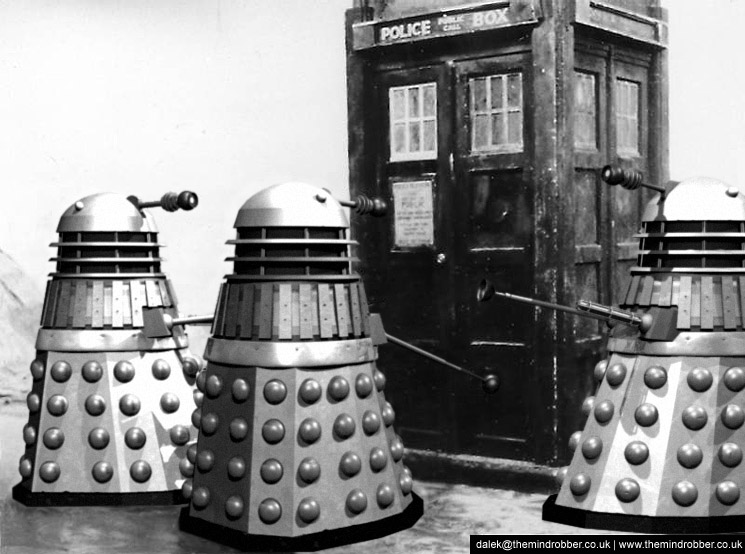
Daleks Experiencing Mechanoid Issues...

We see now that the Daleks are somehow indestructible. Having already had two adventures with them (The Daleks and The Dalek Invasion of Earth) we now get two types of stories for the price of one: a historic piece and a science-fiction story collectively called The Chase. Whether it's a good or bad thing to have such a long story in The Chase depends on your tolerance. Over the course of six episodes (The Executioners, The Death of Time, Flight Through Eternity, Journey Into Terror, The Death of Doctor Who*, and Planet of Decision), we see both the good and bad of the Daleks, both as villains and as comic pieces.

The Doctor (William Hartnell), and his companions Ian Chesterton (William Russell), Barbara Wright (Jacqueline Hill), and Vicki (Maureen O'Sullivan) have just left the Space Museum.  Unbeknown to them, the Daleks have been tracking their movements, and are now in pursuit of the travellers.   They land on the planet Aridus.  While the Doctor and Barbara are content to stay and get some sun (courtesy of the dual suns in the sky--pre Tattoine), Vicki goes exploring with Ian guarding her.  The Doctor and Barbara soon discover, thanks to the Time & Space Visualizer that the Daleks are after them.   While Vicki and Ian attempt to escape from the Mire Beasts which have taken over this once-watery world, The Doctor and Babs get help from the Aridians, fish-like people who are barely surviving in this now-desert world.  The Daleks attempt to take the TARDIS but cannot, and then try to take the Travellers.  However, they manage to escape Aridus and fly off, with the Daleks in furious pursuit.

Now it becomes a chase.  They first arrive at the Empire State Building in 1966 New York, much to the befuddlement of Alabama native Morton Dill (Peter Purves), with the Daleks coming soon after.  Next, they give them the slip aboard a sailing ship, and when the Daleks arrive there, the crew flees in terror...off the Mary Celeste.  Next, they arrive at what the Doctor calls a world of dreams, filled with the Frankenstein monster and Dracula, and at first we think the Daleks will be overcome, but in the confusion Vicki becomes separated from the others.  With no way of going back for her, it's decided that the Travellers will make a stand.  Vicki, however, discovers the Daleks have made a robot Doctor, with the intent to infiltrate and kill.

They arrive on Mechanus, a planet filled with large fungi.  Vicki and the others are reunited, and the False Doctor is destroyed, but they are not out of the woods yet.  Trapped in a cave, they find rescue with a Mechanoid, a gigantic round machine.  At first, it is believed they are saved, but they discover that they are now prisoners of the Mechanoids, as is astronaut Steven Taylor (Peter Purves...again).  It is decided to make an escape while the Daleks and Mechanoids are battling it out.  They destroy each other, and the travellers believe Steven has been killed when he went back to get Hi-Fi, his teddy bear (in reality, he had survived and was last seeing fleeing into the forest with his bear in his hands).  Barbara and Ian realize that the Dalek time machine could take them back to their own time, and after a furious argument with the Doctor he reluctantly agrees to show them how to operate it.  The Coal Hill teachers safely arrive in 1965 London, delighted to be back home.  The Doctor and Vicki see them on the Time & Space Visualizer, and while he is happy, he is also sad. 

As a whole, The Chase holds up remarkably well, especially for such a long story.  Terry Nation wrote some wonderful moments of adventure and even comedy.  For example, in Episode One the Doctor is singing when Barbara hears something off.  "What is that awful noise?" she asks.  The Doctor is insulted, telling her that's no way to refer to his singing.  "No, not THAT awful noise," she replies perfectly straight.  Most of the time in New York with the country bumpkin Dill was just for comedy.  We even have comedy from the Daleks...one Dalek stutters (The Dalek's Speech, anyone), and in Episode Two when a Dalek is told to get backup and he doesn't move, Dalek One turns back and tells him, "Well, get to it". 

Maybe it was a way to lighten the Daleks up, and in retrospect, given how evil they were to become, these funny bits come off as a bit peculiar.  It isn't so much that they end up looking like a joke, but it doesn't really flow naturally from the story or from the limited Dalek mythos already established from earlier stories.  I think that in retrospect, where the comedy comes into The Chase, the story actually suffers.  The arrival of the travellers and the Daleks at the Empire State building feels as if the story is being stretched out.

In fact, part of the problem within The Chase is that, like most long stories, it feels rather stretched out.  Looking at it now, I can't help think that Episodes Three, Four, and Five could have been either collapsed into one episode or cut altogether.  This is especially true in Episode Four, especially when we are given the resolution of how the Frankenstein monster and Dracula and a banshee are all appearing out of nowhere.  When we discover the real reason, it is an eye-rolling moment. 

In short, Episode Four is not merely the weakest of the six-part story, but also the most patently idiotic.  Terry Nation's script for this episode had great promise: what if they had somehow truly ended up within a world of dreams?  Think of the possibilities, of how real people (and Daleks) could enter and escape a world of unreality.  Instead, we are given the BBC version of The Haunted Mansion, and it's such a blatant disappointment.

Now, there are also a couple of other problems within The Chase.  Chief among them, the Mechanoids themselves.  For those who think the Daleks are pretty useless monsters, what with their inability to go up the stairs, well, get a load of the Mechanoids (perhaps we should call them Make-A-Noise or Make-Annoys).  This rotund robots with thin pincers for arms appear even less mobile than Daleks, and while the battle between the Mechanoids and the Daleks is shot beautifully, as full-formed monsters they fall flat. 

Another problem is with the False Doctor (which to my mind is reminiscent of the False Maria from Metropolis).  Even from the wide shot it is obvious that the False Doctor looks nothing like William Hartnell, and having the real Doctor give the chilling last line in Episode Four fails to mask the technical aspects.  On the contrary, they only serve to enhance them.  Granted, given the limitations of technology at the time, one extends a bit of generosity to them and appreciates that they tried the best they could. 

Of course, one can't throw out the baby with the bathwater, and The Chase has some wonderful moments.  The rising of the Dalek at the end of Episode One (while reminiscent of The Dalek Invasion of Earth) is still shot beautifully by director Richard Martin.  The scenes aboard the Mary Celeste are also filmed quite well and do give as probable a solution to the mystery as any other.  The early scenes in Episode One, where they see the Gettysburg Address and Shakespeare summoned to an audience with Queen Elizabeth I are extremely clever and well-filmed (although if one looks carefully, Pennsylvania has a rather desert look...not unlike Arius, but again, a minor glitch).  Side note: sadly, The Beatles' performance of Ticket to Ride, which is the 'classical music' Vicki requested to see in the Time & Space Visualiser, could not be included in the DVD release of The Chase, and more bizarrely, it is the ONLY surviving footage of the Beatles performance of the song for the BBC's Top of the Pops.  The Beatles had wanted to make a cameo appearance as older versions of themselves but the idea was vetoed by their manager Brian Epstein. Of course, no one in 1966 could have contemplated the fate of John Lennon. 

There are wonderful performances all around.  Purves has to be singled out.  First, he had to play TWO characters (the Alabama hick and the British astronaut), and he had to do one of them with a foreign accent.  Second, he has to make it believable that a sensible astronaut would go back for a teddy bear (!).  Granted, when we last see him, he looks slightly crazed and appears to be chastising the bear...which comes off unintentionally comedic, but that's a minor point.  Side note: I figure it's a curiosity that the bear is named Hi-Fi--if The Chase had been made today, he would have probably be named Wi-Fi, but I digress.   His dual performances rightly earn praise--both as the innocent and naive hillbilly and the brooding and intense (albeit a bit daft) space traveller.  Purves had to be comedic and dramatic, and that he handled both well is a sign of why he was brought back.  (Of course, it's curious that the travellers never question why Steven Taylor looks a lot like Morton Dill...).  O'Sullivan's Vicki maintains a balance between the youthful enthusiasm for adventure and fear of a young girl.  Her best moment is in Episode Six, where she calmly tells the furious Doctor that in the end, the decision to stay or go is not his to make. 

It is in the last episode that the original crew's performances really rise to new levels.  Both Hill and Russell in Episode Six capture the need for stability and the desire to go home with the tinge of regret for leaving.  They communicate that they are not so much tired of the adventures but desire to be back in their own time, in their own world.  Hartnell is also wonderful: when he's railing against their idea it doesn't appear so much a fear that using the Dalek's machine will kill them, but that he is personally wounded by their desire to leave HIM.  It doesn't come off as egocentric because at the end, we see in his face a genuine sorrow to see them leave...happy they made it safe, but sadness that they will no longer be with him.  It is curious that Hartnell is best when he plays the Doctor not as a daring adventurer but as a caring, grandfather-type figure.  However cantankerous he may have been (especially with O'Sullivan) the best acting scenes are always whenever the Doctor shows his tender side with Vicki and previously Susan. 

The technical aspects have some excellent work too.  Raymond Cusick and John Woods' set designs cover a vast spectrum, from the deserts and underworld city of Aridus and the Mary Celeste to the organic architecture of Mechanus.  Daphne Dare's costumes, especially for the Aridians, are beautiful.  I would question Dudley Simpson's score, which struck me as rather jazzy for the story.  A Gershwin-type score works when they arrive in New York, but the music was curiously upbeat for a story like The Chase. 

The Chase is, unfortunately, a bit too long for the story it told.  The midsection of the story falters and appears to stretch the story (both the Empire State Building scene and almost all of Episode Four especially so).  The comedy with the Daleks doesn't work (and in retrospect, is bizarre), and one almost has to resist the temptation to laugh at the Aridians (beautiful-looking costumes can't hide acting that draws from the Menoptra in The Web Planet).  Still, the story is lifted by some wonderful acting, especially the final part of the story between Barbara, Ian, the Doctor, and Vicki, as well as both Barbara and Ian/the Doctor and Vicki. 

Adieu, Miss Wright and Mr. Chesterton...

6/10

Next Story: The Time Meddler

*Episode Five of The Chase, The Death of Doctor Who, is one of only two times the actual term Doctor Who is used in a title.  The only other time I can think of is the Jon Pertwee story Doctor Who & The Silurians, which might have actually been a mistake.  In fact, overall, again with few exceptions, the Doctor himself is never referred to or refers to himself as Doctor Who, so this is a curious bit of trivia.

Saturday, April 9, 2011

Editor's Note

STORY 166: THE LONG GAME

It seems a most curious thing to my mind, that Russell T Davies, a man who has made his fame and fortune on television, should turn around and be highly critical of the power and influence television has on the masses. Perhaps, to use a Vulcan expression, only Nixon can go to China. It is good for us to examine what a force the telly has on our lives. Given that, The Long Game could have been a sharp critique of the industry. However, Davies appears to be unable to control himself in introducing certain running motifs in his Doctor Who scripts, one that push this story down.
The Doctor (Christopher Eccleston) along with his regular Companion, Rose Tyler (Billie Piper) and newbie Adam Mitchell (Bruno Langley) arrive on Satellite Five in the year 200,000 (why a Conan O'Brien skit comes to mind, I don't know) during the Fourth Great & Bountiful Human Empire. The station broadcasts all the news there is to the galaxies in the great beyond (talk about Sky Television--perhaps a sly jab from the BBC?) and while Rose and Adam marvel at it all, the Doctor senses something is wrong. The heat on Satellite Five, the lack of non-humans, there is something off.

Aboard Satellite Five is Cathica (Christine Adams) and Suki (Anna Maxwell-Martin), journalists aboard the station who mistake the trio for Senior Management. Deciding to show them just how good they are at their jobs, Cathica locks her mind into the master computer while a group of men, women, multisexuals, undecideds, and robots use the chips in their own minds to show how they can link up and get information into Cathica's mind. Observing all this is The Editor (Simon Pegg) who suspects something is amiss...but it isn't the three new people. Instead, he zeroes in on Suki, who gets "Promoted" to Floor 500, much to Cathica's irritation. When Suki goes up to Floor 500, she does not find walls of gold but a frozen level. Coming upon the Editor, she is unmasked as the last of the Freedom Fifteen, which I figure is trying to bring down Satellite Five. Suki attempts to kill the Editor, but the Editor-In-Chief takes care of her.

Adam goes off on his own, allegedly to recover from the shock of seeing the future, but really to get at future information so as to profit for when he gets back to his own time (apparently like in Back to the Future II). He goes and has the chip (along with the outlet to connect into the mainframe) inserted into his own brain so as to get all the information he wishes. Cathica now sees that something is off with The Doctor and Rose, and so does the Editor. The latter two go up to Floor 500 and discover who the Editor-In-Chief is. Unbeknownst to them, Cathica secretly follows them to Floor 500; meanwhile, Adam is starting to get all the information he desires, calling his parents via Rose's supercell phone and leaving a message on their answering machine.

We discover that The Doctor's suspicions are correct: Satellite Five has been controlling the information given to the Fourth Great & Bountiful Human Empire, manipulating the news to keep the humans in check. This is done at the bidding of the...get ready for it...The Mighty Jagrafess of the Holy Hadrojassic Maxarodenfoe (Max for short), a giant monster who emits so much heat that he has to be kept in a cold environment (hence, the heat in all the lower floors). The Doctor sees Cathica, and subtly gives her clues to help them, while he and Rose see to their horror that Adam, instead of receiving information from Satellite Five, is giving information to the Editor and Editor-in-Chief (aka Max). Cathica locks into the system, bringing the information she has about Satellite Five to the universe. This allows the three travellers to escape and raise the temperature of the Satellite. The Editor attempts to escape, but Suki (who I should point out is technically dead but whose chip is still being used to get information) grabs his leg and forces him to remain underneath the collapsing Max.

The Doctor, furious with Adam's duplicity, takes him to his parent's home, destroys the answering machine, and exiles him from the TARDIS. Unfortunately for Adam, he still has this outlet inside of his head, which can be opened by the mere snapping of fingers. The Doctor and Rose leave him there, just as his mom is coming back from apparently a shopping trip. She is thrilled to see her son back, and comments how long it's been: six months, which flash by like that...

It may be just my imagination since I've no way of reading Davies' mind (I have no outlet to connect my brain to), but I sense a certain series of motifs and themes running in anything he writes for Doctor Who. There is a penchant for strange and excessively long names (the Moxx of Balhoon from The End of the World, the planet Raxacoricofallapatorious from Aliens of London Parts I & II, now the Mighty....). There is the motive for all the mayhem: whenever evil is done, be sure Money (and by extension, the evil of profits) is involved (making money off the deaths or enslavement of beings being the motives in The End of the World, Aliens of London Parts I & II, and now The Long Game, since the Editor represents in his own words, "a consortium of banks"). I think I see yet a third motif within Davies' scripts: namely, his utter hatred and fury about the Iraq Intervention. This one I'll grant is the one I have the least evidence for and is purely speculation, but think a moment. Aliens of London Parts I & II was in subtext about how the government (in this case the more evil than Saddam Hussein and Osama bin Laden, those bloodthirsty tyrants George W. Bush and his poodle Tony Blair) lied to the public in order to enter into an illegal and immoral war against a thoroughly benevolent foreign government that loved its people. While it is only speculation, The Long Game may be Davies' response to how the press also lied to the public, manipulating the news to keep the people docile.

I don't think it's so far out of the realm of possibility to speculate that this is a subtext of The Long Game.

No one will stop you because you've bred a human race which doesn't ask questions...believing every lie

The Doctor shouts at the Editor and Editor-in-Chief. Davies is a smart man, so would it really be a far-out idea that he would include his private views on the press' complicity in the Mass Deception around the Iraq Intervention?

I think it is possible that I'm reading far too much into the story, so I digress. The Long Game, as I've stated, could have been a far richer story, not necessarily about the manipulation of the press on an unsuspecting public, but on how we instinctively trust what we see and what we're told. One only needs to look at the quiz show scandals of the 1950s to see the public can be hoodwinked by this medium called television. The Long Game could have tackled how the search for truth and knowledge can have a high cost and what power those who control the information have, whether it's the BBC or MSNBC or FOX News or the New York Times. However, this theme was done in by other outside factors.

For example, it is hard to take any monster seriously when you give him such a silly, almost unpronounceable name (apparently, guest star Pegg had such a hard time with the name that Max's roar had to cover up part of the line so as to not show how hard it was to actually say). Second, director Brian Grant used the trick of seeing things from the monsters point of view until near the end (which perhaps may have been unavoidable), but once we see the actual brains behind the operation, it is such a disappointment. The Editor-in-Chief is really just a giant slug. When he meets his fiery end, all that crossed my mind was, "I'm melting, MELTING!"

Second, we have the character of Suki to consider. She was fine until we discover she's really not this sweet and bumbling girl, but a fierce revolutionary. It isn't so much this twist that causes problems in The Long Game, it's the fact that if you take it at face value she certainly isn't a smart revolutionary. If this had been a story from the classic era, over two or three episodes we could have been given a hint of her true identity, but because it's only a forty-odd minute show, she just is...and in an ironic twist on a story about accepting everything we're given, we HAVE to accept that she is a revolutionary, who apparently never thought that once on Floor 500 she would have to face the actual source of the evil she was fighting against.

As a sublet to Suki's problem, it strikes me as a convenient deus ex machina that once we're told she is dead (but the chip inside her is still working), she suddenly comes alive in a roundabout way to stop the Editor from fleeing. How does a corpse (which is what she basically is) know to grab hold of her adversary's leg? It is just a little TOO convenient.

Langley and Adams give good performances, mainly because The Long Game is really about them, not about the Doctor, or Rose, or even the Editor or Editor-in-Chief. Adams' frustration as Cathica is relate-able, for most people feel the irritation of being passed over for promotion they have worked long for. In an odd way, so is Adam's fall into the temptation of profiting from future knowledge. He does falter slightly when he tries to have comedic moments prior to the operation, I think because there appears an attempt to make these moments lighter. They don't work.

Pegg is unrecognizable as the Editor, with great makeup work by Supervisor Davy Jones. He appears to be relishing a chance to be a bit over-the-top, but since the Editor is really just a stooge for a more powerful force, we can accept that. Eccleston and Tyler, unfortunately, don't seem to be a major part of The Long Game. In fact, it's Cathica, not the Doctor, who saves the day in the end.

As for kicking Adam out of the TARDIS, I don't see this as controversial in any way. Rather, I see this as the only logical thing to do. Adam has proven himself not just untrustworthy, but downright dangerous. If he were to go on another adventure (say, into the past), what is to stop him from trying to change history and profitting from it? His greed (perhaps not for money, but for inside information) shows him to be a weak man, and a weak man is the last thing the Doctor needs. As a side note, there are a couple of good moments in The Long Game: when the Doctor comments to Rose, "You and your boyfriends" (referring to Adam and Mickey), he shows an unexpected light side that adds a touch of true levity to the story.

I can't get over the feeling that The Long Game was really a lost opportunity; what could have been a sharp commentary on the power of the visual medium are human's reliance and unquestioning acceptance on the news we're given gave way to a second-rate monster and a less-than-thrilling story. Granted, it may tie in to another future story, but the title never really fits into the story itself. We don't have an idea as to what the long game actually is. In the end, The Long Game is not a story that will stop the presses.

4/10

Next Story: Father's Day

Friday, February 25, 2011

A Five Rounds Rapid Salute


NICHOLAS COURTNEY (1929-2011)


There were few constants in Doctor Who over its original 26-year run. There was The Doctor, of course, the TARDIS, and his companions. However, there was one more, one that occurred quite by accident, but which enriched Doctor Who tremendously: Brigadier Sir Alistair Gordon Lethbridge-Stewart, better known on Earth as Nicholas Courtney. He holds the distinction of having worked on screen with all seven of the original Doctors (albeit briefly with the Sixth in the Dimensions in Time charity special). No other person could or will ever be able to make that extraordinary claim. If one wants to be extremely specific, he worked with a record-eight Doctors if you include audio productions. Again, it's hard to think of people who've worked with more than three Doctors (Elisabeth Sladen comes quickly to mind, but besides her...) Out of all his appearances, it was only with the First Doctor that he did not appear as Colonel, later Brigadier, Lethbridge-Stewart. However, once he became the Brigadier, he found himself one of the most iconic of Doctor Who characters.

His Brigadier was almost, to my mind, a parody of the stiff-upper-lip British soldier, one who had a limited imagination but knew how to fight. His response to any situation can be summed up in Doctor Who & The Silurians, when the Third Doctor (Jon Pertwee) tells his Companion Liz Shaw (Caroline John) something along the lines that it's typical of the military mind--come across a problem and the first reaction is to shoot at it. However strict the Brig may have been when it came to otherworldly aliens, he never seemed shocked by them. Here could come Daleks and Daemons, Yeti and Cybermen, and he would just take it as merely another foreigner attempting to conquer his home. Silly aliens, he might have thought, don't they know we're British?

Still, what could have come off as a strict martinet in Courtney's hands became a likeable, almost lovable, man. It's a testament to Courtney's talents as an actor that the Brig was never mean (even when going against the Doctor's recommendations), or obnoxious. At heart, we always knew the Brigadier meant well, and to use modern parlance, had the Doctor's back. We knew that at the end of the day, he and the Doctor (whomever he was) had a great deal of respect and admiration for the qualities they saw in each other. In short, we could say that the Brigadier was one of the Doctor's friends. They made a wonderful team, and I see this relationship shown best in The Five Doctors. If one thinks about it, the Brigadier should have been furious. Here he is, poor man, at his retirement party, and how does he spend it? In the Death Zone of Gallifrey, trying not to get killed. Does he rage against the Second Doctor (Patrick Troughton)? Does he say, 'I won't have any of this?' No. Like every fine old English (or Scottish) gentleman, he stands shoulder to shoulder with the Doctor, giving all their enemies a right once over. That's the kind of man the Brigadier was, and that's why we loved him.

We also loved the actor as well. Few actors have been so proud to have been associated with a single character as much as Courtney appears to have been. It isn't every day that a truly iconic character in a long-running television show is created. He has that extraordinary legacy, to have known at his death that a role he created was his and his alone. Unlike the various Doctors, no one could ever play the Brigadier. Most actors might have run away from the role, wanted to show they could do more than just that one part. Daniel Craig comes to mind--as (overly) praised as his James Bond is, he is constantly trying to show us how he's an ACTOR by doing all sorts of parts. A more relevant example would be Leonard Nimoy. Nimoy is a good actor (see A Woman Called Golda for proof), but he spent so many years railing against Mr. Spock. Courtney didn't appear to be troubled by being identified as the Brig. You can tell the difference between Nimoy & Courtney merely by their autobiographies. Nimoy called the first volume of his life story, I Am Not Spock. Courtney called his Five Rounds Rapid.

I had always hoped that the Brigadier would have had one last chance to be on Doctor Who, now that the series has been revived successfully. It was a terrible pity that Courtney was not able to reprise his role with either Christopher Eccleston, David Tennant, or Matt Smith. I could understand with the Ninth & Eleventh Doctors, but the Tenth had a good four or five years to where The Brigadier could have come back for one more story. It was good to see him with Sarah Jane in The Sarah Jane Adventures story Enemy of The Bane, but alas, the final call has been made for our beloved Brigadier.

As a Doctor Who fan, I pay my final respects to Nicholas Courtney, for in truth, so long as there are novels and fan fiction and comics, The Brigadier will never truly die. He was, curiously enough, supposed to have died in Battlefield. I don't quite know the reason why he ultimately was spared, and I'd have to watch the episode again to see whether it worked or not. However, it just goes to show you old soldiers truly never die. In the case of Brigadier Sir Alistair Gordon Lethbridge-Stewart, they never fade away either. He shall be in our hearts forever.

Here at Gallifrey Exile, we like to think we keep The Eye of Harmony burning until a New Gallifrey is established. For today, the Eye dims in honour of Nicholas Courtney.

IN MEMORIAM


Wednesday, February 2, 2011

Doctor Who Story 015: The Space Museum


STORY 015: THE SPACE MUSEUM

Museum Piece...

It could have been far more than it ultimately turned out to be. The four-part story collectively known as The Space Museum (episodes being The Space Museum, The Dimensions of Time, The Search, and The Final Phase) starts out all right, but then goes down familiar paths and has some rather curious moments. It may be my Twenty-First Century eyes, but I detected an undertone of commentary in Glyn Jones' script on the evils of colonialism. As it stands, The Space Museum has some good moments to it, but not enough to hold much interest beyond Episode One.

We begin with strange goings-on aboard the TARDIS. The Doctor (William Hartnell) along with his Companions Barbara Wright (Jacqueline Hill), Ian Chesterton (William Russell), and Vicki (Maureen O'Sullivan) find themselves frozen in moment briefly, and when they are free to move about, they find themselves in their own clothes rather than in the medieval wardrobe they had in The Crusade they were just wearing. The Doctor is curiously unconcerned about how they got back to their regular clothes or how Vicki managed to break a glass of water and see it restored almost right away. He IS interested in the building on the planet they've landed on. It is a Space Museum with artifacts of all types, including the remains of a Dalek. There, more strange things are going on: the guards and 'visitors' do not see them, the exhibits are visible to them but if they try to touch them they appear to be like shadows, and at the end of Episode One, they make a shocking discovery: the newest exhibits are of themselves!

From this point, the travelers attempt to discover how they got to be part of the Space Museum and to avoid it. The curators of the museum are the Moroks, headed up by Governor/Curator Lobos (Richard Shaw) He is bored on the planet Xeros which the Moroks occupy, much to the displeasure of the native Xerons, who all appear to be college-age men. (Curiously, no women apart from Barbara and Vicki are seen in The Space Museum, not unlike Lawrence of Arabia). The Xerons, led by Sita (Peter Sanders) and Dako (Peter Craze), attempt to foster a revolution, but can't get at the armory, which is guarded by a computer who asks questions that must be answered correctly to open. The travellers become separated: the Doctor captured first by the Xerons, then by Lobos, who starts to turn him into the exhibit. Barbara, Vicki, and Ian at first are together but then the Xerons take Vicki, who promptly begins fostering revolution and gets them the weapons by rejigging the computer to accept the truthful answer regardless of whether it's the logical one. Ian attempts to rescue the Doctor and almost succeeds but is taken by Lobos and the Moroks, and Barbara is gassed and captured. Just before they all succumb to their fate, the Xerons retake the museum and rescue the travellers. The Doctor takes a souvenir of the now dismantled museum (a Time & Space Visualizer) and discovers that a mechanical issue on the TARDIS is what caused the time track jump. We end with them leaving, but they have been observed...by the Daleks!

I think that The Space Museum could have been far better if Jones had not opted for a 'revolution' story. In other words, once Episode One ends, we get bogged down in another story where the Doctor and his Companions find themselves aiding in overthrowing the occupation force. In short, it was a good opportunity wasted with a second-tier story. Once we see the Moroks looking bored while holding Xeros and the Xerons planning revolution, we realize that whatever mystery of how they got to be made exhibits gets thrown out the window (curiously, there are no windows in the actuall museum). The Moroks do appear as if they'd rather be somewhere else and have no enthusiasm or interest in holding Xeros other than they are already there. The Xerons themselves aren't too enthusiastic about overthrowing the Moroks. Instead, they appear to just talk revolution because they truly have nothing else to do. Neither group has any sense of superiority of the conqueror or fury of the conquered.

In short, they all look rather bored to be in the museum (which happens more often than not). If they are bored, imagine the viewer. Jones' script would have worked better if he had opted not to put in this type of story. He could have created a villain who just enjoyed collecting exotic creatures (The Space Zoo would have been a better story), and have them lead a mass escape. A stronger villain or more enthusiastic allies would have done great service to The Space Museum, and the fact that neither are there does the story great damage.

There are also many points of logic in The Space Museum that aren't answered. For example, if this was suppose to be a museum dedicated to the glory of the Morok Empire, why are there no signs to state what a visitor would be looking at or to tell them what room they are in? Much of The Space Museum is built around the fact that the travellers are forever wandering within it, with no idea where they are in this massive complex. If this were to be a real place, any Morok who ventured to the museum would soon become hopelessly lost, and for some reason the Moroks never seem to think this, more than a lack of interest in Morok history, would keep visitors from venturing to what I take it is a remote and distant planet to see a bunch of space junk.

Another oddity involves the Xerons themselves. We're suppose to believe they are the native population, but we never get a full explanation as to why the native population are all young men (and their odd eyebrows are the only things that make them appear alien, but the effect is more humorous than serious). By making them all so young (and remarkably unenthusiastic) The Space Museum gives them very little to do. You'd think they would want to throw the shackles of oppression against the bored Moroks, and thus would try to take the weapons by any way necessary. However, their leaders are either lazy or extremely dumb, and it takes Vicki's need to do something in The Space Museum to lead, or at least instigate, the actual rebellion.

Director Mervyn Pinfield did himself no favors by having some pretty weak effects. His decision to have no original music score made the fight sequences sound odd. The mind-reading effect in Episode Two was a great idea, but it was executed badly with obvious use of photos that didn't seem to mesh well within the story, either here and especially at the end of Episode One. Granted, the effects in 1965 may look weak today, but even then they could have done better. His decision to build up the Doctor's reappearance throughout Episode Three could have been a strong moment, but the final revealing in Episode Four was such a disappointment and remarkably undramatic.

The biggest issue in The Space Museum is just how bored and disinterested everyone looks. No one can muster any enthusiasm or interest: either to stop the revolution or begin the revolution or just to escape the Space Museum. Few stories in Doctor Who appear to have people just going through the motions as this one does. The second biggest issue is in the costumes. The Moroks are all in white and the Xerons all in black. Here, we could have had some subtext about the British Empire and the effects of colonization on the native population. However, when it looks like the Xerons just appear to have come out of a beatnik coffee bar (and I think one of them was wearing Converse shoes) it made it look all so cheap. A side note on the costumes: it strikes me as typical that Ian makes Barbara ruin HER cardigan sweater--far be it for him to sacrifice his jacket threads.

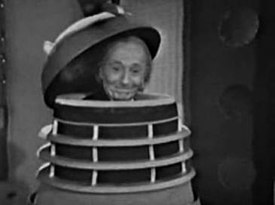
Perhaps the best moment in The Space Museum may also be one of the worse. It is when the Doctor emerges from a Dalek shell, delighted to have found such an excellent hiding place. Granted, it IS clever, but it does run the risk of making the Daleks into a bit of a joke, and from time to time in the future, they do become objects of ridicule as opposed to terror. There are a couple of good ideas: such as when the Doctor is interrogated, but they are few and not enough to life the story.

The Space Museum is not held in high esteem by fans, and I can see why. Overall, the story itself isn't very good, but what pushes it down is the fact that it appears to have wasted a great opportunity. Like An Unearthly Child, it has a good first episode and then wanders away from a strong premise to present a rather boring story of rebellious youth (pun intended). It could have been one of the better First Doctor stories if the villains had been more intent on capturing the travellers and the focus had been on them escaping, not on them leading a revolution. In conclusion, it is clear why people don't visit The Space Museum.

4/10

Next Story: The Chase

Friday, January 21, 2011

Two Of A Lost Kind


STORY 165: DALEK


There was a suspicion that The Doctor's most famous enemy would not be appearing in the revived Doctor Who. This situation was further exacerbated when we have the revival explain that the Doctor is the last surviving Time Lord, his people being destroyed along with all the Daleks at the end of the Time War. How could the Daleks come back if all of them had been destroyed along with all Time Lords? As far as we could see, the Daleks were finally themselves exterminated. However, now we find in Dalek that at least ONE Dalek survived...


The Doctor (Christopher Eccleston) and his Companion Rose Tyler (Billie Piper) receive a distress signal that leads them to the deep bowels of an underground museum in Utah, United States. There, they discover a hidden museum full of alien artifacts. Quickly discovered, they are taken to Mr. Van Statten (Corey Johnson), a billionaire genius who "owns the Internet" and has been collecting space artifacts in order to gain profit from them. He has his own scientific advisor, a British kid named Adam Mitchell (Bruno Langley), whose main job is to find the artifacts and figure out their uses. There is one piece in his collection that is Van Statten's pride and joy: a mysterious object he calls the Metaltron. The reason the Metaltron is so important is because unlike the others, it is alive. Van Statten forces the Doctor to have a look at it, and the Doctor realizes that it is the Metaltron that has been sending the distress signal. He also realizes that it is in fact, a Dalek--the Last of the Daleks who somehow survived the Time War between the Daleks and the Time Lords.


This Dalek cannot fight back, but Van Statten realizes that the Doctor himself must be alien and takes him prisoner. Meanwhile, Adam and Rose are bonding, and she persuades him to show him the Metaltron. She feels genuine sorrow for it, especially when the Dalek tells her that he "feels pain". She reaches out and touches it, and soon the Dalek transfers her DNA to himself, allowing him to free himself and strike back at those who've been torturing him. With the Dalek now loose and causing death and destruction, the Doctor gets Van Statten to release him and attempt to seal the Dalek off. They do manage that, but while Adam manages to save himself, Rose is left behind to face extermination. The Dalek, however, cannot bring himself to kill her. Her DNA, it appears, not only brought him back to full power, but has altered his own nature to where he takes on emotions unknown to Daleks: such things compassion and mercy. The Doctor is now hell-bent on rescuing Rose and killing off the Last of The Daleks, but in the end Rose makes him see that the Dalek isn't the one putting her in danger...it's The Doctor. Once the crisis is over, Van Statten gets what's coming to him and a reluctant Doctor takes Adam in the TARDIS.


Dalek is brilliant to tackle some of the criticisms the iconic monsters have had thrown at them since 1963-64. The most famous of the criticisms is the fact that its shape makes it difficult to move anywhere that doesn't have a flat surface. I think writer Robert Shearman put in that scene specifically to answer the charge that the best way to escape a Dalek is to run up a flight of stairs. The ensuing revelation of how a Dalek can move makes the moment even more terrifying, and it's a credit to The Mill that now we have the technology, we have the capability to create the world's first fully-flying Dalek (to misquote another program) to realize the full potential of the Daleks. We also get a nod to their distinctive design. Near the middle of Dalek, the monster lifts its plunger-shaped arm. The armed guard working at it scoffs. "What you gonna do? Sucker me to death?" Bad question to taunt the Dalek with.


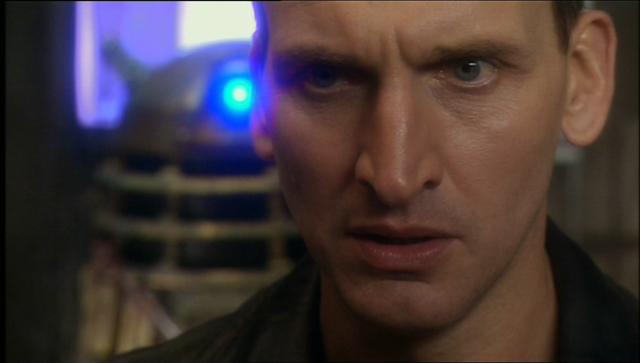
Beyond the special effects aspects in Dalek, director Joe Ahearne created some especially sharp visual moments. When the Doctor first enters the Metaltron's chamber, we don't see much. Ahearne builds the tension by introducing elements slowly in the scene: that humming, that single blue light hovering, that staccatto voice.


Shearman and Ahearne also tap into the unresolved war between the Doctor and the Dalek. As the last of their kind, they find themselves continuing the war that brought an end to both their civilizations. However, we see an evolution in both the characters: the Dalek (thanks to Rose's DNA) is becoming more conflicted and even with individual longings of its own, while the Doctor is becoming more aggressive, more vengeful. Dalek does a fine job of maintaining the tension between these two aggressors who for most of the episode are actually kept apart. In fact, in Dalek they never actually fight each other.


Both leads are in top form in Dalek. Eccleston conveys both the anger and pain he feels as the last of the Time Lords, raging to where he literally spits out when screaming at the Dalek, and also showing something rare for this Doctor: sheer terror when he realizes he's in a locked chamber with a Dalek. He goes through so many emotions within Dalek, and Eccleston manages to maintain the range without going over-the-top either in the pathos or the fury. The best performance, however, is that of Piper. She has a soft vulnerability as Rose and conveys such tenderness to a big pepper pot that it becomes almost a tragedy. It is Rose that is the true heart of Dalek, because Piper projects the full sadness of destroying life, either physically or in an emotional sense. When she confronts the Doctor at the end, the scene is quite moving.


Langley does a good job coming off as a bit of a twit and a coward in Dalek, which is what the character of Adam was. In a smaller role, Jana Carpenter as soldier DeMaggio has a great scene guarding Rose and Adam. It is curious to see anyone tell a Dalek to surrender, but she in her brief scene creates both a strong and scared woman. Great credit should also go to Nicholas Briggs' voice work as the Dalek in Dalek. His Dalek voice is called to show more emotion due to the cross-pollination, and he manages to do that. When Briggs as the Dalek tells the Doctor, "You would have made a good Dalek", it's quite chilling. My only complaint in terms of performance is with Johnson's Van Statten. I kept wondering if he was suppose to be a bit campy and more comedic than straight. Johnson's grinning and excessive self-confidence didn't play like he was a real person but more a parody of a billionaire.


I also have an issue with the Money Motive. This is the third time (The End of the World and ALIENS OF LONDON being the first two) where financial gain is at the heart of the crisis. Granted, I,'m an unashamed capitalist, so I may be on the opposite side of the issue, but I do hope to have another reason for the villain's motives. Finally, how I detest the stubborn refusal to even suggest that other Time Lords may have survived. I don't know why they keep locking that door. Would it have killed them to say that, yes, perhaps, just as this Dalek survived, maybe some Time Lords did as well.


A curious note. According to Dalek, the Dalek crashed on Earth fifty years ago. The date given for Dalek is 2012, which meant that the Dalek came in 1962, which is one year before The First Doctor met the Daleks in the seven-part story collectively known as The Daleks. If one took a too-nerdy approach to all this, it would mean that Gallifrey was destroyed a year before the First Doctor came to London with his granddaughter Susan. It is far too much to think about trying to make sense of it all, so we'll just let it go.


Dalek is a strong story where the Dalek is shown to be the real terror it always could be rather than an object of ridicule. Eccleston and especially Piper brought moving performances to Dalek, showing that in war, there truly are no real victors. There were some light moments that didn't overwhelm the story, and on the whole, Dalek will not be exterminated from any Best Of Collection.


8/10


Next Story: The Long Game

Wednesday, January 5, 2011

Doctor Who Story 014: The Crusade


Image result for doctor who the crusade


STORY 014: THE CRUSADE

Crosses to Bear...

As it stands, the four-part story collectively called The Crusade is incomplete. The pessimist says, "Half the story is lost". The optimist says, "Half the story survives". Episodes Two & Four (The Knight of Jaffa and The Warlords) are the lost episodes, while Episodes One & Three (The Lion and The Wheel of Fortune) still exist. However, all four episodes (in fact, all episodes of Doctor Who) survive in audio form. That being the case, we can reconstruct The Crusade in a roundabout way. The VHS release had William Russell reprise his role as Ian Chesterton to narrate the missing episodes and thus provide continuity. The DVD release of the Lost In Time collection released the audio tracks to Episodes Two and Four, so we could listen to them like we would a radio play. Therefore, in a sense, we have the complete story with us. That is why I've elected to review The Crusade as a full story as opposed to merely reviewing the surviving episodes.

A curious historic footnote to this historic story: in the Arab world, the story that followed The Web Planet was NOT The Crusade but instead The Space Museum. The actual Crusades are still a touchy subject in the Arab/Islamic world, so this four-parter did not air in the Middle East. As a personal aside I find that rather curious given that A.) the Muslims did WIN the wars, and B.) The Crusade portrayed the Islamic leader Saladin (Bernard Kay) in a positive light. It appears to be a consistent portrayal in Western films of The Crusades: Saladin is always a wise and (most of the time) benevolent warrior king. Well, as it stands The Crusade is incomplete no matter how you look at it, and it is a real shame because it is for the most part a well-crafted, well-acted story, although with a few issues.

The Doctor (William Hartnell), along with his Companions Ian Chesterton (William Russell), Barbara Wright (Jacqueline Hill), and Vicki (Maureen O'Brian) land just as a raiding party of Saracens have taken a group of Crusaders by surprise. They seize one of them believing it is Malek Ric, better known to us as King Richard I the Lion-Heart, and take Barbara as well in the confusion of battle. The real King Richard (Julian Glover) escapes, while of his courtiers, William De Tornebu (Bruce Wightman) is injured. The Doctor, Vicki, and Ian take De Tornebu back to Jaffa and the King. The captured man is William De Preaux (John Flint), but while Saladin's vassal El Akir (Walter Randall) is fooled into thinking William is the King and Barbara is the King's sister Princess Joanna, both Saladin and his brother Saphadim (Roger Avon) quickly see through the ruse. King Richard is determined to both get William back and win the war, but the TARDIS crew just want to get Barbara and then get out of there. Richard makes Ian a Knight in order to be an emissary and attempt a rescue, as well as making an indecent proposal: a marriage between Saphadim and the real Princess Joanna (Jean Marsh).

Barbara, believing she is being helped in an escape, is really taken by El Akir, but she manages to escape him and finds shelter with Haroun ed-Din (George Little), a victim of El Akir's tyranny. His wife and son were executed by El Akir, and one of his daughters was taken from him, leaving only his other daughter, Safiyah (Petra Markham). Barbara, in an effort to spare Safiyah from El Akir's men, allows herself to be captured, and soon she is taken to El Akir. Before he can kill her, Barbara escapes into the harem, where she discovers Haroun's daughter Maimuna (Sandra Hampton) is alive. Ian, having escaped bandits, gets to the harem and fights El Akir, who is about to win when Haroun comes and kills El Akir, thus reuniting with his lost daughter. Meanwhile, back in Jaffa, Joanna is infuriated at the prospect of being traded like a bag of flour and will not consent to marriage. At first, Richard believes the Doctor has betrayed his plans, but soon discovers he is mistaken. The Doctor and Vicki, wishing to avoid more court intrigue, are given freedom to leave, and soon all four are reunited. The Earl of Leicester (John Bay), believing The Doctor to be Saladin's spy, captures them and threatens death, but Ian (in his role as Knight of Jaffa), convinces him that HE will be the executioner. Fooling Leicester, the group flees into the TARDIS.

The Crusade faces that difficulty of being a story with missing episodes, but the handling of this situation is brilliant. Russell reprising his role as Ian, links the missing parts so well that the narration flows beautifully, almost as if they were always intended to be there. What is truly incredible about The Crusade is how well it works vocally. David Whitaker's script is so well-tuned that at times it reads like both a stage play and a radio play. For example, in Episode Three (The Wheel of Fortune) The Doctor whispers to Vicki, "Here comes the King", as you would when the character makes an entrance on the stage. In the lost Episode Four, the bandit holding Ian prisoner gives a description of the torture he plans on him in such a way that it almost appears that the loss of The Warlords was anticipated and it was spoken like it would be on radio.

It isn't just how the dialogue was spoken, but the actual dialogue itself is quite poetic. Haroun's monologue in Episode Three about the loss of his family to El Akim is beautiful and quite moving, as is the intrigue in the King's Chamber in the same episode. This doesn't mean that Whitaker doesn't know how to lighten the mood: there is an ample bit of comedy thanks to the character of Ben Daheer (Reg Pritchard), a shifty merchant who is almost always on the losing end of the deal. There is even a bit of Vicki/Victor/Victoria action when, to protect his youngest Companion, the Doctor has Vicki pretend to be a boy...right down to being in drag, confusing the Chamberlain (Robert Lankesheer) to no end when he first mistakes the 'girl' for a 'boy' then when the 'boy' is revealed as a girl.

The performances are also quite strong and intelligent. Whatever personality conflicts Hartnell and O'Brien may have had off-screen, there is no hint of it in The Crusade. Rather, there is warmth and tenderness between The Doctor and Vicki, making their scenes together quite beautiful and sweet. Marsh is excellent as Princess Joanna, being both imperious and tenderhearted in turns. Her best scene comes when she confronts her brother about his plans to marry her off to an infidel. She is on full cylinders, expressing an uncontrolled fury to defy her King. Glover matches her in this scene, and throughout The Crusade he shows Richard to be both petty, almost child-like in his anger, as well as desperate to win the war. Randall's El Akim is what you might call a standard stock villain--all that was needed was for him to twirl his mustache, but since he didn't have one the scar across his face will have to do. Pritchard should also be singled out for his excellent comedy work, and Markham's Safiyah, although in one episode, also gives a beautiful performance.

The success of The Crusade as a story goes to Douglas Camfield's direction. He manages to keep the story going over three episodes and guides the leads and the guest stars without shifting the balance to one or the other. I do note that I said "three episodes" because by the time we get to the fourth episode, the story has lost a bit of steam and is unfortunately becoming a bit repetitive. Take for example the characters of Barbara and Ian. Neither of them are allowed to go beyond what they've done before. Ian is the dashing daring-do type, with action sequences in Episode One (The Lion) and Episode Four. Other than to rescue Barbara, he isn't integral to the story. Babs is the one that suffers most in The Crusade: she is held hostage by one Saracen or another throughout the story, and she's taken prisoner/abducted at least three times. One begins to wonder if it is becoming a running theme in Doctor Who: Barbara abducted/held prisoner and Ian having to go in and rescue her.

Another issue is that by Episode Four, the story starts wandering off a bit. We are no longer with Saladin or Richard the Lionheart; now the focus is on rescuing Barbara--which if one thinks about it was the focus of Episode One before they wandered into Richard's Court. It is curious that in The Crusade the actual Crusades are by this point secondary. Now that whatever Court intrigue (which wasn't that much to begin with) either with the Muslim or the Christian are gone, we have another 'rescue' story. It is a positive that loose ends of the story are tied by the time we leave, but somehow in Episode Four we've shifted the focus from the war between Richard and Saladin to a fight with El Akim.

Given that we no longer have Episodes Two and Four, I am surprised that there was no attempt to reconstruct these episodes for the DVD release. The seven-part Marco Polo had a condensed version recreated with photographs mixed with the audio, and the eight-part The Invasion had the missing episodes animated. For the Lost In Time release we only had one picture throughout the half-hour or so of the presentation of Episodes Two and Four of The Crusade. At the time, it seems no one had the imaginative leap to use photographs or animation to reconstruct the episodes, or at least to give the audience an idea of how it looked when first broadcast. It's a strange thing that you can find reconstructions in places like YouTube but not from the BBC. Of course, it does leave the possibility that a future official restoration of The Crusade is possible, and I would love to have an animated version a la The Invasion released. The chances of that, granted, are small, but given that only half the story is lost (unlike say, the four-part The Myth Makers or single-episode Mission to the Unknown to something like Fury From The Deep or The Power of the Daleks, both six-part stories where all episodes are lost), a full restoration is always technically possible. I Hope.

The Crusade is a good, strong, historic story, with beautiful dialogue and some wonderful performances. The lack of visuals as well as a bit of meandering at the end bring it down a bit, but on the whole it holds up extremely well, especially given that we don't have it complete. We should do our best to both preserve and restore what we have of early Doctor Who, and The Crusade may be our Call to Arms for this noble endeavour.

6/10

Next Story: The Space Museum