Sunday, March 31, 2013

Not Loving Spoonheads


STORY 235: THE BELLS
OF SAINT JOHN

It's difficult to say whether The Bells of Saint John is Jenna-Louise Coleman's debut story as the Doctor's (Matt Smith) newest Companion, given that her character of Clara Oswin Oswald has not only appeared twice before this story (Asylum of the Daleks and The Snowmen) but DIED in both episodes.  With The Bells of Saint John or I choose to call it, The Spoonheads, though, it is the first Clara story where she is the Companion proper.  Now that she has entered the world of the TARDIS, the question is, 'Will it be a return to greatness or a return to form?'  Sadly, it is the latter; rather than being the 'epic' so often promised by showrunner/head writer/Satan Steven Moffat, The Bells of Saint John goes to his old bag of tricks, turning the Doctor almost literally into an organ grinder's monkey.

There is something menacing, dangerous in the Wi-Fi.  If you connect online via a strange gateway, it downloads your soul, trapping you in cyberspace and killing you in the process.  Meanwhile in Cumbria 1207 a Mad Monk (not Rasputin, which would have been a nice twist), is hiding out, waiting for "the bells of Saint John" to ring.  A Brother monk rushes in, and informs the Abbot, who then informs that Mad Monk...one with a painting of a Girl Twice Dead and her final words..."Run, You Clever Boy, and Remember."  It's none other than The Doctor, and the bells of Saint John come from the TARDIS phone, which has the Saint John Ambulance sticker on the door. 

The phone, which is clearly not suppose to work, is a call for technical support from a mysterious woman who got it from 'a girl in the shop', who assured her it was the best help line in the world.  Once he hears her sound out the Wi-Fi password where she's at: RYCBAR123 or Run You Clever Boy And Remember, the DOctor immediately realizes the girl is Clara, the Girl Who's Died Twice.  He must solve this mystery, so off to London he races.

He arrives in his monk's robes only to find Clara A.) has no interest, and B.) asking, "Doctor Who?"  Leaving aside the fact that the Doctor is almost stalker-like in his behavior, a strange little girl suddenly appears.  Clara is confused, then alarmed when said girl not only just repeats whatever she says but literally spins her head, revealing a spoon-shaped head that is 'downloading' Clara.  The Doctor saves her by reversing the download (though not the polarity), which alarms the villainous Miss Kizlet (Celia Imrie).  She quickly tells "The Client" that the one warned about is here.


Tool Rider...
Clara is not too bad off (despite nearly having a plane crash into her, rescued by the Doctor's ability to pilot the TARDIS straight onto it and correcting its descent), and in a coffee shop an incredulous Doctor doesn't believe Clara can actually hack into whoever is stealing people's souls.  Hack she does, and manages to trace it to the Shard (the second tallest building in Europe recently opened to the general public), but what one can do, so can the other.  A horrified Clara finds the Doctor has turned into a Spoonhead, and she has been fully downloaded. 

Now the Doctor must rescue Clara, and he rides to her rescue on his motorbike, which is anti-gravity (thus allowing him to ride up on the Shard's exterior and crash into the nefarious office.  There, he makes a demand: release Clara.  In order to do that, Miss Kizlet would have to download all those she's taken.  Well if that's the case then so be it, because that's not the Doctor...that's the Doctor's Spoonhead!  He forces Miss Kizlet into the program, and with some manipulation the Doctor gets them all out...just in time for UNIT to raid the joint.  However, they were unaware that The Great Intelligence (Richard E. Grant) is revealed as "The Client"... 

While Clara initially turns down the Doctor's offer to go with him, she does say to come back tomorrow and see what she says.   


The First Question: Where's the
Organ Grinder?
At a certain point things go from fun to farce, and with The Spoonheads I think we've more than hit that point.  For me, the death knell in The Bells was when the Doctor rode up the Shard on his motorbike.  I thought this because my mind flashed to the previous Ten Doctors and I thought, "Would ANY of them do something like this?"  Certainly the First and Second would not do anything so patently idiotic.  The Third, a dashing man of adventure, would have applied logic and perhaps used either a helicopter or being more adventurous, a jet pack.  The Fourth, Fifth, Sixth, Seventh, and Eight would likewise not have just ridden a motorbike up the side of a building.  I certainly can't imagine Christopher Eccleston's Ninth Doctor enacting such shenanigans, and while I wouldn't put it beyond the realm of possibility for David Tennant's Tenth Doctor to pull off such a stunt, I find it questionable.  However, with Matt Smith's Eleventh Doctor, this sort of silliness is par for the course (as is his using his beloved fez to solicit change for a coffee, like said organ grinder's monkey).  Steven Moffat, rather than attempt to bother to find a logical way through this dilemma (as all of Smith's predecessors would have), decided the best thing to do was introduce some sort of parody Bond-vehicle to solve the situation.  If the motorbike had been invisible, it wouldn't have been any more idiotic.

The Spoonheads also has some simply terrible moments that are derivative of other Doctor Who stories.  The TARDIS phone ringing when it shouldn't?  The Empty Child Part I.   A malevolent entity using computers and the minds of users for their own nefarious schemes?  School Reunion.  Creepy little children appearing at the top of the stairs?  The Lodger.  The villain sucking people into a viewing device?  The Idiot's Lantern.  Again and again Doctor Who is showing that it has no original ideas, and worse, attempting to pass off the 'mystery' over the Companion as the BIG story rather than anything with the Doctor.  Last season, it was All About River: her identity, death, and transfiguration.  Now, it is Clara Oswald, who adopted the nom de guerre Oswin from "Oswald for the Win...Os-Win" (when hacking into The Great Intelligence's mainframe).  We've seen it all already, and whatever entertainment value the show once had is not almost completely lost.

That goes for our newest Companion.  Jenna-Louise Coleman is a pretty girl, and I'm sure a very nice one.  However, in her third debut story (no, that is not an oxymoron) Clara Oswald was actually rather boring as a character.  Whether it is her character as written or Coleman's limitations as an actress is far too soon to say.  However, I frankly didn't care one bit about her plight or her altogether.  I liked Rose Tyler, got to know her in her debut.  I got to know Amy Pond in her debut...wasn't thrilled by her but at least she had some semblance of action to her (or at least Scottish belligerence).  Clara Oswald, on the other hand, seemed a bit dull.  There's this vague idea that she wants to travel but why should I care?  Also, when she's not dim she appears a bit smug: a bad cross between screamer and brat.
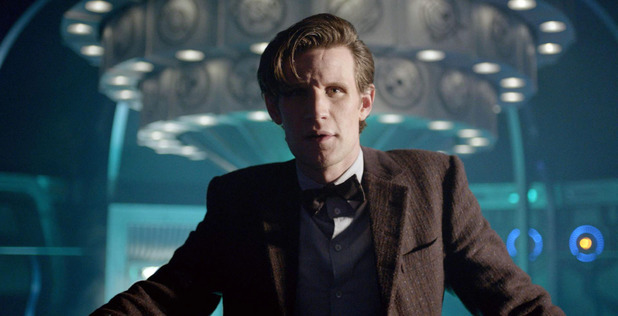
The same can't be said for Matt Smith's Doctor.  I don't find him boring...I just find him stupid.  Whereas the Doctor once was the smartest being in the room, the one who thought his way out of situations, the one who could be counted on to save the day, Smith's Eleventh Doctor is the one you can count on to be goofy throughout.  If necessary he can be called on to be serious, but for the most part Eleventh just behaves like a clown: no wit, no clever plan, no sense of anything other than a lunatic who can barely function in society.  The Doctor is a joke (only he isn't aware of it).  Whether it's appearing in a monk's habit or commenting on how much HE likes hearing people say, "Doctor Who?" (despite that joke having been more than pounded into the ground, that joke has now reached the third level of Hell) or riding up the second tallest building in the European Union on his anti-gravity motorbike, too much time and attention is being given over to show how goofy and silly The Doctor can be, not on how smart or brave he should be.

As a side note, despite Moffat's decision to give this story the more lofty title of The Bells of Saint John, the more appropriate title should really be The Spoonheads, namely because said 'bells' (those from the TARDIS) are actually immaterial to the story itself.   Once "the bells" have run (which begs the question of whether a monk was stationed next to the TARDIS to ensure said bells were heard...one never knows how often the phone rang with no one hearing it), "the bells of Saint John" are never mentioned again.  The only reason I can think of for the title to be thus is because the more accurate title The Spoonheads was too silly...even for Moffat. 

Moffat, however, couldn't resist taking a few jabs at people.  Clara looks at a book of one of the children she's watching, and asks the child what her favorite chapter is.  Ten is her favorite, she replies.  Clara then says that "Chapter 11 is the best; you'll cry your eyes out".  If anything, Moffat can never be subtle...clearly Eleven being our 'favourite' is something he's desperate for fans to believe, and isn't it always Moffat's declarations that almost every story will have us crying? 

Mr. Moffat, I have yet to shed a tear...save for when I think when Doctor Who was actually good, inventive, smart, and fun: all things your bastardization is not.

Of course, not everything in The Spoonheads was terrible.  Imrie played the part well (even if she did come across as a mix of Series Six's Madame Kovarian and The Idiot's Lantern's The Wire), and the idea of something collection souls is not a bad one.  I do note a good exchange between The Doctor and Clara.  When she asks something like shouldn't he know the future, he replies, "I can't tell the future.  I just work there."

However, for me, The Spoonheads was boring.  Even the big reveal of The Great Intelligence taking on The Snowmen's Dr. Simeon's image (or is it the other way round) proved less shocking and more, "...and?"  I just don't care what big mystery Clara has.  I don't even care how this 21-century London girl ended up as both a Victorian governess AND a future astronaut/human Dalek.  The Spoonheads is not this epic I was promised...it's just another dumb, silly, sad parody of a show I once loved but now I merely endure.  Alas, Doctor Who... 

Ultimately Steven Moffat has gone from "Don't Blink" to "Don't Click".          


For God's sake PLEASE stop
embarrassing yourself.

2/10

Next Story: The Rings of Akhaten

Saturday, March 2, 2013

Radiating Success. Doctor Who Story 053: The Ambassadors of Death

STORY 053: THE AMBASSADORS OF DEATH

The Ambassadors of Death is another long story (seven episodes long) and one that has a twist on the 'invasion from outer space story' which Doctor Who was caught in now with The Doctor (Jon Pertwee) stranded on Earth and no way to leave on the TARDIS.  Again I think that at seven episodes it is a bit too long, which makes the wrap-up of the story even more strange given how quickly it went.  However, The Ambassadors of Death had a great deal of action and carried the plot remarkably well to make it another excellent addition to a very impressive debut season for Pertwee's Doctor.

Recovery 7 has been sent off from the British Space Programme to find out what happened to Mars Probe 7.  The latter ship was carrying two astronauts back from the red planet but nothing's been heard from them for seven months.  Astronaut Van Lyden (Rick Felgate), having reached Mars Probe 7, has locked the ships together, but then an ominous sound emanates from the ship, and Recovery 7 similarly goes off line.

The linking up of Mars Probe and Recovery 7 was being broadcast live, and among the viewers is The Doctor and his Companion Liz Shaw (Caroline John).  The Doctor isn't all that interested in the actual space travel (though the missing astronauts safety does concern him).  Rather, he's still tinkering with the TARDIS, still trying to get it to work even after the Time Lords disabled it after forcing his regeneration at the end of The War Games.   That sound alarms the Doctor.  He's heard it before and he fears for everyone.  He and Liz rush to the BSP, which has been under UNIT's protection.

Brigadier Lethbridge-Stewart (Nicholas Courtney) convinces Professor Ralph Cornish (Robert Allen) to use the Doctor's help.  At first Professor Cornish isn't eager for the Doctor's help but quickly sees his importance.  That sound the Doctor tells them is a message, with someone on Earth is sending replies.  Now the question is who and why.

After a battle at the warehouse where the messages were being sent we find that General Carrington (John Abineri), who had been on the Mars Probe 6 expedition, has been sending the messages.  There are more machinations in this tale: Dr. Taltalian (Robert Cawdron), part of the BSP, is involved in trying to cover up the goings-on regarding the missing astronauts.  The Recovery 7 does return, but in a strange twist there is an attempt to steal it, which is foiled by the Doctor.  However, once the capsule is forced open it is empty.

There were three figures inside, but they were taken by a group of common criminals.  These figures, presumed to be the missing astronauts, are a strange group.  They won't remove their space suits and require radiation levels that would kill people.  The criminals have Lennox (Cyril Shaps), a former colleague of Liz's to help with the radiation, and they soon take Liz herself to help them in this nefarious scheme.

The astronauts also are able to kill just by touching someone.  The Doctor tells everyone that they are wrong in this respect: the figures in the spacesuits are NOT the missing astronauts.  Eventually the Doctor has to do something he had not done on the series: fly a spaceship to get to Mars and find out what has happened to the three astronauts.   He does find them, alive and well, but they believe they have returned to Earth and have been held in quarantine for a very long time. 

The Doctor discovers the three spacemen are ambassadors who are being held prisoner by someone who fears them.  The Doctor promises to return the Ambassadors unharmed in exchange for the astronauts.  However, the Ambassadors are being used to provoke a war.  General Carrington has feared these creatures and will unveil them to the world, hoping that they inspire such panic that the world will have a 'preemptive strike'.  The Doctor and the rescued Liz arrive in time to stop him, and with Carrington arrested, and the promise is kept: the Ambassadors will be returned with the astronauts in exchange.

The Ambassadors of Death is the result of many hands working on it.  While sole writing credit went to David Whitaker, it was written by Trevor Ray, Malcolm Hulke, and script editor Terrance Dicks with Whitaker's story serving as a springboard.  Perhaps that is why it is both so long and a bit sprawling.  For example, the idea that Carrington is involved in all this is pretty clear from Episode One, but this plot thread is not really picked up until Episode Seven and rather rushed through.

However, despite the length and vastness of Ambassadors of Death holds together remarkably well.  The story provides great twists and excellent cliffhangers.  Each one of the endings is thrilling and filled with tension.  In fact, Ambassadors of Death plays less than a science-fiction story and more of a spy thriller, particularly in Episode Three when Liz is chased and captured. 

As a viewer I never sensed that the story lagged or wore out its welcome.  Instead, it kept building on each episode and flowed extremely well.    

    
What was incredible about Ambassadors of Death is that the special effects are on the whole quite advanced.  In particular are when the truck transporting the ambassadors changes appearance.  It's done so smoothly that one would think it was done today.  Sometimes the effects didn't work (whenever the Ambassadors struck down someone the big splotch that appeared was slightly comical). 

Ambassadors of Death also had a great series of action pieces that makes it more thrilling.  Episode Two in particular had an extended action scene involving helicopters and aerial assaults that seem to be almost from a movie rather than a television series.  In Episode Three, when Liz is attempting to outrun the thugs sent out to capture or kill her (while wearing a very 60s outfit), we get quite a tense and exciting sequence.

Moreover, The Ambassadors of Death has a great intelligence to it.  In fact, it's almost prescient to how fear and paranoia of 'the other' leads people to do irrational acts.  Carrington isn't evil: his actions aren't motivated by hatred towards the aliens but by fear of them, especially since he saw a fellow astronaut killed by them (even if he refuses to accept that it was an accidental killing since the ambassadors didn't realize their touch was deadly to humans).  In short, the ethical questions Ambassadors of Death asks about whether Carrington's plan was evil is one that makes audiences think as well as keeping them entertained.

We should remember that General Carrington and Sir James Quinlan (Dallas Cavell) were not acting out of hatred towards them.  They truly believed the ambassadors were harbingers of doom and their actions were motivated by a sense of 'moral duty' as Carrington often stated.  They thought they were doing what was best for the planet, so they cannot really be called evil.  However, they were basically using the Ambassadors to start some war, so they were not good.

One of the highlights of Ambassadors of Death was Dudley Simpson's score and the cinematography.  Certain shots (such as when the Ambassadors appear to be coming out of the sunlight itself) are remarkably beautiful.  However, an oddity in the score was in Episode One: the music when Recovery 7 is linking up to Mars Prove 7 sounds almost oddly romantic.


One thing that does make Ambassadors of Death slightly comical is the actual title cards.  It was great to play around with the title sequence, but seeing "The Ambassadors" appear, then "OF DEATH" not only be larger font but accompanied by slightly more dramatic music within the Doctor Who theme makes it almost comical.  Ambassadors of Death also has a slight disadvantage of keeping poor Liz Shaw in mini-skirts and an awfully large hat, as well as slightly pushing her off to the side.  Granted she is shown as being capable of understanding a lot of what the Doctor was doing (and doing some of it in French no less) but one wonders why she had to wear something almost skimpy to show she was a brilliant scientist.  Finally, the actual leader of these ambassadors was clearly the work of make-up artists working with a limited budget; while not awful, not the most convincing either.

Still, these really are quibbles to a story that while long flowed well and kept building a sense of excitement throughout its seven episodes.  We got great treats (at one point Pertwee's Doctor used one of the 'funny voices' Pertwee was known for), and a great performance by both Pertwee as the daring and dashing Doctor of action and Courtney as the loyal right-hand man Lethbridge-Stewart.  We even saw briefly John Levene go from Corporal to Sargent Benton.  The Ambassadors of Death had twist upon twist that keeps on riveted, and on the whole is a fantastic story in what appears to be the Dawn of A Golden Age for Doctor Who.

These Ambassadors will always receive a full welcome in any Doctor Who fan's home.

9/10

Next Story: Inferno

Tuesday, February 26, 2013

De Pompadour of Love

STORY 175: THE GIRL IN THE FIREPLACE

It is only with the benefit of hindsight that I see that with The Girl in the Fireplace, Steven Moffat would eventually plagiarize...himself!  Now, before we get to that, I feel it best to state openly that it has been several years since I last saw GIF.  In fact, I hadn't seen it since its premiere (as with most of Season Two), and at the time I thought it good but not as great as other critics proclaimed it to be.  Certainly having The Doctor (David Tennant) be a major part of the life of a historic figure is nothing new, and even the setting of France isn't new (two First Doctor stories, The Reign of Terror and The Massacre of St. Bartholomew's Eve aka The Massacre are also Franco-centric with the former being within the same century as the events in GIF).

I am trying to keep my growing anger at Steven Moffat (who wrote Girl in the Fireplace) from clouding my view of the episode.  I was successful up to a point: while Girl in the Fireplace has some good ideas rattling around it, in a strange variation of timey-wimey spacey-wasey I found myself constantly referring to an episode from the future because I found a surprising number of similarities between GIF and another story (but much more on that later). 

There is an attack at Versailles, with robotic beings running wild.  A beautiful young woman runs to a fireplace and calls for The Doctor.  Meanwhile, The Doctor and his Companions, Rose Tyler (Billie Piper) and her quasi-boyfriend Mickey Smith (Noel Clarke) have arrived on an apparently empty spaceship.   The spaceship appears to be functioning despite a total lack of a crew.  Among the things they find is a chamber which is 18th Century French, which is rather curious.  The Doctor takes a peek and finds it looks straight into a bedchamber, where a little girl named Reinette (Jessica Adkins) is surprised to see a man in her fireplace.  She's more surprised when with a turn of a secret knob he spins into her bedroom, and triply surprised to find there is a monsters in her room.  It make a ticking sound, and the monster looks like a clockwork man in period costume and a mask, but it does not attack her, stating she is not ready.

The Companions, meanwhile, search the ship and find strange things within: a camera that is a literal eye, and a human heart pumping the machinery.  Meanwhile, the Doctor keeps popping in and out of Reinette's time, next seeing her as a young woman (Sophia Myles).  It is now he discovers that she is none other than Madame De Pompadour.  Instantly she realizes her 'imaginery friend' is not that at all, and he appears smitten with our Gallic Gal.  The Clockwork figures still menace both her and Rose & Mickey, at one point capturing them and threatening to make them a literal part of the ship.  The Doctor comes into all this, obviously after having a bit of a bender at Versailles (and having invented the banana daiquiri a few centuries early). 


What do you mean 'people won't take me seriously?'
The mystery as to why the Clockwork Men have been pursuing Madame De Pompadour is still unsolved, but Rose (who again has taken a dislike towards the French royal courtesan) has been sent to warn Madame that in five years her time (a few seconds or minutes their) the Clockwork Men will be ready to take her head.

Now comes the time, and Madame De Pompadour, having been taken prisoner by the Clockwork Men along with His Majesty King Louis XV (Ben Turner) is ready to face her fate.  Just then, The Doctor bursts through a mirror along with Arthur, a horse that has been wandering the spaceship after inadvertently wandering into it from the gardens of Versailles.  He manages to defeat the Clockwork Men but he knows there is no way for him to return to his Companions.

However, a great fortune befalls the Doctor: Reinette had her childhood fireplace brought to Versailles.  Unbeknown to her, she had brought a portal to the spaceship which allows him to return.  He asks Reinette if she'd like to go with him to touch the stars, and she eagerly agrees, rushing off to pack.  When he returns, he finds a despondent Sun King, who is seeing her coffin being ridden out of Versailles.  The Doctor receives a note from her, stating that she has been waiting for him but fears he never will.  The Doctor goes back to the spaceship, never knowing the real reason why the Clockwork Men pursued our Reinette...the now-abandoned ship was the S.S. Madame De Pompadour.

As I've stated, this was the first time I had seen The Girl in the Fireplace since it was first broadcast.  I have found that a good to great story is one loves watching over and over again.  Classic stories like The Aztecs, The Tomb of the Cybermen, and from NuWho The Unquiet Dead are still stories that I enjoy no matter how often I see them.  GIF won't rank there because despite the praise and awards it has earned,   it has too many things from Doctor Who stories past and future that end up playing a bit like a retread or remake-in-the-making.

Certainly Moffat has a great idea there: the idea of monsters of the future 'haunting' a figure from the past.  I, however, can't shake the feeling that the story could have been much better if an outside antagonist had been at the center of the attempts on Madame De Pompadour's life rather than a mere malfunction by the Clockwork Men.  What great fun we could have had with Rose & Mickey being caught up in the intrigue and decadence of the ancient regime. 

However, there were things in GIF that I flat-out didn't care for.  The first was Myles' performance as Madame De Pompadour.  The real Madame was a woman of refinement, great intelligence and elegant charm, one who held great sway over the monarch.  As portrayed by Myles, she was a simpering, rather blank and vapid woman.  This De Pompadour never struck me as being a woman of elegance or powerful intellect.  Instead, she seems to just be waiting around to satisfy the King's passions or the Doctor's fascination. 

The second is something that occurred to me while watching The Girl in the Fireplace.  It came early on whilst I was making my notes.  It was a simple, little thing, at first of no great importance.  However, once it got stuck in my head, I suddenly had an awakening...not of the Kate Chopin variety (I'd be thrilled), but instead of the "Madame Curie has discovered radium" variety (metaphorically speaking of course). 


"Imaginary friend to Reinette (similar to Raggedy Doctor)", the note read.  That was all.  Nothing more.  However, out of that one note came a shocking series of similarities between The Girl in the Fireplace and The Eleventh Hour that I am genuinely shocked no one has commented on them before.  As I kept watching, I began to wonder whether we were going through the same thing.  While it may be possible that the similarities between The Girl in the Fireplace and The Eleventh Hour are mere coincidences, there seem to be an inordinately large number of them to casually dismiss.

  • The Girl in the FireplaceReinette meets the Doctor for the first time as a little girl.
  • The Eleventh HourAmy Pond meets the Doctor for the first time as a little girl.
  • GIF: There is a monster in Reinette's bedroom.
  • EH: There is a monster in Amy Pond's bedroom.
  • GIF: Mickey & Rose are observed with a long expandable eye (the device created by the Clockwork Men).
  • EH: Amy & Rory are observed with a long expandable eye (the Atraxi taking the shape of it).
  • GIF: Reinette grows up thinking the Doctor was her "imaginary friend".
  • EH: Amy Pond grows up thinking the Doctor was her "imaginary friend". 
  • GIF: Reinette was The Girl in the Fireplace.
  • EH: Amy Pond was The Girl Who Waited.
  • GIF: The Doctor asks Madame De Pompadour if she'd like to travel with him, telling her to pack her bags.  She does but when he returns what he thinks is mere moments turns out to be years, and arrives too late (De Pompadour dying right before he finally arrived).
  • EH: The Doctor asks Amy Pond if she'd like to travel with him, telling her to pack her bags.  She does but when he returns what he thinks is mere moments turns out to be years, and arrives too late (she is a grown woman who needed therapy to convince herself "The Raggedy Man" was not real).

The Girl Who Waited...NOT!
Here we have about the only difference in story structure between The Girl in the Fireplace and The Eleventh Hour (starring The Girl Who Waited).  Moffat could not change history: De Pompadour died at 42, so having the Doctor come after her death solved the dilemma of having a well-known historical figure just disappear.  Amy Pond, however, is a different kettle of fish fingers and custard.

One wasn't able to join the TARDIS because of death.  The other wasn't able to join the TARDIS because she grew up, but now we have a wild continuity error that all but damns Steven Moffat.

From The Eleventh Hour onwards, Amy Pond (who after her marriage became...Amy Pond, having apparently married a man who started out as Rory Williams but ended up as Rory Pond) was "the girl who waited", the little girl who grew up angry at her 'raggedy man' for leaving her waiting outside after promising to take her to the stars.  Her anger was a motivation in her time with the Doctor.  As far as we (and she) knew, the Doctor had left her waiting outside her house and she had never really gotten over it. 

HOWEVER, we find that at the end of The Angels Take Manhattan, the Doctor had indeed returned to little Amy Pond that morning.  I'll grant that it's a beautiful moment (little Amy's face lighting up beautifully), but if he DID go back, then why would she have thought of him as A.) the Raggedy Man when Matt Smith's Doctor would have appeared perfectly dressed (rather than in David Tennant's rags), and B.) why would she harbor such resentment against her "Raggedy Man" when she would have known perfectly well that he would return in twelve years. 

It's a storyline that ultimately makes no sense.  It is frustrating to see two seasons virtually wiped with one 'cute' scene. 

End of Digression. 

I should also mention that we had Reinette at one point ask, "Doctor Who?", which appears to be a running gag with Moffat, using it as a source of comedy.  We also have Reinette's request that the Doctor 'dance' with her.  Curiously enough, the second part of the two-part The Empty Child (The Doctor Dances) was written by...Steven Moffat. 

Coincidence?

There are certain things to like about The Girl in the Fireplace.  The costumes were pretty.

As I kept watching though, I couldn't imagine Sophia Myles' interpretation of De Pompadour to be that of the clever, witty, brilliant courtesan.  Instead, she seemed to be a bit dim and more infatuated with The Doctor than with the Sun King.  The way out for the Doctor left much to chance.  One wonders what would have happened if Reinette's old home had burned down before she became the official mistress at Versailles, or if the movers had damaged something.  It was all a little too convenient.  Also curious to me was that, despite using human body parts to keep the spaceship going, the Clockwork Men seemed oddly hesitant to actually start tearing Rose and Mickey apart for spare parts. 

Yes, it's a clever idea of having the Doctor pop in and out of a young woman's life (like we'll never see THAT again), but despite the praise I found The Girl in the Fireplace a bit cold and rather fast-moving, with a threat that never quite built up to the level it could have.  I still think it would have been better to have had the Doctor and Companions land straight into Versailles, where a much-amused Madame De Pompadour (and a slightly less-amused Louis XV) entertain the couple and save them from whatever menace is after them.

C'est La Vie...

1721-1764
Je suis désolé.  Je suis tres désolé...


4/10

Next Story: Rise of the Cybermen Parts One and Two (Rise of the Cybermen/Age of Steel)

Saturday, February 23, 2013

Smith & Lesson


STORY 174: SCHOOL REUNION

School Reunion is the first time NuWho has acknowledged it had a long backstory before Rose, and it does so by bringing in the Gold Standard of Classic Who Companions.  It's a curious thing that the first time I saw School Reunion (at its premiere), I was thoroughly enchanted, but after a second viewing, I can't keep up the enthusiasm for it I had when first I saw it.  While School Reunion is a great acknowledgment of the promise and perils of being the Doctor's Companion, and while it also is a great story for kids that tap into all the fears and fantasies they have, in this case perhaps making things a little less obvious might have worked wonders. 

The Doctor (David Tennant) is working undercover as a physics teacher while Rose Tyler (Billie Piper) is a cafeteria lady in a school where strange things are going on.  They were first alerted to this by Rose's bumbling boyfriend, Mickey Smith (Noel Clarke), who figured that UFOs around the school area and new math teachers along with a jump in student's intelligence was suspicious (hacking into the Torchwood Institute files  helps).  The new headmaster, Mr. Finch (Anthony Head) is quickly established as a monster, but exactly what kind is a little bit mysterious.

Still, one can't argue with success.  The school scores have jumped, and the Doctor/Rose/Mickey trifecta have traced it to the chips (or fries to us Americans), that most of the kids eat.  This increase in student scores attracts the attention of the press.  Enter investigative journalist Sarah Jane Smith (Elisabeth Sladen).  The physics teacher known as John Smith barely contains his glee at Miss Smith's appearance, but she isn't interested...until she comes across a big blue police box while entering the school at night.  Instantly she realizes that the Doctor is here, and Sarah Jane and Doctor Number 10 reunite.

Still, no time for gentle moments: there's a mystery to solve.  There is also, as Mickey puts it, "every man's nightmare: the Mrs. and the Ex".  It is immediately clear that Rose dislikes, neigh, detests Sarah Jane, seeing herself as The Doctor's first...The Doctor doesn't seem too involved with Rose's jealous streak, telling her that "I live.  Everyone else dies," explaining why he cannot maintain Companions for long.  He has a lighter moment when he finds K-9, the old robot dog that he gave to Sarah Jane in the only Doctor Who pre-Rose spinoff K-9 & Company.  K-9, once fixed, finds that the oil used in the chips is from the Krillitanes, a species that conquers worlds and takes elements from the various creatures they conquer to their own.

Mickey is displeased to find that he is being relegated to the background ("I'm the tin dog", he finds himself saying when Sarah Jane asks what his involvement is to the Doctor).  Rose is displeased to find herself in a competition for the Doctor's affection (even if it is a competition in her own head), and Sarah Jane is displeased to find herself facing her past.  Throw in Mr. Finch and his fellow Krillitanes, who are displeased to find the Doctor interfering in their plans to take over Earth.  They want to break the Skasas Paradigm: the God-Code (or Theory of Everything) that will allow them to rule over all galaxies and time.   They have been tapping into the children to get their imaginations to help them in this endeavour, with the oil & chips increasing intelligence.

In the end, the only boy who never eats the chips due to health issues, one Kenny (Joe Pickley) helps the Doctor and Companions Past & Present blow up the school, though it causes K-9 to sacrifice himself.  The Doctor does something he has not done with Sarah Jane before...say good-bye.  However, he also says hello to Mickey as a full-fledged Companion.  He asks to travel with the Doctor, and while Sarah Jane encourages the Doctor to take him on (he always needs a Smith around, she tells the Time Lord), Rose sounds less than thrilled.

Finally, the Doctor leaves, but he leaves a surprise: a new K-9, with whom Sarah Jane can travel to new adventures of her own...

There were and are still many things to admire in School Reunion.  First is the most important fact: School Reunion ties NuWho (for better or worse) with Classic Who.  Toby Whithouse's script firmly establishes that the Doctor Sarah Jane worked alongside with (Jon Pertwee's Third and Tom Baker's Fourth...not counting One, Two, and Five from The Five Doctors) has been regenerated into David Tennant's Tenth (Ten for Tennant...whatever are the odds).  He immediately recognizes her, she immediately recognizes the TARDIS, and he comments how he's regenerated a half-dozen times since last they saw each other. 

I also thought Whithouse's script worked well if one thought this Doctor Who story was geared more towards children.  School Reunion taps into all those curious fears kids have about their teachers being monsters.  It also has some wonderful moments of dialogue.  At one point Finch tempts the Doctor (like Satan tempting Jesus after His forty days in the desert) by telling him that by helping him break the Skasas Paradigm he could bring back all those who've died.  Sarah Jane is also vaguely tempted by Finch's suggestion that she can be young forever, never grow old or die, always be with the Doctor.  While the Doctor appears to be softening to this line of reasoning, it is Sarah Jane who sets him straight.

"Pain and loss, they define us as much as happiness or love.  Everything has its time and everything ends," she tells them.  With that, the Doctor immediately destroys the mass computer and begins his final take-down of the Krillitane.

Whithouse also comes close to vulgarity.  As K-9 starts shooting lasers at the Krillitanes, Finch (who opts to remain human), tells them, "Forget the shooty dog thing," which I found shockingly risque for a children's/family show.  Whether this taps into Classic Who fans who are divided over K-9 (I fall in the "Love" side of the "Love/Hate" debate) I cannot say.  I like to think Whithouse was having a bit of fun with K-9's divisive mark on the fanbase.

As a digression, I wonder whether the rivalry between Rose and Sarah Jane was prescient over the fierce feud within the Whovian community as to whether the Classic or NuWho is A.) better and/or B.) connected to the other.  The one-upsmanship between Sarah Jane and Rose as to who was more important was slightly amusing.  I say slightly because while watching this interplay between Piper and Sladen, two thoughts occurred to me.

The first is that Rose's reaction was highly irregular to both her character and to Companions in general.  I note the few times Companions crossed paths: The Five Doctors and The Two Doctors (The Three Doctors featured no Companions from The First or Second Doctors Era).  In both stories the various Companions got on quite well and were cooperative.  Here, Rose's instant jealousy marks a negative turning point to Rose's character.  In short, she is a bitch.  Sarah Jane was perfectly civil, friendly, even generous to the Doctor's newest Companion, while Rose's hostility was apparent immediately.  Further insulting Sarah Jane by stating that "rationing had just ended when she met the Doctor" was also just cheap.  I couldn't believe that someone who up to now had been rather generous to all beings could turn around and become so selfish and cruel.  Rose showed kindness to a DALEK for Heaven's sake!  How could the same person who showed compassion to the monstrous killing machine suddenly turn around and be so dismissive of someone who hadn't shown her any hostility whatsoever? 

Rose in short, came across as a horrid little girl, the jealous girlfriend when up to now she had been just a nice working-class girl.  It also suggests that she has fallen in love with the Doctor (setting up a situation that is sadly being replayed over and over in NuWho, with future Companions Martha Jones, River Song, and Amy Pond all suffering from a Doctor-fixation, with only Donna Noble escaping this "I want to sleep with the Doctor" business).  Her reaction to Mickey joining only seals the deal, and we now wonder whether Rose should continue to rank high among Companions given her growing obsession with having the Doctor all to herself (and incidentally, stringing Mickey along).

The second thought, more insidious, is that Whithouse and director James Hawes are resorting to a rather backward view of women as possessive, jealous, and petty (especially when it comes over a man).  I realize there being a desire to have some sort of tension between characters to build up conflict, but I wonder in retrospect whether it was good to have them basically fight over a man.  The conflict could have come from approaches to solving the issue, but instead it devolved into a The Boy is Mine scenario that was only missing Brandy & Monica singing in the background.  This made both Sarah Jane and Rose look rather foolish and neurotic women (which I would argue is not within either character).

However, there are as I said things to admire.  I found Head's performance excellent: he knows how to project menace without being over-the-top.  It is also wonderful having Sladen come back, and she is clearly stepping right into character as a Companion who doesn't scream every few minutes. 

There are also great themes being tackled: the idea that the Doctor eventually abandons or is abandoned by his Companions, the cost of loss, the reunion of the Doctor and Sarah Jane.  All wonderful things to see.  It's unfortunate, however, that the moments between the Doctor and Sarah Jane are undercut by either Rose or Finch and their actions.  It also is bad to see Mickey again reduced to this imbecile.  He can hack into top secret websites but can't figure out K-9?

Again and again I wondered why the reveal of Sarah Jane was made so obvious.  It would have worked wonders to see Sarah Jane just appear before the Doctor rather than see that she was about to come investigate all the goings-on at the school.  I wondered whether NuWho fans who have no idea about Classic Who would even understand who Sarah Jane or K-9 were.  There was never any attempt to explain her importance to Rose (or NuWho fans by extension) and while I knew what was going on I figured that anyone who started watching Doctor Who from Rose onwards would be confused as to who this woman and the tin dog were.   Her appearance would (and probably did) confuse people who like Rose Tyler, never figured the Doctor travelled with anyone else.  These NuWho fans pay lip service to Doctor Who's long history, but if they were honest they'd tell you they flat-out don't care about anything that happened between An Unearthly Child to Survival (or Doctor Who: The Movie aka The Enemy Within depending on who you ask).  That being the case, Sarah Jane Smith's importance to Doctor Who is only relevant in terms of what she does with David Tennant and future Doctors, not what she did with any Doctor prior to Christopher Eccleston.

That basically means that School Reunion would be touching to Classic Who fans, but NuWho fans would be less impressed to not impressed at all, and thus one loses some points for the reuniting of two icons from this legendary series.    

At first, I was so enchanted by Sarah Jane Smith's return to Doctor Who that I was convinced that School Reunion would rank among the Greatest Who Episodes of All Time.  I still have great fondness for it, and think seeing The Best Companion of All Time is wonderful.  However, after a second viewing I've lost some of that lovin' feeling for School Reunion.  There are good moments, even great ones (what child at some point hasn't fantasized about seeing their school go kablooey), but in this case, School Reunion lost a little the second time round. 

Class Dismissed.

Forever Our Sarah Jane...
   

7/10

Next Story: The Girl in the Fireplace

Wednesday, December 26, 2012

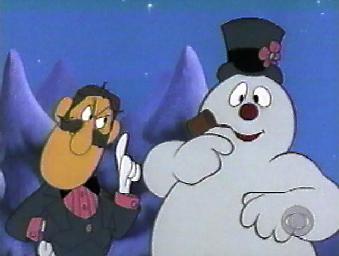
Frosty's Revenge


STORY 234: THE SNOWMEN

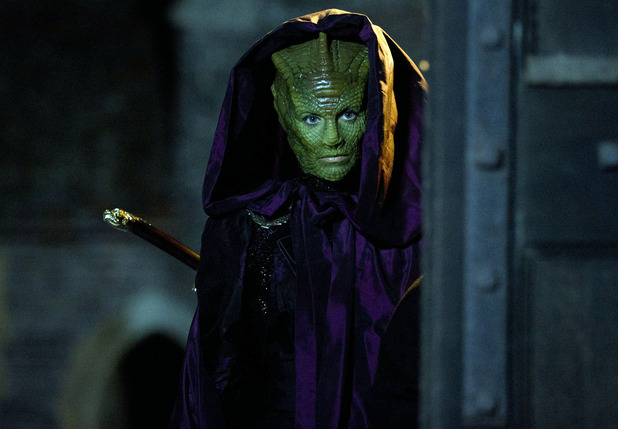
The Snowmen is perhaps the best pilot for a spin-off I've seen, given that the secondary characters of lizard-like alien Madame Vastra (Neve Macintosh) and her Victorian-era human lesbian lover Jenny (Catrin Stewart) are infinitely more important than the former lead character of The Doctor (Matt Smith).  The Snowmen has the return of the Great Intelligence, which is a villain not from the mind of writer/producer Steven Moffat (which must come as a shock to his sycophants) but from the Yeti stories of the Second Doctor era: The Abominable Snowmen and The Web of Fear.  What it doesn't have is the need for the Doctor.  In many ways, the Doctor seems to merely be in the way of the Vastra/Jenny/Sontaran Strax (Dan Starkey) fun-and-games.  In short, for all it's worth he might as well have remained up in his cloud.

It's 1842 and a little boy is making a snowman.  He's a solitary little chap who thinks the other children are 'silly'.  As it happens, the snowman thinks so too...and tells him so.  Soon we go fifty years, and little Walter has grown to the sinister Dr. Simeon (Richard E. Grant).  He is the servant of the Intelligence or Great Intelligence (voiced by Ian McKellen), who is none-too-subtle about who he is (given the bad doctor's calling card literally reads G.I.). 

We then get a look at ye olde Victorian wench Clara (Jenna-Louise Coleman), who is puzzled by the sudden appearance of a snowman.  The passing wanderer cares not about this phenomena, but our persistent serving-wench jumps on his carriage and asks those immortal words, "Doctor Who?"

The Doctor tries to get Clara to forget they met via a Memory Worm (I suppose those devices from Men in Black weren't available), but that comic Silurian Strax keeps making a right mess of it.  The Doctor doesn't care about anything, least of all Clara Who...which leads her to reply "Doctor Who".  She however, manages to follow the Doctor up to his Castle on a Cloud...or TARDIS on a Cloud...but runs off before he finds her.

Our Clara all but magically changes from ye olde Victorian bar-wench to the veddy proper Victorian governess Miss Montague.  She watches over two children, Digby (Joseph Darcy-Alden) and his sister Francesca (Ellie Darcy-Alden...wonder if they're related).  Francesca has been having nightmares about her previous governess, who drowned in the pond (emphasis mine) coming back to punish her on Christmas, which is that very night.  Digby suggests she needs a Doctor...

With that, Clara returns to where the TARDIS on a Cloud was, shouting for him.  Coming upon this odd scene is Jenny.  Clara tells her she needs to speak to the Doctor, to which Jenny replies, "Doctor Who?"  Jenny then takes her to meet the star of The Snowmen...


...and they have a most interesting conversation where Vastra puts her to The One-Word Test.  What is that one word that will bring the reclusive Doctor out of retirement to save the world?  Vastra tells him that One Word, which reawakens him from his enforced metaphorical slumber...

POND!

I suppose technically the fact that the estate's pond remains solidly frozen while everything else has thawed is what Clara was referring to...or IS IT?  The Doctor goes to where Clara works and quickly things happen: the Ice Governess comes alive to terrorize the children, the Doctor finds things exciting again, the Companion dies (sort-of), the Great Intelligence tries to win but can't, something outside the Doctor saves the world, Doctor bids farewell to Clara and at her funeral realizes that the same Clara Oswin Oswald was the SAME Oswin from Asylum of the Daleks!  She's The Girl Whose Died Twice (wonder if she's related to Rory Pond...Williams...Whatever).  We end in present-day where a girl not unlike Clara/Oswin is wandering that same graveyard.  She's not afraid of ghosts.  Now the Doctor has a mission: to find this girl.


He's With Stupid
   
The plot of The Snowmen was described thus by my DVR: 'Though saddened by the loss of his companions (sic), the Doctor helps a young governess battle a frosty menace".  I don't know if they were intentionally or not trying for a pun but I took it as unintended comedy.   For myself, while I did find some good things within The Snowmen, it's just another in the sad and sorry disappointments of the Moffat-Smith Era I have endured.

Let's start with the dominance of the secondary characters.  For the first half of The Snowmen the Doctor isn't a player in any of it.  I know it's because he is now a recluse, but because of this the slack has to be picked up by Vastra, Jenny, and Stax: three characters the NuWho fans have inexplicably gone mad for (why secondary characters who were in River's Secret Part I: A Good Man Goes to War for less than fifteen minutes are suddenly iconic I know not) but who basically take over the story.  That perhaps might be forgiven if there was anything good about them, but there simply isn't.  Again and again I am puzzled why so many NuWhovians appear to be celebrating same-sex bestiality.  Madame Vastra is a know-it-all (hints of River Song), Jenny is basically a tart, and Strax...well, poor Strax.  Poor, poor Strax.

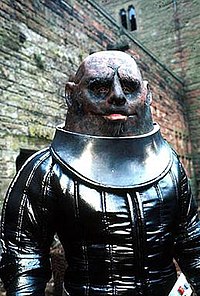
The Silurians were once a feared enemy of the Doctor.  Making their debut in The Time Warrior (which also was the debut story of Elisabeth Sladen's Sarah Jane Smith), they became fierce foes to the Doctor, even having managed to invade Gallifrey itself in The Invasion of Time.  However, now this once proud warrior species has been reduced to comic relief, a figure of ridicule more than menace.  Strax, more than any other Sontaran, has shifted the image from that of a committed foe to that of a dimwit who doesn't quite get the social manners of humans or any other species. 

Perhaps that's what NuWho fans want, but somehow it doesn't ring true.  It turns things into a joke when perhaps the Doctor might have called for a Sontaran's fighting ability, especially one that is willing to help him.  The entire scene between Strax, the Doctor and Clara goes on for far too long and is nowhere as funny as Moffat or Smith think it is.  Comedy is OK so long as it adds something to the story or grows out of it (example: The Romans).  Given that it was neither, the whole sequence should have been cut tremendously.

Going on to Madame Vastra and Jenny, I still fail to comprehend why their relationship (one of the most twisted in Doctor Who history) is so beloved.  We can't quite leave aside the fact that it's a lizard involved in a sexual relationship with a human.  However, we'll try as apparently Jenny is so in love with Vastra that she doesn't seem to mind that her 'wife' drinks human blood.  When Clara and Vastra meets, she doesn't straight-up say she's drinking blood but intimates as much.  We can also leave aside the idea that it is impossible for these two to be married in any legal sense of the word: WHO would marry them, HOW?

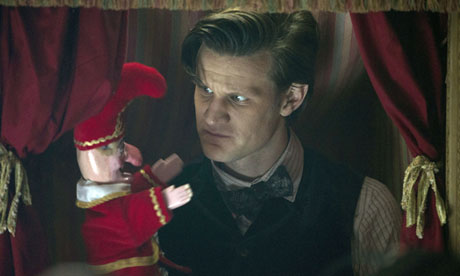
The thing about Vastra and Jenny is that they simply aren't interesting.  Other than the fact that it's a Silurian in Victorian London hooking up with this slinky Cockney, they don't appear to be clever (the mystery of the snow having been solved off-screen) or particularly important to the story.  Instead, they do serve the purpose of drawing attention and time away from the Doctor.  It was his show once, and once HE would have been leading the case.  Now, he's reduced to being Punch (and a bad one at that).

There are moments of astonishing stupidity in The Snowmen that boggle the mind as to how they would have released it the way it was broadcast.  We already have this "Doctor Who?" business that by now should be retired.  There were four, FOUR uses of something a child might find amusing but that is by now simply tiresome, even silly.  However, for sheer unintended (we hope) laughter, we have to go to when the Doctor and The Great Intelligence meet.

We begin this with the G.I. saying, "Danger.  Danger.  There is danger here".   Hearing, "danger, danger", I did expect for the Great Intelligence to call out for Will Robinson.  Perhaps Lost in Space wasn't as popular in the U.K. as it was in the U.S., but it still sounds odd at the least to hear "danger, danger" ringing out throughout the cavernous institute Simeon is at.

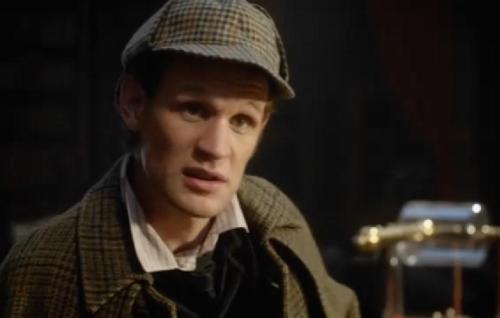
To add an even more bizarre (or perhaps self-serving) element, we have the Eleventh Doctor doing what he does best...look foolish and not taking anything seriously.  Simeon's manservant rushes into the laboratory saying that he has a caller...Sherlock Holmes.  In comes in Matt Smith, complete with pipe, dazzling us with that Moffat-Smith humor we've come to detest.


Making things even worse is Moffat/Smith's penchant for deliberately trying for laughs when the situation doesn't call for them.  When the Great Intelligence confronts the Doctor about not being from this world, the Doctor's reply is "takes one to SNOW one". 

I don't hear a rim shot.

There isn't anything wrong with having a Doctor unafraid: the Fourth would offer jelly babies to his adversaries.  However, there is laughing at the face of danger and being downright stupid.  Smith's Doctor constantly crosses that line by A.) ceding the spotlight to others (be they River or Vastra) and B.) by appearing to not realize that he is facing a serious threat...well, perhaps when you're being menaced by snow and ice, maybe not so much. 


The fact that Steven Moffat is also the producer/writer of the updated Sherlock I suppose has very little to do with this get-up.  There is a lot of mentioning in The Snowmen of Holmes and his creator.  Dr. Simeon states that Dr. Doyle has more than likely based his stories on Vastra and Jenny (changing a few things of course).  This doesn't seem likely given that the first Sherlock Holmes story, A Study in Scarlet, was published in 1887 (a full five years prior to the events in The Snowmen) and despite all claims to the contrary Madame Vastra and Jenny are never actually seen investigating anything, let alone using reason or logic to deduce the mysteries they investigate.  Furthermore, what we think of as the Sherlock Holmes look didn't originate from the stories themselves, so the deerstalker cap and cape seems a bit anachronistic. 

Of course, I could speculate that Sherlock has some homoerotic undertones in the Holmes/Watson relationship in the same way Vastra/Jenny celebrate their own unholy union, but then again, that is speculating without having all the data.

Regarding the guest stars, it seems that an opportunity was lost when they gave Grant and McKellen little to do.  What a great twist it would have been to find that Dr. Simeon wasn't the brains of the operation, but it was an old foe.  Grant looked menacing, I'll give him that, but like the Doctor never played a major role in the entire scheme. 

Now, let's move on to some good things in The Snowmen (and there are).  The interplay between Vastra and Clara is good: the former's directness matching the latter's, their one-word series of interviews well-played thanks to director Saul Metzstein (not often I say that...Pond Life, anyone).  As for Coleman, she was strong as the Victorian working-class/posh girl, though I personally wish that she had been strictly one or the other.  The reasons as to why this Cockney was masquerading (successfully so) as a governess we know not, and we could have dispensed with that angle. 

I also note that Clara has the same Doctor problem almost all NuWho Companions have: she's got the hots for him.  They've only met and in the middle of all this chaos she goes and gives him a passionate kiss.  Why?  Well, no time to answer that: we've got an Ice Governess to fight, one who keeps shouting, "That's the way to do it," and who frankly isn't terrifying (although Clara's death was sad...illogical that her body would have remained beautiful after falling thousands of feet, but sad nonetheless). 

One thing that perhaps IS frustrating is that now we have this puzzling mystery as to who Clara is.  She dies in The Snowmen (rather gruesomely and needlessly I thought) and Oswin (who is suppose to be the same person) dies in Asylum of the Daleks.   We already get there is a connection when Clara comments on how much she likes making soufflés, and the Doctor establishes that Oswin and Clara are one and the same.  That on the surface appears impossible: how does a Victorian end up serving on a spaceship?  How it will be resolved will make or break this season.

However, here again we have a Companion-centered story rather than a Doctor-centered story.  This is something I don't understand and which has plagued the NuWho since Rose: whether it's about Rose Tyler or Donna Noble or River Song or Amy Pond or now Clara Oswin Oswald, when are we going to return to stories about the Doctor?

There was a lot of comedy in The Snowmen (screaming maids, Strax's continued befuddlement, the Sherlock quasi-crossover), there were nice sets.  What for me The Snowmen didn't have were: a successful resolution (really, crying saved the day?  Nothing the Doctor did?), a shift away from the Doctor to Vastra/Jenny/Strax, a comical villain (when the Ice Governess came out, I thought they were being attacked by Mrs. Butterworth), and nothing that would interest me from revisiting The Snowmen.

Truth be told, I'm finding Doctor Who to be losing its magic.  Perhaps they can borrow that old silk hat from Frosty...       

Dr. Simeon Instructs His Minions...


2/10

Next Story: The Bells of Saint John

Thursday, December 20, 2012

Doctor Who Story 050: The War Games

STORY 050: THE WAR GAMES

The Longest War...

If it weren't for the fact that the twelve-part The Daleks' Master Plan has several episodes missing, The War Games would be the SECOND-longest Doctor Who story in existence, coming in at a whopping TEN episodes.  Since The War Games is complete, it means that this story is about four hours and fifteen minutes long if one were to watch it in its entirety from beginning to end.  Some epic films like Lawrence of Arabia and Ben-Hur aren't that long.  The War Games isn't just famous for being the longest surviving story in Doctor Who history.  It also is the first story to mention the Doctor's own people (The Time Lords), the last black-and-white Doctor Who story ever made and the farewell performance of Patrick Troughton as the Doctor himself.

The War Games is a massive tale, but it really isn't until Episode Eight that exhaustion finally sets in, which is to its credit.  Oftentimes some past (and future) Doctor Who stories would wear out their welcome long before the story ends, and The War Games doesn't escape the "maybe it's TOO long" problem that plagued the series until a four-part story became the norm for Classic Who.  Fortunately, writers Terrance Dicks and Malcolm Hulke managed to not make The War Games feel as padded out as it ultimately became, and did manage to overcome some problems not of their making.  The end result is a remarkably fast-paced, well-acted story that added new ingredients to the Doctor Who mythos that would be important in the stories to come.

The Doctor, along with his Companions Zoe (Wendy Padbury) and Jamie (Frazer Hines) find themselves in the trenches ofWorld War I.  Soon, they are taken prisoner by the British.  General Smythe (Noel Coleman) believes Jamie is a Scottish deserter and Zoe and the Doctor spies.  Lady Jane (Jane Sherwin) and Lieutenant Carstairs (David Savile) do not believe it. 

However, strange things are going on.  Smythe is able to hypnotize everyone under him, and he is reporting via advanced technology to a mysterious group.  Furthermore, Lady Jane and Carstairs always get the sense that something is blocking their memory, and there is the case of a literal fog that has some power over everyone.

The Doctor and his Companions manage to escape, but then to their utter amazement find they have run straight into a Roman battalion, then to an American Civil War battle.  They soon discover that they are not in World War I.  In fact, we're not even on Earth.

We find out beings from another world have been kidnapping humans out of their own time to form a super-army.  The War Chief (Edward Brayshaw) has given them the power of time travel.  Reason being he is of the Doctor's own race, whom we discover are the Time Lords.  Some of the kidnapped warriors have discovered they are being used, and form a resistance that so far has been only a minor nuisance, but with the Doctor's help they soon all link up, bringing the aliens, especially their leader the War Lord (Phillip Madoc) to the brink of being defeated.

After ten episodes the War Chief is defeated (killed by the very aliens he had been aiding) but victory for the Doctor comes at a high price.  All this time the Doctor had been basically avoiding detection from the Time Lords, but because he could not take all the abducted back to their own time he needed to call upon the Time Lords for help.   Now that he's been found at last, the Time Lords do manage to return everyone to their right place, but because he has interfered with matters on other worlds (the equivalent to Star Trek's Prime Directive), he is to be punished.  His two Companions are returned to their own time, remembering nothing of their adventures with the Doctor save their first (even Time Lords can't erase all history) and the Doctor himself will be both exiled to 20th Century Earth and be forced to change his appearance.

The War Games is an epic in terms of its length, but the great success of The War Games as a story that holds together goes primarily to its two writers: Terrance Dicks and Malcolm Hulke.  Originally a six-part story, the story following it for some reason was not made.  The orders came from above: make it now ten episodes long.  That Dicks and Hulke managed (for the most part) to make the added War Games episodes seem to be part of the story is a credit to their collaboration and talent.

I say 'for the most part' because it is only when we get to Episode Eight that not only do we get a sense of exhaustion (both in viewing and story-wise) but the introduction of a new character, one Arturo Villar (Michael Napier-Brown), a stereotypical Mexican bandido.  Throwing him into the mix just seems to be a way to add a new dimension to a story that is slowly running out.  I can largely overlook the cliched way Napier-Brown played Villar (not a lot of British people can play Mexicans convincingly, even when they lay on a 'Mexican' accent).  However, I am reminded of that old Cousin Oliver Syndrome: the adding of a cute kid to give a series new life.  While this isn't the same thing, it is in a similar vein: adding a new character to give a story new life.  That was a flaw.

Another flaw is in the entire idea that the War Lord, not the War Chief, was the real brains of the operation.   As good as Dicks and Hulke were in crafting the story, I can't get the notion that again, we had a lost opportunity with the antagonist.  The main conflict was always between the War Chief and the Security Chief (James Bree), with the War Lord playing only a minimal role in the hijinks.   

However, some parts of The War Games are quite effective, even chilling.  In particular the end of the story; the Doctor has lost his two Companions, who sadly will barely remember him or all their adventures.  He then is forced to 'change his appearance' (the term 'regeneration' having yet to be invented), and the final few moments, with a at turns defiant and frightened Doctor desperately trying to stop the changes as he slips further into the void, is downright chilling. 

I also think that The War Games has a subliminal message about the foolishness of war, in particular how these 'masters of war' manipulate the troops.  I don't think it was a coincidence that the ones who communicated with the aliens were the Generals while their subordinates were almost completely unaware of how they were being used as cannon fodder to then be used to conquer the galaxy.  The heroes are 'the Resistance', those soldiers who are refusing to play these 'war games'.   

Leaving aside the political aspects of The War Games (which can be read into the story but which if existent are mercifully subtle and don't interfere with a good science-fiction concept), let's focus on some extraordinary bits within this massive story.  Chris Hayden's editing was seamless, especially in Episodes 2, 9, and 10 when we get thrilling and genuinely shocking twists: the World War I group rushes straight for a Roman legion! the Time Lords slow down time itself! the Doctor is sent into the void!  Complimenting Hayden is Dudley Simpson's score, which enhances the tension and twists in all these moments.  

The performances from the guest stars are equally well-crafted.  In NuWho, Castairs would have been considered a Companion (one with a spin-off attached as all NuWho guest characters are inexplicably tagged with spin-off fever).  However, Savile gives Carstairs a full range, from the decent-chap style of British drama to that of a man fighting for his life and sanity.  Jane Sherwin's Lady Jane Buckingham is equally strong as the woman who does her best to outwit these aliens.  Truth be told, I don't know if we saw enough of her (especially after Arturo Villar popped into the picture) but given both the length of The War Games and the fact that women tend to be demoted it isn't a surprise she was left to 'nursing'.   While Bree's Security Chief was excellent in his clipped and haughty manner, I'd argue that Breyshaw's War Chief was a bit over-the-top (neither the Fu Manchu mustache or the Nehru jacket helped, by the way).  Despite this, David Maloney directed both his guest stars and the regular characters in a near-spotless way to where on screen they almost never lagged or looked as if they didn't belong.

Maloney put both the acting and technical elements together so well that one rarely notices that The War Games is extremely long.

Finally, I think that we did have a bit of a lost opportunity to expand on the Doctor Who world when we gave the Time Lords themselves only one episode.  Granted, it's later that we get all that Gallifreyan machination and conspiracies that we all love, but they did come across as these remarkably boring quasi-deities.  Anyone would have run away from them.

I can't say that The War Games is too long because through its four-hour running time it held my interest and managed to hold up under its massive weight.  Very few stories can last six episodes or more and stay interesting (almost all Dalek stories and perhaps The Invasion or The Seeds of Death, maybe The Ice Warriors being exceptions up to this point in Doctor Who's history).  While I can't say The War Games is too long I will say that it is a bit stretched out.  That's not a particularly bad thing: The War Games does hold your interest for most of the story but one wonders whether we had some lost opportunities by not delving into the Doctor's home world or putting more focus on the conflict between the War Chief and the Doctor.  Minor things, perhaps, but still things to consider.

Still, on the whole The War Games is an intelligent and clever story with great twists and shows that a long story can work, even if at times it veers close to breaking.


Trust me, compared to other Doctors,
this look is pretty sane...

9/10

Next Story: Spearhead From Space

Thursday, November 29, 2012

Doctor Who Story 049: The Space Pirates


STORY 049: THE SPACE PIRATES

Pirate Copies...

There is something almost perverse in that the only surviving episode of The Space Pirates exists in two places. One is a 35mm film print, which was preserved only because it was the first BBC program ever placed on film (which explains why said episode, Episode 2, is the only one surviving).  Then there is a rare instance of a video recorder being used on The Space Pirates.  Would you believe it...it is the EXACT same episode!  That means out of the six episode story, only Episode 2 remains for us to enjoy.  Enjoy, however, may be too grand a term for it, because even in that one episode, The Space Pirates looks like a slow and dull adventure made slower and duller by its length.

The Space Pirates lives up to its billing: it's about pirates in space.  That in itself is a bright idea, and Robert Holmes, in his second Doctor Who screenplay, at least presents the notion as instructed.  However, The Space Pirates is more a 'Western in Space' than a pirate story, complete with crazed prospector.  These touches, along with others, sinks The Space Pirates to mediocrity.

The TARDIS materialises in Earth's future on a space beacon just before it is attacked by pirates. The Doctor (Patrick Troughton) and his Companions, Jamie (Frazer Hines) and Zoe (Wendy Padbury) find themselves trapped in a sealed section of the beacon. It is blown apart and flown to where the pirates will plunder it of the precious mineral argonite. They witness a conflict between the pirates and the Interstellar Space Corps, led by General Hermack (Jay Mack) and Major Warne (Donald Gee).

The ISC are convinced that the pirates' mastermind is an innocent yet eccentric space mining pioneer named Milo Clancey (Gordon Gostelow), while their true leader is a man named Caven (Dudley Foster). Caven has a secret base on the planet Ta. He is assisted by Madeleine Issigri (Lisa Daniely), daughter of Clancey's ex-partner Dom, who - unknown to her - is now his captive.

When Madeleine discovers Caven's full treachery she helps to bring him to justice. The time travellers are given a lift back to the TARDIS by Clancey in his rickety old ship, the LIZ 79. *

Even in the surviving Episode 2 we see what makes The Space Pirates a weak Doctor Who story.  Namely, the Doctor and his Companions are basically irrelevant to the story.  Minus the Doctor's efforts to bring the broken-off section of the spaceship closer to the piece where the TARDIS is (which given the length of the story, he obviously was going to get wrong) they played no part in the episode itself.  In fact, if you cut their scenes, you would have had a whole new story that might have worked as a separate series. 

The NuWho fans are fond of demanding spin-offs for every Tom, Dick, and River that appears as a guest star/character  (getting their wish with the Captain Jack Harkness spin-off Torchwood).  The Space Pirates gives us a roundabout vision of what a potential Doctor Who spin-off might have looked like.  For all the length of The Space Pirates, one could easily have written the travellers out of the story without being part of anything. 

Granted, it's pretty difficult to make that argument without being able to see the other episodes, but the synopsis is pretty Doctor-lite.   I'd argue that if you removed the main characters you don't affect the overall flow of the story.  That being the case, it makes it hard to imagine that a story where the Doctor is almost irrelevant would be a good to great Doctor Who story.

Even that perhaps could be forgiven (although intensely difficult to do so).  The Space Pirates unfortunately suffers from other factors.  The decision by director Michael Hart to ask his characters to appear as if they were in a Western (particularly with Gostelow's "hillbilly in space" Milo, which makes him look a pickax and dance short of Walter Huston in Treasure of the Sierra Madre) turns this almost into farce.  Another space crew member, Technician Penn (George Layton), was allowed to have shaggy hair and a mustache that made him look like a lost Beatle.

One poor decision was in the costumes, which in terms are grand and almost comical (the space helmets themselves being a source of unintended laughter).  Dudley Simpson's score was on the plus ambitious, but curiously the vocalization that opens each episode of The Space Pirates makes it sound far too grand for the story its telling.  One thing that is in retrospect amusing is that The Space Pirates with that vocalization predated Murray Gold's NuWho score which similarly echoes a female vocal in space.

One final note: Robert Holmes' script makes mention of a 'mind probe', and I have no way of knowing whether Terrance Dicks subconsciously drew from The Space Pirates or Holmes himself when he turned 'the mind probe' in The Five Doctors into one of the most famous (or infamous) lines in Who history...but we'll cross that bridge when we get there.

One complaint I continuously make is that with the possible exception of Dalek stories, long Doctor Who stories (those that are longer than four episodes) simply can't maintain the stamina or interest of an audience.  The Space Pirates at six episodes appears to be another case of the story being far too long for the tale that it's telling.  Even if it were to be rediscovered I doubt The Space Pirates would be all that popular.  Still, it would be nice to have more lost episodes found, even if it were something as weak as The Space Pirates.

* My thanks to TARDIS Wikia for the plot synopsis. 

3/10

Next story: The War Games