Wednesday, February 5, 2014

The Worst Doctor Who of All Time. OF ALL TIME!


STORY 179: LOVE & MONSTERS

When the revived Doctor Who came in 2005, I was like so many NuWhovians are today.  EVERY episode was BRILLIANT, every story was EPIC, everything was THE GREATEST OF ALL TIME.  OMG Rose Tyler is the GREATEST COMPANION OF ALL TIME!!  OMG Christopher Eccleston is the GREATEST DOCTOR OF ALL TIME!  OMG David Tennant is the GREATEST DOCTOR OF ALL TIME!!  OMG! Lady Cassandra is BACK! OMG!!! Sarah Jane Smith is BACK!!  WOW...The Doctor met Madame De Pompadour!!!

DOCTOR WHO IS THE GREATEST TELEVISION PROGRAM OF ALL TIME!!!!!!!!

Then came Love & Monsters, and I was violently awakened from my Doctor Who slumber.  For me, Love & Monsters marked a demarcation line.  After this episode, I became more cynical, more ambivalent, more suspicious, towards this sci-fi program.  I realized that I could no longer give Doctor Who a free pass just because I was a fan.  Love & Monsters is more than appallingly bad.  Love & Monsters is a flat-out insult to Doctor Who fans, and ever since I have looked on NuWho with a jaundiced eye.

I had not seen Love & Monsters since it premiered, and looking back at it the memory of Love & Monsters is actually worse than the episode itself.  That doesn't mean Love & Monsters will ever be reevaluated: it is still a simply inexcusably bad episode.  However, it is not as horrifying the second time round as it is the first time.  Still, Love & Monsters will never an episode which a non-Who watching person should ever see as their first Doctor Who story. 

Told primarily through the video recording of Elton (Marc Warren), we hear of Elton's fascination with The Doctor (Tennant), whom he has crossed paths with on many occasions.  He was there when the Autons attacked, when the Slitheen arrived, and when the Sycorax threatened the world. He also has an earlier encounter with Tenth, but more on that later.  Online, he manages to contact Ursula Blake (Shirley Henderson) who is also a believer in The Doctor ("Doctor What?", Elton asks, showing that Steven Moffat didn't write this episode).  Soon Elton and Ursula meet other believers: the quiet Mr. Skinner (Simon Greenall), the chatty Bliss (Kathryn Drysdale) and the endearing Bridget (Moya Brady).  They begin at first to try to find the mystery of The Doctor, but soon LINDA (London Investigating N Detective Agency) starts becoming a bit of a social club and soon all but forget looking for The Doctor.  They bring snacks, Bridget shares about how she comes to London to find her drug-addicted daughter, Mr. Skinner begins reading from his unfinished novel, and soon they all form a garage band of sorts (Elton, despite his name, is a big Electric Light Orchestra fan).
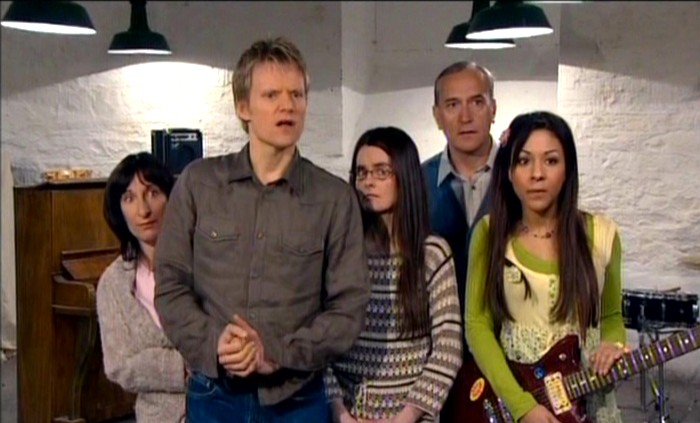
       
The fun and games (not to mention their rendition of Don't Bring Me Down) comes to a brutal halt with the arrival of Mr. Kennedy (Peter Kay).  This mysterious figure, all draped in black and who cannot touch or be touched due to a skin condition he says, tells them he will bring them back to their mission.  They soon begin to do hard work, following every lead that comes their way.  Among those is the beginning of Love & Monsters: Elton's encounter with the Doctor and his Companion.  After a quick investigation, we find this Companion has a name, Rose Tyler (Billie Piper) and her mother, Jackie (Camille Coduri).  The ever-tarty Jackie takes a shine to Elton, even going so far as to attempt to seduce him and getting him through subterfuge to get his shirt off.  As Elton contemplates a romp, Jackie calls it off after receiving a call from Rose, which puts her out of a romantic mood.  Elton by now has decided to give up these espionage ways and start a platonic friendship with Jackie, but she finds a photo of Rose and the TARDIS in his jacket, and promptly throws him out.

By this time LINDA has been reduced to three members.  Bliss and Bridget have disappeared and the others don't really question or follow-up on their friends.  Elton, backed up by Ursula, tell Kennedy to get lost and begin to leave.  Kennedy manages to hold Mr. Skinner back, saying he has news on Bridget (with whom Skinner has fallen in love).  However, we find he disappears when Ursula and Elton return almost immediately to get her phone.  Here, we discover that Mr. Kennedy is really a monster, literally.  He is an Abzorbaloff, a monster who absorbs other creatures.  He has absorbed the other members of LINDA, and managed to absorb Ursula due to his touch.  The Abzorbaloff goes after Elton, but he is saved by the Doctor and Rose, who have tracked him down so Rose can give Elton a right dressing down for having upset Jackie.  The Abzorbaloff threatens Elton, but Ursula, Mr. Skinner, Bridget, and Bliss (all of whom are still within the Abzorbaloff) pull together to pull him apart.  Still, it is too late for them save Ursula, who through the Doctor's 'magic wand' (Elton's words, not mine), is able to restore her somewhat.

As for Elton's first memory of the Doctor, it seems that the Doctor had chased down some creature to Elton's home, but was too late to save Elton's mother.  Still, Elton quotes Steven King, "Salvation and damnation are the same thing," and at least Elton and Ursula are together.  They even have a bit of a love life...or as much of a love life a man can have with a woman who is basically a large piece of cement.

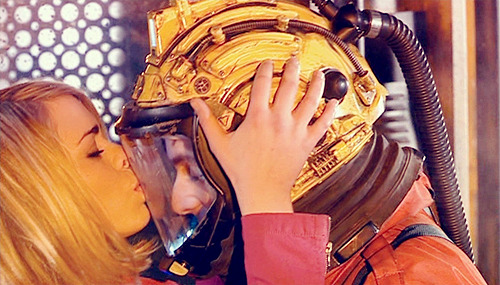
Talk about giving head...


Insert Where?

Doctor Who has had some real clunkers in its fabled history. Starting from the First Doctor story The Web Planet right on through the Second Doctor story The Dominators or The Fifth Doctor's Time-Flight and the Sixth Doctor's Timelash,  it would be fair to say that every Doctor has had at least one bad story (though Matt Smith's Eleventh Doctor has more than his fair share).  However, I have seen the Doctor Who episode so atrocious, so hideous, so repulsive, that it killed the series for me. 

How HORRIBLE was Love & Monsters?  It was so bad...HOW BAD WAS IT?...It was so bad I refused to watch the succeeding episode Fear Her because the trailer came out at the end of it, and I wanted NOTHING to do with anything connected with Love & Monsters

How HORRIBLE was Love & Monsters?  It was so bad...HOW BAD WAS IT?...that after stumbling through Doomsday Parts 1 & 2 (Army of Ghosts/Doomsday) I flat-out REFUSED to watch Doctor Who.

That's correct.  I QUIT watching Doctor Who.  It wasn't until The Waters of Mars that I returned, and that was only because I knew David Tennant was leaving the series.  I missed the Master, all of Martha Jones and Donna Noble, and the 'meta-crisis' Doctor, all because I was so utterly disgusted by Love & Monsters that I could no longer give my time to something so flat-out hideous.

It isn't even the oral sex thing that damns Love & Monsters (though frankly that doesn't help).  It as if Davies wanted to deliberately insult Doctor Who fans, not just with this story, but with the whole LINDA concept.  The members all seem to be rather lonely, a group of misfits who find little outside their fixation on The Doctor to fill their lives.  Even the things they do have seem rather sad (did Davies think Bridget looking for her drug-addicted daughter shouldn't have a resolution).  All I could think of was that poor Bridget's daughter was out there, homeless, high, with little hope of ever recovering and no chance of they ever reuniting.  Is it me, or am I the only one who finds that cruel?  Putting these people and have them come to grisly ends is so, so wrong. 


However, the story itself is idiotic and illogical on so many levels.  Who exactly is Elton relating this story to?  It looks like he is putting this video online, so we have to ask who exactly is his target audience?  Furthermore, why is he talking at all, and why does he interrupt his video with his dancing to Mr. Blue Sky...twice?  With Elton telling us about his encounter with the Doctor and Rose, the story starts off well, but as soon as we cut to Elton telling us the story, all the menace is lost.  Instead, we get treated to Doctor Who doing a Benny Hill skit with the Doctor, Rose, and a monster running around.  I really was waiting for Yakety Sax to start playing as they ran across the various doors.

I also question why Kennedy would so easily take power over LINDA.  No one objected to him bullying his way and taking the fun out of things, no off-sight meetings where they talk about how unhappy they are with him there, and no sense where any of them asks whatever happened to the missing members.  You'd think they would have each other's e-mails or phone numbers, but apparently they didn't.  We also get the rather horrifying sight of Jackie so nakedly trying to get at a man she barely knows (though in fairness, even though Warren and Coduri are the same age, he looks much younger, so at least it is no longer as sick as I originally thought when I thought he was somewhere between Rose and Jackie's age).  Throw in the flat-out insulting bit of Rose dressing down Elton when he's about to be devoured by the Abzarbaloff.  Is she stupid or just so whiny that she misses the point of all this?  Even the Abzorbaloff looked at her with a puzzled expression, as if he himself couldn't believe the Companion could be so daft.

Finally, the entire "Oh, I saw your Mommy get killed thing" is so appalling on so many levels.  How does Elton forget his mother getting killed, and why is the Tenth Doctor involved?  Was Rose with him in all this?  Given that Nine regenerated to Ten with Rose with him, and there hasn't been evidence she has left him for any period of time, where does Mrs. Pope's death fit within their adventures?  Come to think of it, Elton shouldn't be obsessed with the Doctor.  Elton should try to kill him.  The Doctor has been inadvertently responsible for his mother's death, his friends death, and his love interest's death.  Given all that, why does Elton LIKE the Doctor?

A big hurdle for Love & Monsters was that the monster was created by a nine-year-old boy.  William Grantham (no relation to Downton Abbey's Lord Grantham) won the Blue Peter "Design a Doctor Who Monster" Contest.  The obvious question is, "Why?"  How bad could the other entries have been if the winner turned out to be so horrendous?  It doesn't seem fair to beat up on a child, but the entire decision to hand over a major part of a Doctor Who story to a child seems like a daft decision.  It certainly opens up the production to charges that, "it's so easy even a child could do it", which in this case, a child did.  Grantham stated that he envisioned the Abzorbaloff to be the size of a double-decker bus.  I would have hoped it would have been envisioned to be...well, interesting.  The Abzorbaloff (I always wonder whether he should have had a Russian accent) has only the vaguest reason for being an antagonist, and a pretty weak one too. 

The performances were almost all bad.  I thought well of Warren, but apart from him everyone else was either awful (Kay) or slumming it (Tennant, Piper).  The comedy fell flat, the drama was overwrought, the horror was not, and in short Love & Monsters is an ugly mess all around in every manner. 

Love & Monsters was a deeply troubling and traumatizing episode, and not just for the 'love life' bit Elton threw in at the end.  Put it down to my hopelessly naïve nature, but the first thing I wondered when Elton said that was, "How could they have a love life?"  It took a while, and then I thought, "Eww...".  Russell T Davies may deny it all he wants, but the inclusion of an oral sex joke in a children/family show is the lowest point in Doctor Who history.

In the final analysis, the actual memory I have of Love & Monsters is uglier than the actual episode itself.  Time has healed the horrifying, traumatic experience I had with this episode.  I can look back at it without actually vomiting (as I did the first time, which was my exact reaction when I saw Hayden Christensen at the end of Return of the Jedi).  However, while the passing of the years has softened the actual viewing experience of Love & Monsters, the story itself remains a sad and sorry embarrassment to all concerned.  I would rather watch River Song in a ménage a trois with the Eleventh Doctor and Madame Vastra (which I figure many Whovians would LOVE to see) than watch Love & Monsters

I survived Love & Monsters, and thank God I NEVER have to watch it again... 
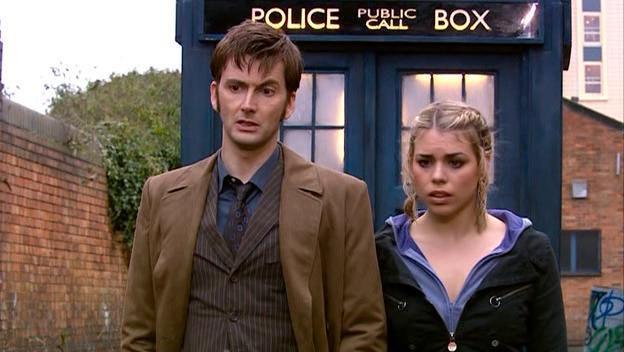
I'm sorry.  I'm so sorry...
Well, you should be!


0/10

Next Episode: Fear Her

Wednesday, January 15, 2014

Works of The Devil


STORY 178: THE IMPOSSIBLE PLANET          PARTS 1 & 2
(THE IMPOSSIBLE PLANET/
THE SATAN PIT)

The two part The Impossible Planet Parts I & II (The Impossible Planet/The Satan Pit) introduce a new alien species, the Ood, and to my memory this is the first NuWho story where the aliens are actually memorable.  We've had monsters and villains in NuWho (The Lady Cassandra comes quickly to mind), but in many respects the Ood are different.  The Ood are not just one of the best NuWho aliens/monsters to originate with the revived series.  The Impossible Planet Parts I & II is also the first great story of David Tennant's tenure, a breathless, fast-paced story that reminds me of Classic Doctor Who at its most inventive.  It has the requisite terror aspects, incredible performances from both regular and guest stars, and tension that isn't relieved until the end.  The Impossible Planet Parts I & II surprised me at how much I got into the story.  It's been several years since I've seen it, and at least for this one bright shining moment I found myself doing something I have not done in a long time: love NuWho and think that it truly has achieved par with some of the best stories of the Classic Era. 

The Doctor (David Tennant) and his Companion Rose Tyler (Billie Piper) arrive on a mysterious space station.  It is a sanctuary station, one manned by the Ood, a slave race that does so willingly.  The humans here are a motley crew, but one which wants to discover the secret of the world they are in.  The planet  is K37 Gem5 or Krop Tor, The Bitter Pill.  What makes this such an 'impossible' world is that the planet is suspended within a black hole.  Instead of being taken within the black hole, Krop Tor maintains itself there.  The kind of power to hold itself in place without being swallowed by it apparently is so great it would take the power of six to the power of six every six seconds.  As they deal with the crew: acting Captain Zachary Flane (Shaun Parkes), Ethics Commander Danny Bartock (Ronny Jhutti), archaeologist Toby Zed (Will Thorp), science officer Ida Scott (Claire Rushbrook), Security Head Mr. Jefferson (Danny Webb), and Mechanical Trainee Scooti Manista (MyAnna Buring), the Doctor and Rose realize they are now trapped there, the TARDIS having been swallowed up by the planet into the pits.

Oddly, the TARDIS going down is the least of their worries.  The Ood, a docile group who communicate via orbs that allow them to speak, soon begin muttering very frightening things.  "The Beast and his armies shall rise from the Pit to make war against God."  Toby is soon possessed by a mysterious entity, and the Ood soon go from docile to dangerous.  They tell the horrified Doctor and crew that the one who has taken them goes by many names: Abbadon, Krop Tor, Satan or Lucifer, the King of Despair, The Deathless Prince, The Bringer of Night, the Devil.  The Ood have now gone mad and are besieging the base.  Under the possession of this force, Toby kills Scooti, and perhaps literally all Hell is breaking loose.

Marks of The Beast
With everything devolving into chaos it now is up to the Doctor and Rose to work separately to save themselves and everyone.  The Doctor and Scott had gone down to the depths of the planet prior to the Ood uprising and found the Pit, which has now opened.  Rose, left behind and temporarily cut off from the Doctor, takes charge.  The Captain, however, has authorized Strategy Nine: total evacuation of the planet and escape via a field that comes from the black hole which can hold gravity and not be dragged down.  The Beast, the being that has taken over the Ood, wants to break free from his imprisonment, and the Doctor now believes that the Beast is an ancient being who has spread evil across time, and has entered into myths and legends of all faiths (such as the Arkiphets, the Church of the Tin Vagabond, Christianity, and Neo-Judaism among others). 

Rose believes that the Doctor would have urged them to not give into despair but to think their way out of their situation.  With the Captain, besieged but still in control of the power, he guides Rose, Mr. Jefferson, Toby and Danny away from the rampaging Ood, though Mr. Jefferson falls behind protecting them and dies when the Captain is forced to cut his oxygen off to save the others.  Unbeknown to them all, Toby is still possessed by the Beast, and he escapes with the others.  Rose is determined to wait for the Doctor to return, but Strategy Nine won't allow anyone to stay behind, so the crew grab her and force her to the rocket. 

Scott, contemplating her own impending death, helps the Doctor go down to the Pit, where he meets the monsters.  He realizes that the Beast wants to escape but that now it is only the body that remains.  The mind of the Beast is now free, and if the Doctor tries to destroy the body he risks killing everyone.  Despite this, the Doctor does strike at the Beast, knowing that if there is one thing he believes in, it's Rose Tyler.  The body is destroyed, but a horrified crew discover that Toby is still possessed, and he now is going to use the ship to escape as Krop Tor is slowly going into the black hole.  The Doctor, who now has found the TARDIS, gives Rose hope, and with that she quickly manages to fling Toby/Beast into space, and with Scott rescued the Doctor now helps the rocket escape the black hole's pull.  Sadly, the Ood cannot be rescued, but Captain Flane recognizes their sacrifice by noting in the record each Ood's death, with honors, along with Toby's.


The Impossible Planet Parts I & II astonished me in its inventiveness, its fast pace, its terror quality, and in how good everything was.  Let's start with the two lead performances.  From the moment Tennant and Piper appear, literally laughing at the thought of danger, we see the rapport they have as Doctor and Companion.  Tennant is allowed to make great speeches about what The Beast is, and his declarations of "Brilliant!" are not words of praise but astonishment, which an attribute that can be applied to Tennant himself in the two-part story.  He moves so easily from calm to manic, courageous to thoughtful, that he runs through so many emotions without missing a beat.  Piper's Rose can be a bit clingy, but here at least we see that the stakes are terribly, terribly high and her fierce loyalty to the Doctor is not done out of erotic love but of genuine affection for her friend. 

The guest stars all fill their roles so well you'd think the odds of one of them stumbling would take, but none of them go wrong.  Thorp's Toby Zed (curiously, Zed is the non-American way of pronouncing the letter 'Z', so could there be something there?) goes from frightened to frightening with ease, where one feels sympathy and horror in quick succession.  Seeing his final end made me a little sad, given that Toby was another victim of the Beast.   Parkes' Captain was all business, and he did command the screen whenever he was on.  Webb's Mr. Jefferson was also excellent as the strong security chief, Jhutti's Danny lent lightness and/or fear when needed.  While Buring had a smaller role her final moments of terror sent chills down the spine, and Rushbrook's Ida Scott served as a great candidate for Companion if things had turned out differently.  She went from inquisitive to resigned so well. 

I can't find one performance that was bad or off, and this is not just credit to the individual actors but also to James Strong's apt directing, which kept things moving but which allowed for moments of rest when required.  The pacing was incredible, where the story flowed fantastically without feeling rushed or padded, and there are some beautiful visual moments (such as when in Part II the Doctor is suspended in total darkness, just him in the center). 


I think there is also something subliminal, perhaps accidentally so but still visually striking. Whenever we see the Doctor and Scott walking around in the dark with their space suits, is it me or do they look like Death, skulls moving about?  It adds another element in the 'chilling' aspect of The Impossible Planet I & II, which appears to borrow heavily from Aliens in not just the space station but in the story of having to do battle with a monster that devours all.  The story also appears to echo Dante's Inferno from The Divine Comedy, where in the lowest level of Hell Satan is bound rather than serving as Ruler of the Underworld (though if memory serves correct Shaitan, the Islamic term for Satan, was frozen rather than chained). 

Matt Jones' screenplay uses the motifs of Judeo-Christian theology (the idea itself of the Devil, the subtle quoting of Scripture when the possessed Ood say "We are the Legion of the Beast", the opening moments where the Doctor and Rose are greeted with a 'Welcome to Hell' written on the walls) and trusts his audience to understand what he is referring to.  Moreover, the idea of religion and faith is treated with respect.  The Doctor is not presented as an atheist or a believer of a specific theology.  Rather, when the Doctor states the various faiths that exist in the universe (which does raise the question of how Christianity spread throughout the universe or what Neo-Judaism looks like), he is stating a fact.  He does not pass judgment, he does not ridicule faith itself (in fact, he asks Scott if she has any particular faith, and she says she was brought up Neo-Classic Congregational.  These elements make things familiar without being specific, as if this world could exist. 

The score for The Impossible Planet I & II works so well (deliberately creepy with the elongated violin notes, mournful when at Scott's farewell to the Doctor there is a solitary violin) and the visual effects also work excellently. 

If I were to have any caveats about The Impossible Planet I & II is that we are constantly told how something is 'impossible'.  I counted at least eight uses of 'impossible' in the two episodes.  It was soon becoming silly how nearly everything was 'impossible'. 

As a side note, what I find bizarre is the Matt Jones has never written another Doctor Who story after The Impossible Planet Parts I & II.  While he wrote one Torchwood story (Dead Man Walking), Jones has yet to write again for the Doctor.  Given a.) how good this two-part story was, and b.) how awful repeat Who writers like Toby Whithouse, Gareth Roberts, and yes, Steven Moffat have been, I can find no reason why Jones has not returned for more adventures.

The Impossible Planet Parts I & II left me breathless, excited, totally involved in the story.  It had a fantastic performance by David Tennant, who held our attention and commanded the screen as The Doctor.  It had an equally great performance by Billie Piper as Rose Tyler, who reminded us of why so many fell in love with her as a Companion, mixing strength with compassion.  The guest stars are brilliant.  The story moved and felt epic, worthy of a two-parter.  I truly can't find fault in it. At least in this case, I give the Devil his due.


10/10

Next Story: Love & Monsters

Wednesday, January 8, 2014

You've Got To Change Your Evil Mind. Doctor Who Story 056: The Mind of Evil


STORY 056: THE MIND OF EVIL

The tricks of the mind are nothing new to The Doctor.  In The Mind Robber the whole story was built around how one being, The Master of Fiction, manipulated the space travelers to build up his universe.  In The Mind of Evil, we see another Master attempting world conquest by appealing to humanity's desire to 'improve' the mind.  The Mind of Evil does a wonderful job of integrating the Master into the story to where we believe it is possible to have him behind the machinations and not just a convenient villain to use, and while I quibble at a few aspects on the whole I was surprisingly pleased how well The Mind of Evil worked both visually and storywise.

The Doctor (Jon Pertwee) and his Companion Jo Grant (Katy Manning) go to Strangmoor Prison to see the Keller Process.  Through a machine, criminals can have all their negative impulses removed, making them docile but functional members of society.  Barnham (Neil McCarthy) is the latest criminal to undergo the Keller Process.  This time, some things remain the same: the prisoners are in an uproar whenever the Keller Machine is used.  Some things, however, are different: under the eye of Professor Kettering (Simon Lack) the Keller Process creates a particularly painful reaction to Barnham.  The Doctor is fiercely opposed to the Process and insists the machine be destroyed.  Needless to say, he is ignored, even after two people end up dead near the machine, including Kettering, who died by drowning in a dry room.

In a seemingly unrelated story, UNIT Brigadier Lethbridge-Stewart (Nicholas Courtney) has his hands full with a World Peace Conference.  The Chinese delegate's security detail, headed by Captain Chin Lee (Pik-Sem Lim) comes to the Brigadier with various complaints.  The Chinese delegate's room has been robbed, despite round-the-clock surveillance from UNIT.  However, she herself has stolen the papers, under some form of mind control.  The Chinese delegate now turns up dead, and despite his objections the Doctor is forced back to UNIT HQ by Captain Yates (Richard Franklin), with Jo staying behind.  The Doctor puts things together when he learns that a Chinese girl (Captain Lee) is missing, because a 'Chinese girl' had assisted the mysterious Professor Keller in installing the machine.


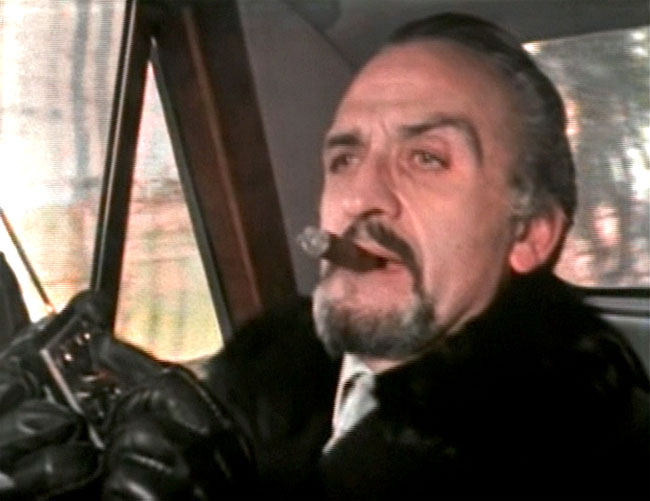
Professor Keller unmasks himself (literally).  It is The Master (Roger Delgado), plotting a wild scheme for world domination.  UNIT has been placed in charge of destroying The Thunderbolt, a missile so dangerous it has been universally banned and will be destroyed.  He will take it and use it for blackmail, and failing that, launch it at the Peace Conference and start a world war.  The Master takes advantage of a situation at Strangmoor: a riot where the next person up for the Keller Process, Mailer (William Marlowe) attempts an escape but only manages to take over the prison, taking Jo as a hostage.

The Master offers Mailer a chance to escape with a fortune if he helps him use the prisoners as a private army to seize the Thunderbolt and use it against his enemies, especially the Doctor.  The prison changes hands repeatedly: Jo manages to start a counter-revolution and the guards briefly retake Strangmoor until the Master leads the counter-counter-revolution.  The Doctor is now forced to help the Master, especially since the Keller Machine (which contains a parasite that uses a person's greatest fear to kill them) is growing out of control.  It soon takes a life of its own, moving at will and apparently killing at will too.

The Brigadier learns the Thunderbolt has been taken and mistakenly believes the Master took it to Strangmoor.  Leading a daring raid, he retakes the prison (saving the Doctor and Jo in the process) but discovers through Captain Yates, who was taken prisoner, that it is being stored in a warehouse not far.  The Doctor makes a bargain with the Master: the missile in exchange for the dematerialization unit he took from the Master's TARDIS in their last encounter.  The Master agrees.  Barnham is brought along with the machine because he no longer has evil impulses and thus the machine has no power over him.  However, in the chaos of the confrontation between the Master and the Doctor the machine, the Thunderbolt, and Barnham are all destroyed.

Worse still, the Master has managed to recover his dematerializing unit, while the Doctor is still stuck on Earth in his forced exile on orders of the Time Lords.

The Mind of Evil is a rarity in that it is one of a handful of non-Dalek stories where at six episodes, it does not feel stretched out.  In fact, every ending works, leading to a more and more exciting conclusion.  Even the fact that we had few settings (Strangmoor dominated the story) and that the Peace Conference was basically forgotten by Episode Three does not hamper The Mind of Evil one bit.

Screenwriter Doug Houghton had some brilliant ideas within the story.  Chief among them was to keep the Doctor, the Master, and Jo basically separated for almost half of the story.  It allows for the Doctor to solve this mystery of who is behind the Keller Process and the attacks at the delegates, for the Master's scheme to be exposed, and for Jo to take a more proactive stance.

Certainly Katy Manning is in top for in The Mind of Evil.  She is not the sweet-but-dim Companion she was in danger of becoming.  Instead, she comes across as a kind person (she is hit especially hard by Barnham's death) but we also see that she is unafraid.  Without the Doctor to help her in any way, she uses her wits and inner strength to literally kick-start the short-lived retaking of Strangmoor from Mailer and his lot.  What we see in Jo Grant is a girl who is strong, brave, and endearing. 

It is also a great showcase for Courtney, who is allowed a bit of humor when in Episode Five he goes for a Cockney accent when masquerading as a lorry driver.  Courtney and Pertwee work so well together, allowing for great humor to lighten up a series of killings.  When the Doctor is taken to see the Chinese delegate, someone mentions the delegate speaks a specific Chinese language.  Referring to the ethnic group, the Doctor says, "So he's Hokkien," the Doctor states.  "No, he's Chinese," the Brigadier replies.  As usual, the Brigadier missed the point of the Doctor's comment, making him both a bit thickheaded but endearing.

Courtney and Pertwee show how great a duo they make when in a tense opening to Episode Six, we find it is the Brigadier who saves the Doctor from Mailer's gun.  "Thank you very much, Brigadier," the Doctor says, then adds snappishly, "but do you think for once you can come BEFORE the nick of time?"  The unflappable Brigadier merely looks on and says, "Good to see you again, Doctor."  Here we see how strong and deep their relationship is.

As for the Doctor and the Master, we get a master class in performing.  Pertwee gives the Doctor a full range of emotions: he is light when arriving at the prison, serious when he sees what he believes to be wrong, terror when the machine attacks him, respect when speaking to the Chinese, and a whiff of anger when he realizes the Master can get away while he can't.  Delgado makes the Master a calm, cool, elegant figure, a worthy adversary to the Doctor.  However, we are allowed to see under the veneer of suave calm there is a deeply frightened figure. 


Nothing captures this more than when we are shown the Master's greatest fear.  Each person who has come under the power of the Keller Machine dies by what they fear the most.  For one, it was rats, and another, water.  The Doctor is almost killed when he relives the horror of an exploding world (flashbacks to Inferno).  As for the Master?  His greatest horror is The Doctor Laughing Triumphantly over him. 

Director Timothy Combe has some simply brilliant moments in Mind of Evil.  Granted, the special effects on Classic Doctor Who were never the most avant-garde or lavish, but Combe did wonders with what he had.  The Keller Machine's power of disorientation is done with distorted images and twisted camera work.  There is a beautiful transition from the Doctor to the Master in Episode Four that is astonishing.  Dudley Simpson's score is in turns chilling and exciting.

If there were anything to quibble over it is that yes, some of the special effects are noticeably bad.  The Thunderbolt's appearance is so patently blue/green screen it doesn't even match.  The 'Dragon' that appears in Episode Three is similarly laughable, so much so that its appearance is cut down considerably so as to not draw attention to how fake it is. 

I would also argue that the whole 'parasite inside the machine' bit never worked for me.  It didn't go anywhere and I would have preferred that the Keller Machine just be the Master's own creation that spun wildly out of his control. 

Finally, it should be mentioned that the restoration work on The Mind of Evil is simply brilliant.  The Mind of Evil was virtually lost, and while filmed in color only black-and-white copies existed.  However, the colorization process was worth the wait and release delay, as I was completely unaware that it was not the original print I was watching, but instead a painstaking restoration.  The story simply never looked better.

Minus a few hiccups The Mind of Evil gives one a worthy villain, an exciting series of episodes, and some fine bits of acting and action.  Combining this with great music and camera work we find that in the final analysis, this is indeed a beautiful Mind

Honestly, Jo, who'd think I'D "talk Baby" or 'Horse',
let alone hop up and down
screaming about a 'Golden Ticket'?


9/10

Next Story: The Claws of Axos

Tuesday, December 31, 2013

The Matt Smith Autopsy

I lost count of Who I Am,
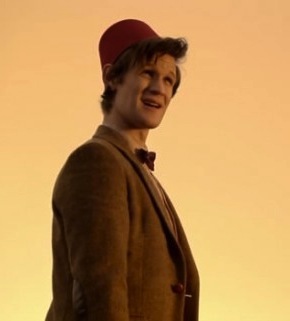
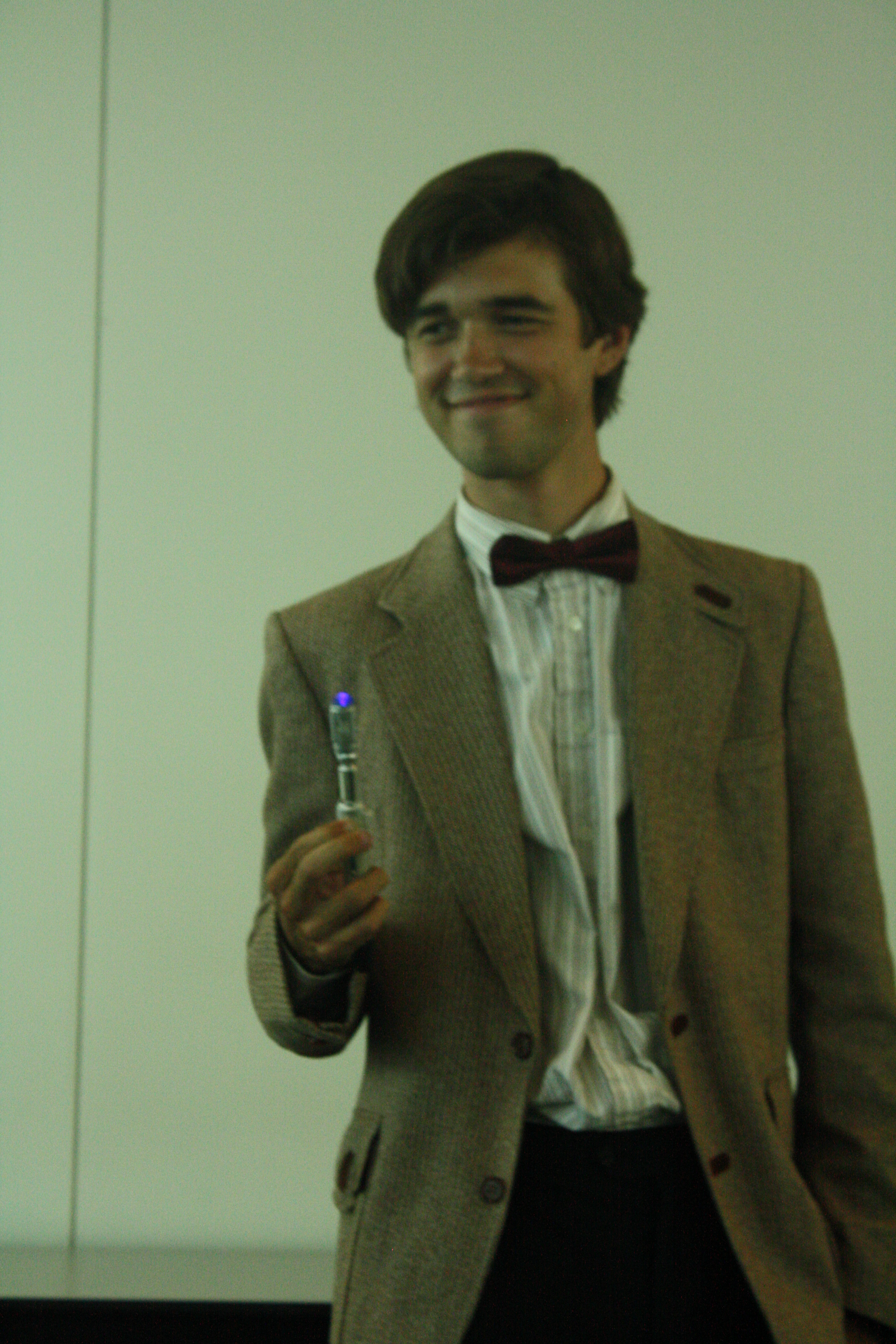
but focus on the fez.

Steven Moffat never had a 'Master Plan' for Doctor Who.

A 'master plan' suggest that something will be long, but that it's been worked out, step by step, and that at its conclusion you can follow the clues to the same conclusion presented.

That isn't Doctor Who.

Moffat's three years as showrunner on Doctor Who show that he doesn't just make things up as he goes along.  He just makes things up.

If there were a 'master plan', there would be cohesion, continuity, and consistency in Doctor Who.  There just isn't, no matter how hard the Moffia (his fans, those who think every word he writes either for Doctor Who or Sherlock is holy writ) insists.

A fool will always find
a greater fool to admire him...

Weeping Angels die if they look upon each other (Blink).
Weeping Angels DON'T die if they look upon each other (The Time of Angels).
Weeping Angels die AGAIN if they look upon each other (The Time of The Doctor).

Little Amelia is left waiting for The Doctor all night, and he doesn't come back until many years later (The Eleventh Hour).

Little Amelia is left waiting for The Doctor all night, but he does come back in the morning to tell her of all the adventures she will have (The Angels Take Manhattan).

And I won't even get into the Many Deaths of Rory What's-His-Name (Williams?  Pond?  Pond-Williams?  Williams-Pond?).

When you can't even keep a character's last name straight, you can't claim a 'master plan'. 

It isn't just that Doctor Who under Moffat has had no sense of continuity within the three seasons he's been in charge.  However, that isn't to say that isn't one of the major problems Doctor Who has.  Story threads that are given are never answered.  It's been two episodes since The Name of The Doctor and I'm STILL waiting to find out exactly HOW the Doctor and Clara got out of his timestream in Trenzalore and get back to Merry Olde England in The Day of The Doctor.   I have a sense that such questions will never be answered, because all Moffat Era stories (not just ones penned by him, but by his minions) rush through things without seeing a need to answer points of logic.

Take the end of The Crimson Horror.  Here, we see the two annoying children present Clara with evidence of her past adventures as perhaps the Doctor's first part-time Companion (has she ever really travelled in the TARDIS in two consecutive stories, I wonder).  Among the bits she is shown is a photograph of herself aboard the Soviet submarine from Cold War.  When I saw that, all I could ask was, 'who was taking pictures inside what I thought was a secret submarine?'  I don't think stories are meant to provoke such questions.

The photograph thing is also something I wondered about while watching The Day of The Doctor.  Just how did UNIT get pictures of people they neither worked with or who were technically both not yet born and already dead by the time the Zygons were making their play for Earth?

If that is perhaps being nitpicky, let us briefly look over how Doctor Who casually either ignores or flat-out erases Canon from both the Classic and even NuWho Eras.  In The Trial of a Time Lord season, we were introduced to the villain of The Valeyard, the amalgamation of the Doctor's dark side that comes between his twelfth and final regeneration.  That being the case, the Valeyard should have been somewhere in the last season once The Time of The Doctor established that Smith is technically the Thirteenth Doctor.  However, that did not happen. 

I'm sure a convoluted answer can be provided how something introduced in Canon in 1986 was ignored in 2013.  However, the easiest answer is almost always the best, so here it is: NuWho fans who know nothing of anything that came before Rose simply hadn't heard of the Valeyard so it was easy to ignore and dismiss pre-Rose Canon for their benefit.


Kind of a drag...
In regards to NuWho, it is amazing how things change from one producer to another.  When David Tennant's Tenth Doctor had an abortive regeneration in Journey's End Parts I & II (The Stolen Earth/Journey's End), we were told by Russell T Davies that it was not, repeat, NOT an actual regeneration.  Now, with Davies' successor Steven Moffat, we are told that it WAS an actual regeneration.  Even worse, with the introduction of John Hurt's 'War Doctor', the entire numbering that had been pretty much undisturbed since 1966 was thrown completely out of whack.  Still, despite what really is an exercise in nonsense is dismissed by the Moffia.  When we were told Ninth was still Ninth, Tenth still Tenth, and Eleventh still Eleventh the Moffia went through all sorts of contortions to show how Hurt's 'War Doctor' was not an actual regeneration (despite all evidence to the contrary). 

Now that Moffat has reversed course, enshrining it in The Time of The Doctor, the Moffia now say that Matt Smith is somehow bizarrely still The Eleventh Doctor but the Thirteenth Form of the Doctor (as The Nerdist put it). 

As a side note, The Nerdist is basically a whore for Moffat.  Chris Hardwick has metaphorically rimmed Moffat so often he ought to have 'Moffat's Bitch' tattooed on his forehead.  The Nerdist, which insists is the repository of all things nerd/geek-related, knows which side of its bread is buttered, and it will never contradict any proclamations 'The Moff' makes regardless of how contradictory or illogical it may be. 

Yet I digress.  Doctor Who now, if we go step by step, story by story, is a collection of illogical bombast where every episode sets fans crying.  I truly am amazed how much time NuWhovians spend crying over Doctor Who episodes.  It's getting to where a single Doctor Who story causes more tears than Schindler's List, Casablanca, and It's A Wonderful Life combined.  Honestly, the only time I remember coming close to crying at a Doctor Who story was at the final episode of Planet of the Spiders, but at least then we had two things that are missing from NuWho: genuine acting and stillness to which to appreciate it.  No sappy/loud Murray Gold music needed to play for Elisabeth Sladen and Jon Pertwee, just solid acting and great dialogue.  It must be the quietest regeneration in all of Doctor Who, and I think still the best precisely because it was so still, so soft. 

You know, Jon Pertwee always HATED
silly costumes, feeling they diminished the Doctor's authority.
Then again, what would Jon Pertwee know about being The Doctor?

As I look at the Matt Smith Era, I am filled with such a sense of disappointment.  I started out liking Smith as the Eleventh Doctor, but by The Vampires of Venice my enthusiasm began to waver.  Once we got into Doctor Who as River Song & Friends with Special Guest The Doctor, things started sliding downhill.  Now, with his tenure as the Eleventh/Thirteenth Doctor at an end, I find that the stories have been abysmal.  Part of the problem is the writing.  Moffat is blessed with having the Moffia.

Moffat never needs to provide answers.  He knows that the Moffia will either never ask questions or will repeat like robots any answer 'The Moff' gives, no matter how illogical or ridiculous.  If confronted The Moff and his Minions will dismiss it all with a 'they are too stupid to understand the intricacies of it all' rather than actually answer the objections. 

The stories, particularly this last season, have been lousy.  The average score for the Eleventh/Thirteenth Doctor has been a dismal 3.  By comparison, only three Classic Who stories so far (The Gunfighters, The Web Planet, and The Dominators) have scored lower.  The fact that only three Classic Who stories earned a lower score than an average Eleventh/Thirteenth Doctor story says something about where the series is at.

I'm sorry.  I'm so sorry.

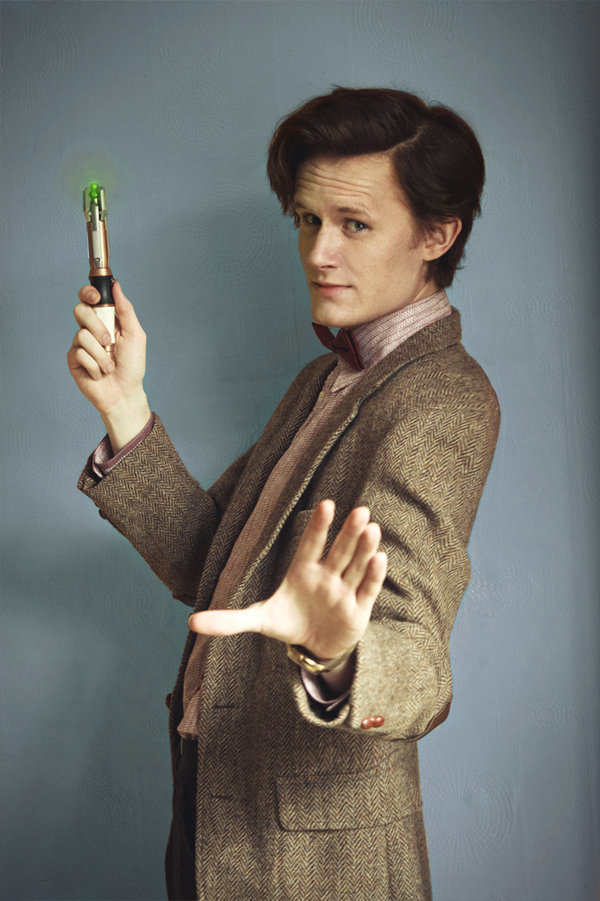
A part of the problem in the Smith Era has also been Smith himself.  His interpretation has been described as 'child-like'.  I take objection to that description.  The Eleventh/Thirteenth Doctor is actually an idiot.  His era has been built on little catchphrases ("XYZ are cool", "Geronimo!") and randomly bizarre behavior.  He appears nude for no reason.  He uses his handy-dandy sonic screwdriver to where it becomes a virtual magic wand.  He waves his hands more than he does his handy-dandy sonic screwdriver and does some really nutty things, like insist Santa Claus is real and named 'Geoff'. 

Smith has become highly popular, especially in America, but that popularity I think stems from the fact that he has turned the Doctor from a heroic figure people of all ages can rely on to save the day to a gibbering nutjob who hops up and down screaming about his 'Golden Ticket'.  A successful lead character has to have a sense of authority.  This is why Benedict Cumberbatch's Sherlock Holmes or Patrick Stewart's Jean-Luc Picard have been successful.  They can be odd, goofy, even comic, but they still have a sense of gravity to them.  Smith quickly threw that out the window with his take on the Doctor as this bumbling half-wit who did the worst thing possible...defer to other characters.

Take River Song.  When she 'landed' the TARDIS without the familiar whooshing sound, she remarked that the TARDIS wasn't suppose to do that, that he 'left the parking brake on'.  Never mind that all other TARDISes we've seen in the show's history (the Meddling Monk, the Master, the Rani) all made that whooshing sound.  Never mind that people who could operate the TARDIS better than the Doctor (his granddaughter Susan Foreman or the Time Lord Companion Romana, whom I discovered some 'Whovians have never heard of) kept that whooshing sound.  By this little bit of dialogue, Moffat and Smith diminish the Doctor.  Worse, the Doctor, rather than reply that River is wrong, merely says that he likes that sound, showing that River is right and the Doctor, the lead character, is wrong.

It isn't just with River that he cedes power.  The new main character has been the same-sex bestiality of Silurian Madame Vastra and Jenny Flint.  Since when do others rescue the Doctor? 

For myself, I am so glad Matt Smith is going.  He was in no way my favorite Doctor.  I truly don't have a favorite Doctor.  My view has always been that of the Brigadier, "Wonderful fellow.  All of them".

All of them...except Matt Smith.

Finally, if Peter Capaldi (the Twelfth/Fourteenth/First Doctor of a New Regeneration Cycle) is not allowed to make the Doctor the daring and dashing wise man, if he is made to basically do Matt Smith's Doctor, Doctor Who may please NuWhovians/the Moffia who are easily pleased, but both Classic Whovians and average run-of-the-mill viewers will reject the show and it may continue to make money but the quality, the intelligence of some truly great stories from the past, will be forever gone. 

Doctor Who will appeal only to those like the person I sat next to at the Day of The Doctor screening, who said, "It's not suppose to make sense.  It's British!"

CLEAN UP THIS MESS, MOFFAT!!!

Friday, December 27, 2013

Always Christmas, Never Logical

 
STORY 244: THE TIME OF THE DOCTOR

With The Time of The Doctor, at least two things are certain.  One, this 'trilogy' (The Name/Day/Time of The Doctor), or as I call it, 'the lazy way to title stories' has finally come to an end.  Two, Matt Smith's Eleventh Doctor is No More. 

Put this under the 'thank God for small favors' department. 

The Time of The Doctor is simply not just a mess, not even a disaster.  It's a chaotic, insulting and crushing end to simply the worst Doctor in the series' history, one that even he did not deserve.

A message is being sent throughout space from a mysterious planet.  This planet is surrounded by all sorts of aliens, and the Doctor (Matt Smith), with the aid of a Cyberman head he calls 'Handles' (Kayvan Novak) attempts to find out what the planet and the message is.  There is a quarantine on the planet which even the TARDIS cannot break through.  Wouldn't you know it, at this exact time Clara Oswald (Jenna-Louise Coleman...I still use the 'Louise') is in need of a boyfriend for Christmas, having invented one to her family.

Side note: I thought only closeted lesbians were in need of 'inventing boyfriends' to their families.  Not that, if the dialogue is to be believed, the Doctor has 'invented a boyfriend' himself, though I think he means android, at least I think that's what he meant.  Hard to say given the same-sex bestiality of Madame Vastra and Jenny.  In any case, I digress.

When he arrives, Clara rushes into the TARDIS to see the Doctor completely naked!  Why is he naked?  Because he's going to Church.  Why does he seem oblivious to the fact that he is complete nude in front of anyone, let alone a woman?  Well, in a nutshell, it's because the Eleventh Doctor is either a total idiot or clinically insane, not a quirky insane, but in a 'posing a danger to himself and others' insane.  The Doctor and Clara hop between her family (who are at the very least puzzled as to why Clara's 'boyfriend' is to them completely naked but to Clara fully dressed) and the TARDIS. Handles now identifies this planet.

It is Gallifrey, The Doctor's lost world.

The Doctor refuses to accept it is Gallifrey (despite having set as his goal in The Day of The Doctor to search for his home world, a mere month ago).   Now they encounter the Papal Mainframe, the first ship that arrived on 'Gallifrey' and which put the quarantine and can get them through it.  Tasha Lem (Orla Brady), the Mother Superious, beckons them enter (which does require them to appear nude, though we are spared more actual nudity).


He really didn't need to reveal all...
Tasha Lem, carrying on a River Song-like flirtation that actually is creepier than anything Song and Eleven ever got up to, informs him that this mysterious message brings fear due to no one knowing what it actually is.  Not as much fear as Clara has when encountering the Silence for the first time.  Tasha sends Clara and the Doctor down to the planet, where a town exists.  There be dangers on the surface, like Weeping Angels that temporary threaten them, that is until he magically gets the TARDIS to sweep them away (and we learn, the Doctor is naked again, this time it's his bald head that's exposed.  He got bored one day and shaved it off.  Rational thing to do, right?).

The signal comes from a clock tower on this planet in this town. Here, no one can tell a lie due to a truth field, here in this town called Christmas.  Yes, Virginia, the town is called 'Christmas'.   The clock tower reveals all: the crack in time we first encountered in The Eleventh Hour and which reveal a shocking secret.  The message in Gallifreyan is decoded.  The Message is "Doctor Who?"  Sadly, Handles analysis broadcasts the Question to every ship waiting out above this mysterious planet.  He also learns the name of the planet with the town called Christmas.

It is Trenzalore, where he is destined to die.  Moreover, should he reveal his name (and given the truth field, he has no choice), the Time Lords will emerge and the Time War begin again.

Decisions, decisions.

The kick is good...
The Doctor sends Clara to the TARDIS, ostensibly to help but to try to send her to Earth and safety.  She, however, will not be denied, and hangs on to the TARDIS as it begins to dematerialize.  With him refusing to speak his name, the Doctor now will protect Christmas and Shan declares that 'silence will fall'. 

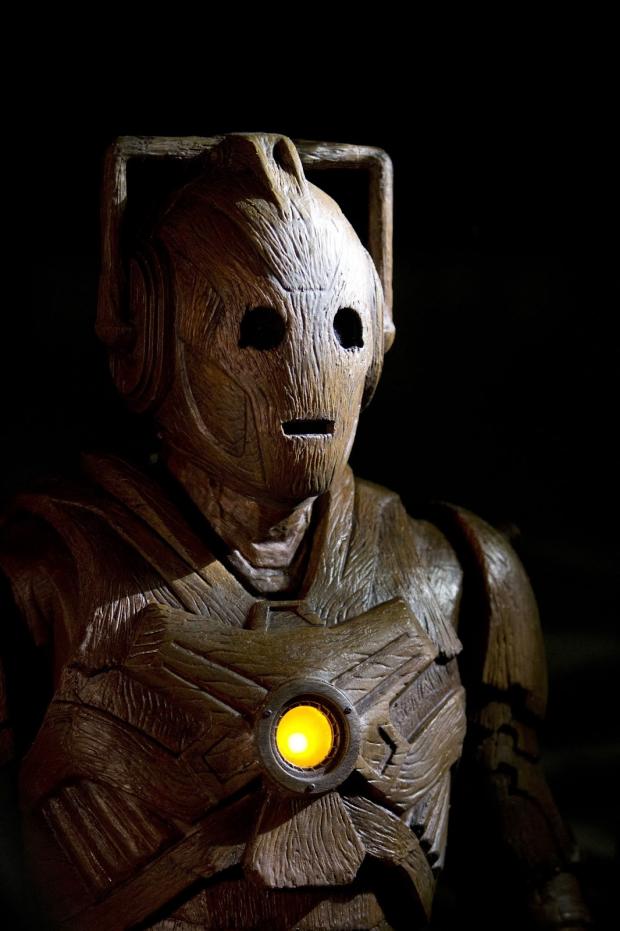
All sorts of aliens manage to get through: Sontarans, Weeping Angels, even a wooden Cybermen, a wooden Cyberman who unleashes fire.  The Doctor defeats them all as he grows older.  After a 300 year wait on Trenzalore, Clara and the TARDIS finally get back to Christmas.  The Doctor takes Clara up to the clock tower to see the brief Christmas sunrise but Wilson, I mean Handles, finally breaks down.  We also learn that rather than being the Eleventh Doctor, he is actually the Thirteenth.  The 'War Doctor' was Regeneration Number 9, and whom we once thought the Tenth actually was the Eleventh AND Twelfth, his quasi-regeneration in Journey's End Parts I and II (The Stolen Earth/Journey's End) counting.  Hence, he who was once the Eleventh is now (by Moffian fiat) the Thirteenth and final Doctor, having come to the end of his regeneration cycle and thus doomed to die permanently. 

In what must have been yet another confab with Tasha Lem, we learn that those aboard, like the Silence and even Tasha are actually dead and basically Daleks in drag.  Despite Tasha saying that she is dead, Tasha somehow pushes the Dalek within her back long enough to kill the other Daleks and allow the Doctor and Clara a chance to escape.

And finish cooking the Christmas turkey they put in the TARDIS console. 

Despite his promise to never send her away again, the bird literally ends up holding the bird when he dumps her back at her parents...again! 

Guess Clara doesn't get the hint that the Doctor is just not that into her.

Now there is all-out war on Trenzalore where all the Doctor's enemies battle it out in Christmas, with only the Daleks left rolling to fight the Church of the Mainframe.   Clara is at home with her family at Christmas, moping over the Doctor (as all women are apt to do).  Fortunately, the TARDIS materializes and she whisks herself off yet again, to see Tasha Lem piloting the TARDIS!

In the Battle of Christmas, Clara beholds a decrepit Doctor, sitting in front of the crack.  The Daleks demand he emerge, and he shuffles up the clock tower, deciding to sacrifice himself and meet his final end.  Clara, however, goes to the crack in the wall, pleading with the Time Lords to spare him, telling them his name is "The Doctor".  From the sky the crack emerges and sends out regenerative energy, which allows him to have such power that he literally blows up the Dalek mothership with the regeneration energy.

The Doctor, now restored to his younger self, bids farewell to both Clara and a vision of Amy Pond (Karen Gillan), and then a quick facelift.  The new Doctor (Peter Capaldi) comments about how he doesn't like his kidneys colors before asking an incredulous Clara one question: "Do you happen to know how to fly this thing?"    

Geronimus Idiotus...

The Time of The Doctor is the perfect embodiment of what the Matt Smith/Steven Moffat Era has been to Doctor Who: a massive pile of shit.  The Time of The Doctor is the After Earth of Doctor Who: a hopelessly idiotic vanity project that fails spectacularly to achieve anything good but is an embarrassment to all involved. 

The best example of how The Time of The Doctor is a vanity project for writer/showrunner Steven Moffat is when Tasha Lem informs the Doctor of the breakaway sect that "engineered a psychopath to kill you".  His reply?  "Totally married her.  I'd never have made it here alive without River Song".  Song has been extremely divisive: some think her as this great Doctor Who icon, some see her as a monstrous character.  I fall squarely in the latter, detesting her ever since I saw her, not in Forest in the Library Parts I & II (Silence in the Library/Forest of the Dead) but in The Time of Angels Parts I & II (The Time of Angels/Flesh and Bone).  With little bit of dialogue, Moffat sticks it to the River-haters by having the Doctor credit her with being vital to his life.  He even manages to go one more, by throwing in Tasha Lem, a River Song clone in all but name.

Tasha and River are cut from the same cloth, so much so that even the most casual Doctor Who viewer cannot miss the parallels between them.  Both carry this oddly flirtatious, almost brazenly sexual banter with the Doctor.  Both basically attempt to have sex with the Doctor (and the Doctor appearing both pleased and a bit frightened, like a virgin in Reno).  Both apparently can fly the TARDIS, something once reserved exclusively for Time Lords (The Doctor, his granddaughter, Romana, and the Doctor's Time Lord enemies like the Meddling Monk, the Master, and the Rani).  We can even thrown in the fact that technically, both are dead.

However, having seen The Time of The Doctor twice now, I am astonished that, even given the low IQ of the NuWhovian, the ridiculous plot holes and questions The Time of The Doctor has are not questioned by them. 

Trenzalore has an impenetrable shield...that the Weeping Angels could get through.  The Doctor picks up a Cyberman head that acts like a cross between the Angels in Voyage of the Damned and K-9 exactly why?  He couldn't find information the old-fashioned way...Wikipedia?  WHY is there a town called Christmas where apparently it always snows and people dress like they all came from Scandinavia?

I'm bald now.  Baldness Is Cool...

When Clara sensibly asks how can a town be called Christmas, the Doctor rapidly replies, "How an island be called Easter?"

I'll field that question.  Easter Island, or Rapa Nui as the inhabitants call it, was sighted by Europeans on Easter morning 1722 and thus christened 'Easter Island'.  The ball is in your court, Moff. 

Again and again Moffat shows either his contempt or his shockingly lack of coherent storytelling by putting things in that make no sense in the first place, then never bothering to answer things. 

Tasha Lem can fly the TARDIS?  How?  The Daleks have taken over the Papal Mainframe and are masquerading as Tasha Lem or the Silence.  How then can the Dalek-as-Silence continue to have the power to make people forget?  Moreover, is Tasha actually dead or alive? 

The answer to that one must be that Tasha Lem, River Song substitute, is alive OR dead depending on Moffat's whim.  If she is dead, and the Dalek inside her controlling her, how can a dead person come back to life to kill off the other Daleks and save the Doctor and Clara?  How does a dead person be conscious of the fact that, as she put it, "The Dalek inside me is waking".

I confess to bursting out laughing at this particular line.  "The Dalek inside me is waking."  I thought I'd heard all sorts of idiotic things on Doctor Who these past few years: "Bow ties/fezzes/Stetsons are cool", "Hello sweetie", "Spoilers", "I blew'em up with love", but "The Dalek inside me is waking" certainly ranks up there with being astonishing in its idiocy.

Moffat tries to get the emotions going with characters like Barnable (Jack Hollington), this 'adorable' little boy from Christmas who looks up to The Doctor, or with Handles, the head of a Cyberman.  However, we can't feel for these characters because there is no actual connection between the Doctor and anyone else apart from Clara.  Throwing in an 'adorable' little boy does not equate having a relationship between the two of them that we can feel anything for or about.  Given Barnacle and the Doctor were never shown building a lifelong relationship or indicating anything other than misguided hero worship I as a viewer couldn't care less about little Barnacle.

Even worse is Handles (typical idiotic nickname).  Despite Murray Gold's score trying desperately to pull at my heartstrings, I cannot bring myself to cry over a metal head finally wearing down.  At least with Castaway's Wilson (the most obvious inspiration), there was a connection between Tom Hanks and the volleyball through Hanks' interaction with it.  Try, try, try, anyone crying over Handles (and I imagine quite a few NuWhovians did), I found the whole thing dragging. 

As a side note, shouldn't Murray Gold just retire and give the music to someone else? 

Moffat also throws things in for the spectacle of the thing, but never bothers to answer the questions he poses.  I've already mentioned some things that don't make sense, but let's throw in some more.  The subplot with the Oswalds is irrelevant to The Time of The Doctor.  Let's leave aside how derivative this whole thing is of Bad Wolf Parts I & II (Bad Wolf/The Parting of the Ways), right down to how the Doctor tricked Rose...I mean, Clara...into going in the TARDIS and back to Earth only to have her rescue him.  Let's also leave aside how Clara pleading with the Time Lords to save the Doctor is reminiscent to Martha's "I DO believe in Doctors, I DO, I DO!" business in Vengeance of the Master Part III (The Last of the Time Lords).

What true purpose did the Oswalds play in the story?  They popped in at the beginning to showcase bad comedy, and then near the end to do what, exactly?  Given the Oswalds, unlike the Tylers, the Moffs-Nobles, or even the Ponds/Williamses, were never part of Doctor Who, why bother throwing them in now?

What The Time of The Doctor really was was a showcase to show off Matt Smith, who gives yet another overdone, overblown performance.  He couldn't resist one final monologue at the end when he defeats the Daleks ("I blew'em up with regeneration"), and there was Smith, hamming it up with gusto and lousy make-up.  He was so relishing the chance to get a spectacular send-off that poor Peter Capaldi got the shortest regeneration in the show's history (NuWho AND Classic).  Just a quick face change and voila, a new Doctor.  Whether he is now the Twelfth, Thirteenth, or even Fourteenth Doctor (thanks to another lousy deus ex machina that played like parody...the trapped Time Lords sending new regenerative powers to the Doctor after he declared Canon the "War Doctor" and the abortive Tennant regeneration being two previous regenerations) remains to be seen, but no matter how you cut it Capaldi's regeneration scene was a slap in the face to which to welcome him.


What is highly amusing to me is how NuWhovians, who did contortions that a Chinese acrobat would look at in envy, attempted to say how Smith was still the Eleventh Doctor with elaborate counting systems or that the "War Doctor" was not a real regeneration because he called himself the "War Doctor" rather than just plain Doctor; when Moffat said Smith was still the Eleventh they said the same thing. NuWhovians would also go on about how the Doctor could go past the Twelve Regeneration Rule established in The Deadly Assassin by harping about how River "gave up her remaining regenerations to the Doctor".  Now they meekly go back to their online forums to deny what they had been repeating as Scripture only a month ago in order to fit into Moffat's own nutty bastardization  of the Doctor Who world.  After enduring NuWhovian nonsense about how we, who argued that Smith couldn't be the Eleventh Doctor given the events of The Day of The Doctor (I won't even get into that quasi-regeneration business with Tennant), were all wrong, were all stupid, were all incapable of understanding the genius of "The Moff" (and by extension, theirs), now contradict themselves to keep the logical inconsistency Doctor Who stories have become.

In short, the fact that they cannot or will not grasp how nothing in this so-called The (Blank) of The Doctor trilogy makes sense on any level says more about a.) how utterly demolished Doctor Who has become under 'The Moff' and b.) how utterly inept and witless NuWho fans truly are.          


Wooden Cyberman: an oxymoron.
Time of The Doctor: from a moron. 

Let's be frank: The Time of The Doctor is nonsense from beginning to end.  Naked Doctors?  Why?  Wooden Cybermen?  Who came up with that idea?  Did the Cybemen think that a version of themselves made out of wood, complete with FLAME THROWER, made any sense?  Besides, weren't all the Cybermen destroyed in Nightmare in Silver?  Is a wooden Cyberman really a Cyberman, given Cybermen are humans who have been technically modified?  If Smith is the actual Thirteenth, where oh where did the Valeyard, the amalgamation of the Doctor's dark side who comes between the Twelfth and final regeneration go?

Oh, yes, that's from the Classic Era, and no NuWhovian (or Moffat) really care about THAT!  How is something between An Unearthly Child and Survival relevant to Doctor Who anyway? 

Brady is basically doing an Alex Kingston as River Song impersonation and the script doesn't give her anything to hold onto.  In terms desirous and enraged by the Doctor, there is no sense in why she does anything: why she admires his nude body, why she rages against his keeping Christmas safe.  Coleman continues to play Clara as a typical NuWho female Companion, one forever pining after the Doctor.  While it's good to know she went from nanny to English teacher I can't for the life of me figure out why Coleman struggles to make Clara interesting.  Smith by now has become so entrenched with his 'Doctor As Idiot' that it's not really even worth commenting on how bad he was.  The make-up and walking stick, which I figure was there in part to make his Doctor more 'distinguished' merely served to point out how weak his Doctor eventually devolved to.  No make-up in the world makes up for teaching children 'The Drunk Giraffe'.

The Time of The Doctor is a big, loud, overblown piece of trash, appealing only to people who can't be bothered to look past the pretty colors and naked bodies to see that it holds no logic within itself, let alone with its The (Blank) of The Doctor alleged trilogy, and let alone within the eight years NuWho has been on.

If Peter Capaldi is not allowed to make The Doctor a more serious, stable, rational, and intelligent hero, if he continues down the road Smith and Moffat created, then without a doubt The Time of The Doctor is up. 


What Would Pertwee Say?


1/10


Next Episode: Deep Breath

Tuesday, December 24, 2013

100 Whos, 100 Reviews


Before The Time of The Doctor premieres (and once reviewed, I would be up to 101 Doctor Who stories), I thought I'd have my rankings of all the Doctor Who stories I have reviewed.  Again, to set the ground rules: this is for all Classic Doctor Who released on DVD in the United States from the First Doctor story An Unearthly Child to the Third Doctor story Terror of the Autons except for the First Doctor story The Tenth Planet.  Also included in the rankings are the Fourth Doctor story The Sun Makers and all NuWho stories from the Ninth Doctor story Rose up to the Tenth Doctor story The Idiot's Lantern, and all Eleventh Doctor stories from The Eleventh Hour to The Day of The Doctor.

How I arrived at this list is as follows.  Every story earned a score between 1 and 10, 10 being a masterpiece, 1 being an absolute disaster.  Once they were scored, they were compared to other stories with similar scores and then determined which was 'better'.  This determination came from such things as overall story, acting, cinematography, etc.  There was also the Would I Rather Rule, as in "Would I rather watch Story A or Story B?"  If I preferred watching one over the other, it went higher. 

The listing includes both the score and the Doctor the stories featured.  Example: The Tomb of the Cybermen (10/2), means the story got a score of 10 and it was a Second Doctor story.

With that, let us move on.  In order from 1 to 100...

Num. 1: Simply the Best So Far

  1. The Tomb of the Cybemen (10/2)
  2. Spearhead From Space (10/3)
  3. The Aztecs (10/1)
  4. Inferno (10/3)
  5. The Time Meddler (10/1)
  6. Doctor Who & The Silurians (10/3)
  7. The Seeds of Death (10/2)
  8. The Mind Robber (10/2)
  9. The Evil of the Daleks (10/2)
  10. The Unquiet Dead (10/9)
  11. The Ice Warriors (10/2)
  12. Inside the Spaceship (aka The Edge of Destruction) (9/1)
  13. The Ambassadors of Death (9/3)
  14. The Romans (9/1)
  15. The Dalek Invasion of Earth (9/1)
  16. The End of the World (9/9)
  17. The Invasion (9/2)
  18. Terror of the Autons (9/3)
  19. The War Games (9/2)
  20. The Daleks (8/1)
  21. The Sun Makers (8/4)
  22. The Celestial Toymaker (8/1)
  23. The Web of Fear (8/2)
  24. Dalek (8/9)
  25. Father's Day (8/9)
  26. The Rescue (8/1)
    Num. 27: The Highest-Ranked
    Eleventh Doctor Story
  27. Cold Blood Parts I & II (The Hungry Earth/Cold Blood) (8/11) 
  28. Amy's Choice (8/11)
  29. New Earth (8/10)
  30. Rose (8/9)
  31. Night Terrors (8/11)
  32. The Krotons (8/2)
  33. The Eleventh Hour (8/11)
  34. An Unearthly Child (7/1)
  35. The Daleks' Master Plan (7/1)
  36. The Enemy of the World (7/2)
  37. The Doctor's Wife (7/11)
  38. The Underwater Menace (7/2)
  39. School Reunion (7/10)
  40. Marco Polo (7/1)
  41. The Idiot's Lantern (7/10)
  42. The Girl Who Waited (7/11)
  43. The Sensorites (7/1)
  44. Galaxy 4 (7/1)
  45. The Wheel in Space (7/2)
  46. The Empty Child Parts I & II (The Empty Child/The Doctor Dances) (6/9)
  47. The Crusade (6/1)
  48. The Christmas Invasion (6/10)
  49. The Reign of Terror (6/1) 
  50. Bad Wolf Parts I & II (Bad Wolf/The Parting of the Ways) (6/9) 
    Num. 50: Stuck in the Middle
  51. Planet of Giants (6/1)
  52. The Keys of Marinus (6/1)
  53. The Faceless Ones (6/2)
  54. The Chase (6/1)
  55. Vincent & The Doctor (6/11)
  56. The Abominable Snowmen (6/2)
  57. Victory of the Daleks (6/11)
  58. Aliens of London Parts I & II (Aliens of London/World War III) (6/9)
  59. Day of the Moon Parts I & II (The Impossible Astronaut/Day of the Moon) (6/11)
  60. The Big Bang Parts I & II (The Pandorica Opens/The Big Bang) (6/11)
  61. Tooth & Claw (5/10)
  62. The War Machines (5/1)
  63. Rise of the Cybermen Parts I & II (Rise of the Cybermen/The Age of Steel) (5/10)
  64. The Time of Angels Parts I & II (The Time of Angels/Flesh and Stone) (5/11)
  65. A Christmas Carol (5/11)
  66. The Moonbase (4/2)
  67. The Rings of Akhaten (4/11)
  68. The Space Museum (4/1)
    Num. 69: The Most Wildly
    Overrated Doctor Who Story
  69. The Girl in the Fireplace (4/10)
  70. The Gangers Parts I & II (The Rebel Flesh/The Almost People) (4/11)
  71. The Doctor, The Widow, and the Wardrobe (4/11)
  72. The Beast Below (4/11)
  73. Boom Town (4/9)
  74. Dinosaurs on a Spaceship (4/11)
  75. The Long Game (4/9)
  76. The Ark (3/1)
  77. Hide (3/11)
  78. The Crimson Horror (3/11)
  79. The Day of The Doctor (3/10-11)
  80. The Space Pirates (3/2)
  81. The Power of Three (3/11)
  82. The Name of The Doctor (3/11)
  83. The Angels Take Manhattan (3/11)
  84. The Wedding of River Song (3/11)
  85. A Town Called Mercy (3/11)
  86. The Lodger (3/11)
  87. The Gunfighters (2/1)
  88. The Bells of Saint John (2/11)
  89. Asylum of the Daleks (2/11)
  90. The Vampires of Venice (2/11)
  91. The Web Planet (2/1)
  92. Journey to the Centre of the TARDIS (2/11)
  93. The Dominators (2/2)
  94. The Snowmen (2/11)
  95. River's Secret Parts I & II (A Good Man Goes to War/Let's Kill Hitler) (2/11)
  96. Cold War (2/11)
  97. The God Complex (1/11)
  98. The Curse of the Black Spot (1/11)
  99. Nightmare in Silver (1/11)
  100. Closing Time (1/11)
Num. 100: Grotesque in Every Way

Too low?  Too high?  Did I make a mistake in ranking one story over another?  Let me know.  We have so many more stories to go, from the Third Doctor story The Mind of Evil to the Tenth Doctor story The Impossible Planet Parts I & II (The Impossible Planet/The Satan Pit) to the Eleventh Doctor story The Time of The Doctor.  I know there will be duds in the future, but there are also good stories too. 

Let us begin...