Tuesday, March 13, 2012

The Way Of All Flesh


STORY 224: THE GANGERS
PARTS 1 & 2 
(The Rebel Flesh/The Almost People)

For the longest time, I have looked upon the sixth series/season of Doctor Who with a great deal of trepidation mixed with a total lack of enthusiasm.  I find my love for the series as a whole waining terribly.  In fact, it was only the pressure of deleting items on my DVR that got me to watch the two-part story The Gangers after a very lengthy hiatus.   

It's not often I give an original title to a revived Doctor Who story, but with this one I feel that neither The Rebel Flesh or The Almost People makes for a good overall title.  Moreover, since the villains are the Gangers, I feel having the two-part story be called The Gangers makes more since. 

In any case, I saw The Gangers long after everyone else did.  After various disappointments for me this series/season (Day of the Moon Parts 1 & 2: 6/10, The Curse of the Black Spot: 2/10, and The Doctor's Wife pulling the highest score with 7/10), I somehow didn't want to watch The Gangers.  How could it be that I've gotten to a point where I, devoted Whovian, just DON'T want to watch a Doctor Who episode?  The Gangers, sadly, has not cured me of this terrible malady.

Part 1: The Rebel Flesh

A storm has forced the TARDIS to land at a monastery on Earth.  The Doctor (Matt Smith), and his Companions Amy Pond (Karen Gillan) and Rory Williams (Arthur Darvill) soon find that the monastery is really a factory.  The workers there create plastic forms of themselves, which they call Gangers (short for doppelgangers).  The head of operations, Miranda Cleaves (Raquel Cassidy) isn't happy to see them, and doesn't believe that a stronger storm will cause problems.  Neither do the other workers: Jimmy Wicks (Mark Bonner), Buzzer Edwards (Marshall Lancaster), and Jennifer 'Jen' Lucas (Sarah Smart).  The Doctor takes a quick look at the Gangers production (where his hand comes ominously close to the vat), and the storm comes.

We quickly learn the storm has released the Gangers, who resent being so easily destroyed and discarded.  As far as they are concerned, they are real, they are alive, and thus worthy of staying around.  Because they not only look like the Humans and can think like them, fighting them will be difficult.  The Doctor sympathizes with the Gangers, but the Humans want them disintegrated.  "They're monsters, mistakes.  The have to be destroyed", Miranda says. Now the battle between the revolutionary Gangers and the Humans begins, but with a new ally: a Ganger version of the Doctor emerges.

Part 2: The Almost People

Rory has become attached to Jen (both the Human and Ganger version), and soon takes their side that the Gangers should be allowed to exist.  The Doctor is thrilled to find his double, while the Gangers in their acid suits are besieging the Humans, who are planning their escape.  Amy does not trust or like the Ganger Doctor, but at least is able to unburden herself by telling the Ganger Doctor about how she saw the Gallifreyan Doctor die. 

Jen has basically gone mad: determined to wipe out the Humans and take their lives.  She pushes the other Gangers to follow her lead.  Miranda, who has a clot in her head, has already in her fear and anger killed the Ganger Jimmy, to the Doctor's intense anger.  However, Rory still thinks well of Jen, unaware of her duplicitous plan.   She shows him a pile of discarded Gangers melting together into one blob, suffering.

The Doctor manages to contact Buzzer's toddler, who is celebrating his birthday.  The Ganger Buzzer, having the same memories as the Human Buzzer, realizes that as much as he may feel he is Buzzer, he is not the child's father.  The child's real father is in danger, changing Ganger Buzzer and rescues the Humans trapped by Jen.  However, the Human Buzzer dies in the fracas, so Ganger Buzzer is given the blessing to take his place. 

As Ganger Jen goes on a rampage (having already killed Human Jen), the Gangers and Humans join forces to flee to the TARDIS.  Amy discovers that Ganger Doctor and Gallifreyan Doctor switched places, and now Ganger Doctor and Ganger Miranda stay behind to destroy Jen (which means destroying themselves).  The Doctor drops Ganger Buzzer home, takes Human Miranda and Human Jimmy to the factory headquarters to tell all, then exposes a shocking secret.

Amy is herself a Ganger, and the Doctor is forced to melt her.  The real Amy is in a white room, where the Eye Patch Lady (Frances Barber) that has been popping up left right and center tells her to push.  Amy finds that she is about to give birth..

I think that this Eye Patch Lady is this year's version of the Time Crack from last season: something that has been popping up, almost always near the end, to tie all the stories together into one epic one.  I have never warmed up to the idea that all the stories have to tie together: from Bad Wolf to the Crack in Time to the Eye Patch Lady, I sense a sense of repetition.  I didn't mind the Bad Wolf thing because there the stories can appear to act independently of each other, but during Steven Moffat's reign he has a madness of putting things into the stories in an obvious manner.  One almost waited to see the Crack come out in the end, and now the Eye Patch Lady is almost required to pop in and out real quick. 

The Gangers is that it was eerily reminiscent of Cold Blood Parts 1 & 2 (The Hungry Earth/Cold Blood).  You had two lifeforms which don't trust each other and have members in each who want to destroy the other.  You had the Doctor attempting a truce between them that would help them coexist.  You had one member of Group A killing a member of Group B out of fear.  You had the Doctor get angry.  You had that action be the spark of a full-fledged war.

I'm not saying Matthew Graham was using Cold Blood Parts 1 & 2 as a template for his script of The Gangers Parts 1 & 2.  I'm just saying that while I was watching The Gangers, I noticed it followed a similar pattern.  I could even make a case that The Gangers tackled a similar theme to Cold Blood: the idea of the right of the Other to live.  With Cold Blood, it was the Silurians.  With The Gangers, it was the Gangers themselves. 

There are some good moments in The Gangers and some good ideas.  The plea for tolerance within the story is not subtle, but it is introduced cleverly to where it doesn't overwhelm the story.  It also is nice to see Rory take a role apart from being The Doctor and Amy's stooge, the comic relief who is easily disposable (see The Many Deaths of Rory Williams in Amy's Choice, Cold Blood Part 2, The Curse of the Black Spot, and The Doctor's Wife).  Also, it was a clever idea to have the Gangers wear the acid suits, making it easier to distinguish the Gangers from the Humans.

I also thought Balazs Bolygo's cinematography was excellent: all grays to capture the night or the morning in this unforgiving terrain.  Murray Gold's score still is consistently good, and special credit should go to Barbara Southcott and her staff's make-up (given the make-up is a driving force in the story).  Director Julian Simpson evoked good scenes, in particular when we come across the sight of discarded Gangers.  That was unexpected and frightening (perhaps too frightening for children, but that's a judgment call).

However, the things I disliked about The Gangers outweigh the things I though were good.  Even though this was a two-part story, I thought Part 1 (The Rebel Flesh) was extremely rushed to get to the outbreak of chaos.  I couldn't help think about how if The Gangers were made during the classic era, we would have had more of a build-up to the eventual Ganger Spring.  We certainly would have met the characters and seen how the Doctor became to be remade as a Ganger. 

To my mind, there were no real surprises except for the end.  I knew there was going to be a Ganger Doctor (since Part 1 took pains to hint at it), I knew Ganger Jen was not alone (as big a hint as I can give without giving away something I though pretty obvious).  When Amy reveals to the Ganger Doctor she saw him die, I knew...oops, she shouldn't have done that.  A lot of the story, again despite it having two hours, felt hurried, almost like the story was stretched out to make it two episodes long, in particular Part 2 (The Almost People).  I would have though making Part 1 the Rise of the Gangers and Part 2 the Siege of the Humans would have made The Gangers far better.

Also, I was not amused by the Doctor's obvious delight at seeing himself.  The comedy between Doctor and Doctor didn't make me laugh.  Instead, they irritated me.   As for the big twist in the end, I though it was inconsistent.  The Doctor has spent the two episodes pleading for the right of the Gangers to exist, yet he at the end destroys the Ganger Amy.  What about her?  Granted, it had to be done, but still...Besides, I couldn't get how or when Amy was replaced with her doppelganger, and both the Eye Patch Lady and Amy's labor pains just appeared to come out of nowhere.  Add to that, this last scene basically overwhelmed The Gangers, making look like the entire two stories were nothing more but filler for this Big Twist. 

As a side note, I was confused by something in Part 2.  I thought I heard the Doctor call Rory "Rory Pond".  I don't know if that was accidental on the part of the character or it was written that way, but I think it captures better than anything I could write or say just how redundant Rory is...has he been reduced to being Mr. Pond rather than Amy being Mrs. Williams?  Perhaps somewhere along the way he changed his name and I just missed it.

One thing that is obvious is that now that we learned that the Ganger Doctor and the Gallifreyan Doctor switched places, the Real Doctor now knows of his upcoming death, so we know that he knows and thus we know that the Doctor will not die, at least not on Lake Silencio.  Maybe another Ganger will take his place by the lake.  If it was thought that all would be revealed, then they did their job.  Basically, Season/Series Six is now a Long Game if you will, a wait to see where the season will go even though we already know where it's headed.

The Gangers Parts 1 & 2 isn't a bad story, but I felt it was rushed, followed a similar pattern to others, and was just filler for the really BIG moment: that damn Eye Patch Lady waiting for Amy to give birth...to I wonder whom...

Rory Williams Death Count
In Episode: (Zero)
Overall: (Four)

4/10

Next Story: River's Secret Parts 1 & 2 (A Good Man Goes to War/Let's Kill Hitler)

Tuesday, November 15, 2011

Yes, Spouses Can Be A Little Ood


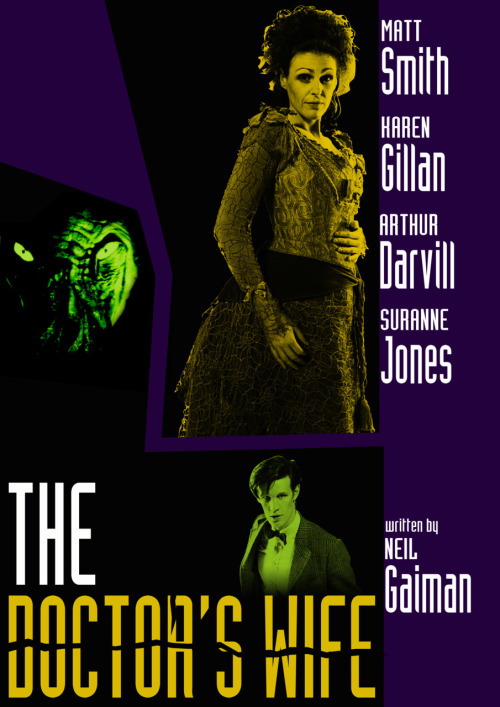
STORY 220: THE DOCTOR'S WIFE

Although the Doctor (Matt Smith) has had children and grandchildren (or at least a daughter and granddaugther), he's never had a wife...until now.   However, trust the good folks at Doctor Who to make even the simplest of things extremely complicated.  The Doctor's Wife comes from comic book/science-fiction icon Neil Gaiman, so it is bound to be good, and it is.  However, there are some things that this series simply can't get away from. 

The Doctor (Matt Smith) receives a distress signal...from a Time Lord.  He is not surprisingly thrilled...perhaps there WERE some survivors of the Time War and he is not the Last of the Time Lords.  With that, he flies the TARDIS outside the universe, to what appears to be a junkyard.  There, he encounters four beings: Auntie (Elizabeth Barrington), Uncle (Adrian Schiller), an Ood called Nephew (Paul Kasey), and a disheveled woman named Idris (Suranne Jones).  The Doctor misleads his Companions Amy Pond (Karen Gillan) and her husband Rory Williams (Arthur Darvill) into going back to the TARDIS while he seeks out The Consair, his old Gallifreyan friend.

Bad move on two points.  The Consair is truly dead, as are other Time Lords who survive only in messages within boxes.  Second, the asteroid they are on is really a living thing, called House (voiced by Michael Sheen), who lives off the energy of TARDISes (or would it be TARDI?).  With The Doctor yet again the last of the Time Lords, guess who is after the TARDIS?  As it stands, Idris is not like Auntie, Uncle, or Nephew (all who are made up of various parts, including pieces of Time Lords--lo, how the mighty have fallen), isn't like all the others.  She in truth is the TARDIS  in human form.

House has taken the TARDIS, threatening Rory and Amy.  To extend the story...I mean, to keep themselves alive, Rory and Amy challenge House to toy with them before killing them, leading to an old Doctor Who standard: running down corridors.  During the chase, Amy and Rory are continuously separated, and at one point Amy comes across what appears to be Rory's bones (this will be important later).  The Doctor and Idris, meanwhile, build a TARDIS console made up of pieces from other TARDI/TARDISes to rescue his Companions.  The Doctor and House 'meet' in the old console, and it takes Idris' sacrifice to save them.  In the coda, Rory tells the Doctor Idris' last words: "the only water in the forest is the River"...foreshadowing.  Da-da-DUM!

The Doctor's Wife has a great inventiveness to it with great nods to the whole Doctor Who mythos.  By setting the entire thing in a junkyard, it is highly reminiscent of the very first Doctor Who story An Unearthly Child.  Whether Gaiman also threw in a nod to the Doctor Who cliche of having people running down the same corridors I do not know, but seeing Rory and Amy doing just that evokes memories of that. 

The story is also highly creative in giving a Doctor Who icon a voice for a very first time.  In all the years of Doctor Who, we've never considered the TARDIS (with a few exceptions) as anything more than a mode of transportation.  With The Doctor's Wife, we now see the breath of the TARDIS' power.  Gaiman's script also has a great deal of humor that never comes at the expense of the tragedy or horror of the story.  The Doctor tells Idris, for example, to send a telepathic message to "the pretty one".  Not surprisingly, she would pick Rory as "the pretty one" (Idris being a woman, she WOULD pick Rory to be the 'pretty one').   There is even a quick joke about Smith's chin.

Part of the success of The Doctor's Wife comes from the performances, in particular Jones' as the manic, almost looney Idris (side note: Gaiman's script has great wit in the names.  Idris, TARDIS--how close they are, right?).  In her quirky, somewhat nutty interpretation of Idris, she appears to be mimicking Smith's Doctor in his oddity, rapid movements, and generally quirky behavior.  I keep flipping on Matt Smith: sometimes I love his interpretation of the Doctor, sometimes he annoys me in his twittering mannerism.  It depends I suppose on the story.  In The Doctor's Wife, Smith balances his usual wild take on the Doctor with a genuine heartbreak at how the Time Lords yet again have disappeared from his world. 

Another strong performance comes from Sheen (whom I generally love as an actor except in the Twilight films, where I found he made his 'vamp' camp).  To his immense credit, he has only his voice to work with as House, and he could evoke menace with the proper inflection without making House a raging lunatic.

There are many great things in The Doctor's Wife, but some things I objected to greatly.  Chief among them is a throwaway line.  When the Doctor was telling them about the tattoo the Consair always had at every regeneration, he said the Consair had it whenever himself, 'or herself, a couple of times', regenerated.  That would appear to establish that Time Lords can change genders, and this kind of dialogue is dangerous business.  Recall The Deadly Assassin: a simple line established that Time Lords regenerate only twelve times, and now we have that as established mythology.  With this, we now have a situation that might appeal to fans (oh, the Doctor can be a woman, Romana can be a man), but we have something I don't think people think out: Time Lords, apparently, are now hermaphrodites. 

I have long argued that Time Lords are single sex beings: a male Time Lord will always be a male Time Lord, a female Time Lord will always be a female Time Lord.  By having Time Lords be either, we have this situation where the control of their regeneration is completely in their hands.  That being the case, if the Doctor regenerates as a man, it's because he wants to.  Therefore, why hasn't he simply regenerated with ginger hair, seeing he wants it so much?  Furthermore, we can't have things thrown at us and quickly forgotten.  The TARDIS still makes the 'whoosing' sound, even though the Legendary Legend of Legendness, DOCTOR RIVER SONG (who mercifully isn't in this episode), already established that the sound is only made because the Doctor parks the TARDIS without taking out the brake.  It wasn't funny then, it isn't funny now (and I would have thought Idris would have told him how much that hurts her...if it were a real thing and not just a cheap joke).

Granted, this may all be a bit nitpicky, but why shouldn't I take writers and producers to task for such things?

I also thought House wasn't all that powerful of an adversary.  He devoured TARDI for his own power beyond the universe (side note: it did make me think of E-Space, but I digress) but he didn't really have as strong an impact as other monsters (though having the asteroid as the living thing was a stroke of genius).  The presence of the Ood wasn't all that important: Nephew could have been any creature if one thinks on it.

Finally, I'm instituting the Official Rory Williams Death Count.  This simple service will keep track of the number of times Mr. Amelia Pond has died on screen, both in the individual episode and the series as a whole.  Here is where we have a question: did Rory Die Again?  This could go either way: we didn't see him die (unlike all the other times) but Amy did come across a corpse that we took to be Rory.  It was all done so quickly I'm almost tempted to not count it as an official Rory Williams Death because this was the first time he didn't actually die on screen.  However, given how we're suppose to believe that the bones Amy comes across are suppose to be Rory, I'll have to count it as yet another example of how poor Rory never seems to complete a series/season without kicking the bucket. 

Side note: I'd love to see a scene where Rory literally kicks a bucket.  Might as well have more jokes on his perpensity to drop dead every few episodes. 

The Doctor's Wife is one of the best episodes of Series/Season Six, one with a good mix of horror and humor.  However, I can't overlook a few things, especially how it gave me hope there were still some Time Lords only to rip that from me almost as quickly.  "You gave me hope and then you took it away.  That's enought to make anyone dangerous," the Doctor tells Auntie and Uncle on discovering that his fellow Time Lords were being used for spare parts.  I couldn't have found a better way of describing the revived series myself.

Rory Williams Death Count


In episode (ONE)
Overall (FOUR)

7/10

NEXT STORY: The Gangers Parts 1 & 2 (The Rebel Flesh/The Almost People)

Tuesday, November 8, 2011

Doctor Who Story 033: The Moonbase

STORY 033: THE MOONBASE

Half-Moon...

The Moonbase is the earliest Second Doctor story that can be reconstructed.  His first two adventures, The Power of the Daleks and The Highlanders, have no surviving episodes and only some clips.  The third Second Doctor story, The Underwater Menace, has only one complete episode.  The Moonbase, a four-part story, has two complete episodes, and with the audio of Episodes One and Three you can build the entire story around the surviving material.  Just like The Crusade, we therefore can reconstruct The Moonbase and review it as a complete story rather than as bits and pieces.  While I hope that we will one day get an official reconstruction of The Moonbase, and while this story has the bonus of being the return of the Cybermen, The Moonbase itself falls a little short of expectations. 

The Doctor (Patrick Troughton), his Companions Ben (Michael Craze) and Polly (Annek Wills) and the Highlander Jamie McCrimmon (Fraser Hines), have landed on the Moon.  The Companions want to explore the Moon, and the Doctor reluctantly agrees.  Jamie is injured, but fortunately there is a base on the moon.  Here, a group of scientists are controlling the Gravitron, which controls the weather on Earth.  The moonbase is run by Hobson (Patrick Barr), who is highly suspicious of the new arrivals, but accepts them thinking that the Doctor is the doctor Earth is sending to try and find why so many of his crew are starting to fall ill.

Jamie is placed in sick bay and while there, continues to mutter about The Piper, threatening to take him to that big Highland in the sky.  However, it's no Phantom Piper that menaces the moonbase; it's the Cybermen.  Believed destroyed in The Tenth Planet, they have somehow survived and now are attempting to take over the moonbase.  One by one they are taking the crew: they have released a virus that makes them ill, then the Cybermen take a sick crewman one by one to "remake" him.  Soon, the Doctor discovers what is making them ill and how the Cybermen have been entering the moonbase surreptitiously.  Now, the Cybermen attack, determined to take the moonbase and kill all life on Earth (since the Gravitron on the moonbase controls the weather, it can create chaos on the surface).  The Doctor defeats the Cybermen by manipulating the Gravitron, and the metal villains (along with their ships) literally float away.  With that, the Doctor and his Companions quietly leave, and The Moonbase ends with our heroes seeing a gigantic claw on the monitor.

It is a shame that The Moonbase doesn't exist complete.  However, Kip Pedler's script starts out great and then slowly goes downhill, particularly in Episode Three.  Some things are beyond his fault.  During The Highlanders, it was decided that the character of Jamie would be part of the TARDIS crew, so he had to be written into the story.  The way to include Mr. McCrimmon was to put him in sickbay for two episodes, which perhaps was the only way to work him in, but his constantly protests about the Phantom Piper started wearing a bit thin and were becoming almost funny. 

There were also some rather bizarre choices director Morris Barry made.  For example, on the moonbase itself, the crew wore t-shirts with their respective country's flags on them.  Perhaps this was a way to denote they were from various countries (although from the footage we only saw British, French, Norwegian, and Australian crew--not exactly a worldwide effort), but the effect is a little curious.  One couldn't help think this was a cost-cutting effort.  If that aspect of the costumes wasn't already strange, it was the caps the crew had to wear inside the central control of the Gravitron that was just silly: it looked like they were wearing shower caps made of foam. 

There was also some pretty awful acting in The Moonbase.  Episode Four has what is suppose to be a terrifying assault by the Cybermen where the oxygen supply is cut off.  The way everyone is 'gasping for air' is so totally fake and highly exaggerated.  In Episode Two, when another crewman is taken ill, the acting is pretty lousy (if not laughable), but when the virus is seen to spread through his veins, that is a particularly effective, even frightening scene.  This I think more than anything else shows the good and bad of The Moonbase: a good story ruined by some bad choices.  One bad choice was in the voices of the Cybermen, not the actual voicework by Peter Hawkins, but in its use.  At times, it was hard to fully understand what they were saying.  This is more a growing pain for the Cybermen I imagine: their robotic voices would improve over time to where by their final appearance in the classic series (Silver Nemesis), they were intelligible. 

Side note: is it me, or are the Cybermen a lot like the Daleks?  They are at least similar in this way: both have no emotions.  Just a thought.

In a more historic sense, The Moonbase shows the casual sexism of the 1960s.  While Jamie and Ben are going around stopping the infected crew (controlled by the Cybermen) and the Cybermen themselves from taking the base, Polly is relegated to making the coffee and serving it to the crew.  She also gets attacked by a Cyberman in Episode Two, but the next time we see her in the same episode she is perfectly fine.  Watching The Moonbase now, it is hard to imagine someone like Sarah Jane Smith, let alone Rose Tyler or Amy Pond, doing nothing more than bringing coffee.  Admittedly, times have changed, so it is unfair to judge The Moonbase by today's standards.  However, it doesn't take away from seeing how a character is relegated to near-irrelevance.

Finally, the actual resolution to the Cybermen assault appears so quickly and almost comic.  A change in gravity has the Cybermen (along with their ships, which sadly you can see the strings on), just float away.  Literally, just float off into space.  To my mind, it appears a remarkably cheap and easy way to eliminate a threat that has been building for three episodes. 

There are good things within The Moonbase.  The story itself is quite clever, and the actual Cybermen attack in Episode Four creates a strong sense of menace and danger.  Troughton creates a great balance between serious drama and light comedy; he is trying to find the source of the virus but has had no luck.  Hobson is continuously threatening to kick them out of the moonbase, and the Doctor bluffs his way to get Hobson to leave the sickbay where he's conducting his experiments.  Here, Troughton shows his talent: he manages to sound serious to Hobson while quickly switching to slightly bumbling as soon as he leaves.

There is still a strong rapport between Wills and Craze, an affection mixed with a mild dislike, somewhat like a brother and sister.  Ben still refers to Polly as "Duchess" (mocking her more posh background to his Cockney roots) whenever he gets irritated with her questions, but it never appears to be said to spite her.  Hines starts out very slow (because he has to wait for that Phantom Piper), but by the end he takes the action role of Jamie and makes it his own.  It is unfortunate that with Hines' addition to the crew, the Companions often appeared to be secondary to the action rather than part of the story itself.  This isn't any of their faults: Wills, Craze, and Hines work well together, but having so many people in such a small space makes it hard to give them individual moments. 

It has a inventive story that with a bigger budget and some changes could have made it stronger (like getting rid of the national t-shirts).  Perhaps if the actual assault on the moonbase had been carried on longer, and we had more use of the unwitting Cybermen Fifth Column via the sick crewmen, The Moonbase could have been a real exercise in terror.   Despite its incomplete status,  The Moonbase is not one of the better Cyberman stories because of too many exterior aspects.  It does have the benefit of bringing back one of the best Doctor Who villains, one that have become iconic and rival the Daleks in terms of popularity.  However, the resolution doesn't work, the Companions are relegated to almost background players, and The Moonbase suffers from that.  In the end, The Moonbase ends up a trifle cheesy.

4/10

Next Story: The Macra Terror*

Monday, October 31, 2011

Have A Nice Ninth

THE NINTH DOCTOR: CHRISTOPHER ECCLESTON
A RETROSPECTIVE

With the exception of The Eight Doctor (in terms of televised episodes, which are the ones I go by), The Ninth Doctor has the shortest tenure of any Doctor on Doctor Who.  Allow me to state how I got to this conclusion.

If you go by number of stories, The Ninth Doctor has a total of ten.  The Sixth Doctor has a total of eleven stories IF you (like me) count The Trial of A Time Lord as four separate stories (The Mysterious Planet, Mindwarp, Terror of the Vervoid, and The Ultimate Foe).   IF you count The Trial of a Time Lord as ONE story, then you bring the Sixth's count to eight.  HOWEVER, if you go by number of episodes the Ninth Doctor has a total of thirteen (thanks to three two-episode stories).  Even by that standard, the Sixth Doctor still beats him because The Trial of a Time Lord has fourteen episodes ALONE (and that's if you count Trial of A Time Lord as ONE story.  If you went by the FOUR story cataloging...)  Tricky thing this accounting business. 

In any case, I count ten stories from Christopher Eccleston era:

Rose
The End of the World
The Unquiet Dead
Aliens of London Parts 1 & 2 (Aliens of London/World War Three)
Dalek
The Long Game
Father's Day
The Empty Child Parts 1 & 2 (The Empty Child/The Doctor Dances)
Boom Town
Bad Wolf Parts 1 & 2 (Bad Wolf/The Parting of the Ways)

Now that we have come to a parting of the ways with our friend from the North, it's time to pause and look over his tenure. 

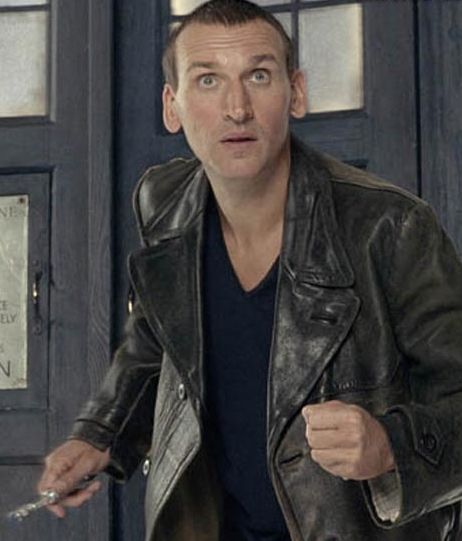
On the whole, I think Eccleston was 'fantastic' as the Doctor.  He could be funny, he could be deadly serious, he could be difficult, he even, at least once, could show genuine fear.  There were a variety of reasons why Eccleston decided to leave, and I wonder if Bad Wolf Part 2 would have been different if he did not have to regenerate.  Eccleston is in retrospect, the moodiest, dare I say, the angriest of Doctors, and it's not without blame: he saw all Gallifrey destroyed (something I have always felt was a mistake from the get-go).  Still, given he was there for just one season, I think he will rank on the higher end of the Doctor scale (even though I think all the Doctors have been good).

Now, it's on to our selections for the Best of Doctor Who: Series/Season One (Revived Edition).

BEST FEMALE GUEST STAR

Zoe Wanamaker (The End of the World)
Yasmin Bannerman (The End of the World)
Christine Adams (The Long Game)
Florence Hoath (The Empty Child Parts 1 & 2)
Jo Joyner (Bad Wolf Part 2)

Tough call since all were wonderful, but as I look at things, I give the edge to Wanamaker only because unlike the others, she had to use only her voice to create her character.  The fact that she could only be heard and still create a magnificent character (a bitchy trampoline, if memory serves correct), only adds to the strength of her performance. 

BEST MALE GUEST STAR

Simon Callow (The Unquiet Dead)
Corey Johnson (Dalek)
John Barrowman (The Empty Child Parts 1 & 2)
Simon Pegg (The Long Game)
Shaun Dingwall (Father's Day)

Now, is it fair to put a Companion here while not in the female category?  Well, I think it's because Captain Jack, as beloved as he is in certain circles (though not in this one), I felt worked best as just a guest star on The Empty Child Parts 1 & 2.  Note how he was redundant in Boom Town to where we almost forgot he was there.  He was the requisite action hero in Bad Wolf Parts 1 & 2, and would it have killed Davies to have left him for dead?

I understand writers have an affinity for their characters, but for some reason Steven Moffat has done his best to build up the characters he's created (Captain Jack Sparrow...I mean, Harkness, and later on DOCTOR River Song) to being these Doctor Who Icons without whom the show simply could not go on.  In both their cases, I've never been particularly overwhelmed with either Harkness or Song (however, I digress...Spoilers, Sweetie).  This is why I consider him a Guest Star (although I begrudgingly have to recognize he IS a Companion).  However, I can't get into the Captain Jack mythos both Doctor Who and Torchwood build up.   

As for why Dingwall over Callow (a close vote)?  Well, I think Dingwall brought a great tenderness and tragedy to Pete, someone we end up liking but know must die.  Though both Callow and Dingwall were beautiful performances, I was more moved by the latter emotionally.

BEST VILLAIN

The Lady Cassandra (The End of the World)
Dalek (Dalek)
Henry Van Statten (Dalek)
Adam Mitchell (The Long Game)
The Dalek Emperor (Bad Wolf Part 2)

There's something sleazy in how Van Statten disposes of everyone, and worse, how he even does what was once inconceivable: make us feel sympathy for a Dalek.  If only that Dalek hadn't yearned for the 'human touch', if you will, we might have had another winner altogether.

Again, another curiosity: a Companion as a villain?  Well, first, he had no problem leaving Rose behind in Dalek, and then his greed for knowledge (which would grant him wealth and power in his own time) caused so many problems for everyone on Satellite Five.  In so many ways, Adam Mitchell was a major problem, so he is in a strong sense, a villain.

BEST INDIVIDUAL MOMENT

The Doctor realizes just who is calling for help (Dalek)
The Doctor and Rose face off over the Dalek's fate (Dalek)
Rose saying goodbye to her father Pete (Father's Day)
The Doctor pledging to rescue Rose (Bad Wolf Part 1)

I had to think between three emotional moments in Doctor Who: Season/Series One, and it's so interesting that for a science-fiction show, we have many tender moments.  This moment, when Rose gets to say goodbye to the father she's never known (at least until now), knowing that her face will be the last thing Pete will see, is extremely heartbreaking.  With all the power of time travel, Rose still cannot alter the future to where she and her father will be together.  They had this brief moment, and if one extends things, all children eventually have to let their parents go.  It was a beautiful moment. 

MOST FRIGHTENING MOMENT

Jackie Tyler besieged by the Slitheen (Aliens of London Part 1)
The Doctor confronts his ultimate nemesis (Dalek)
The Dalek Rising (Dalek)
The Doctor, Jack, and Rose besieged by empty patients (The Empty Child Part 1)
Lynda getting blow away...literally (Bad Wolf Part 2)

A good Doctor Who frightening moment should make you curl up in your sofa, wondering what will happen next, fearing for your heroes.  The cliffhanger in The Empty Child Part 1 did exactly that.  When Lynda gets killed off, it is an especially effective moment of terror, made especially more so due to the silence (not to be confused with The Silence, another Moffat-ramming-pseudo-icons-down-our-throats business).  I think, however, having all these people, particular the titular child him, menacing an action hero (Captain Jack), the intellectual hero (The Doctor), and our fighting beauty (Rose Tyler), with seemingly no way out, made that moment far more frightening.

BEST ART DIRECTION
The End of the World
The Unquiet Dead
The Long Game
The Empty Child Parts 1 & 2

The cold of the Editor's room, the chaos of the floor the TARDIS landed in, all contributed to making The Long Game a set that could not benefit from being a period piece (which both The Unquiet Dead and The Empty Child Parts 1 & 2 were).  Instead, we had to imagine a place that could exist, and one that was both familiar and alien. 

BEST COSTUME DESIGN

The End of the World
The Unquiet Dead
Father's Day
The Empty Child Parts 1 & 2

Here, there can be no contest.  As much as I like the 80s (though my memories of them are vague), it is almost for certain that period pieces win out, and from the shrouds of the undead to Rose's gowns and Dickens' frocks, The Unquiet Dead gains an edge. 

BEST DIRECTING

Keith Boak (Rose)
Euros Lyn (The Unquiet Dead)
Joe Ahearne (Dalek)
Joe Ahearne (Father's Day)
Joe Ahearne (The Empty Child Part 1)

I can't help that Ahearne earned three nominations: he is the director of three of the best Doctor Who: Season/Series One stories.  When considering directing, it isn't just the story, but the performances.  All the performances in Father's Day, from Camille Couduri's Jackie Tyler and Shaun Dingwall's Pete Tyler right on down to Billie Piper and Christopher Eccleston, were all so beautiful: going from comedy to tragedy so effortlessly. 

BEST SCREENPLAY

Russell T Davies (Rose)
Mark Gatiss (The Unquiet Dead)
Robert Shearman (Dalek)
Paul Cornell (Father's Day)
Steven Moffat (The Empty Child Part 1)

It takes a great deal of talent and ability to introduce a historic figure without making it a gimmick.  Gatiss' screenplay for The Unquiet Dead kept a balance between being a fright-fest and being a great man, a true genius, contemplating his past.  I could talk about either The Doctor or Charles Dickens, and maybe I am talking about both.  Here, Dickens is an integral part, and the clever moments ("What the Shakespeare?") mixed in with the fantastical (the specters haunting Dickens' reading), and even the sad moments (Gwyneth's end) made The Unquiet Dead a brilliant story. 

BEST STORY

Rose
The End of the World
The Unquiet Dead
Father's Day
Dalek

It was really a matter of going over which earned a Perfect Ten.  Only two stories did.  One blew me away, one moved me almost to tears.  So close, so close.  However, after some thought, I still can't help being impressed by The Unquiet Dead's wit mixed with sadness. 

Yes, as with all things Doctor Who, we've had some simply ghastly moments.  I would be remiss to skip over them.  Therefore, with that in mind...

WORST INDIVIDUAL MOMENT

Rose telling the Doctor he's so "gay" (Aliens of London Part 1)
The Slitheen make a BIG NOISE (Aliens of London Parts 1 & 2)
The revelation of the Editor (The Long Game)
"Don't forget the welfare state" (The Empty Child Part 2)
Captain Jack reveals all (Bad Wolf Part 1)

I had narrowed down to two, and both involve Russell T Davies.  First, for an openly gay man like Davies allowing one of his characters to use the word 'gay' as a slur is to my mind simply inexcusable and highly distasteful.  However, at least a defense can be made that this would be true to the character: Rose is a working-class girl with no great education, so one could argue she doesn't see it as offensive.

What I DON'T like, and have never liked, is to have the person's political views enter into the show so nakedly.  When trying to inject politics into science-fiction, it should be subtle and clever (District 9, the original The Day the Earth Stood Still).  Davies doesn't have that subtlety: Aliens of London Parts 1 & 2 were nothing but his thinly-veiled hatred for George W. Bush and Tony Blair involving us in the Iraq Intervention.  Even that I could overlook, but having the Doctor take a direct  position (the joys of perpetual Labour governments providing womb to tomb services) is something I don't understand, believe, or accept. 

WORST MONSTER

The Slitheen (Aliens of London Parts 1 & 2)
The Mighty Jagrofess of the Holy Hadrojassic Maxarodenfroe (The Long Game)
Adam Mitchell (The Long Game)
The Reapers (Father's Day)
Margaret Blaine (Boom Town)
Beyond useless, The Mighty...has the silliest name of any monster, and he has such a long name just to show off how long his name can be.  One can't take such a monster seriously, and frankly, since he doesn't look like he is the brains behind this operation, I can't believe the menace is real.  Yes, in the long term, The Mighty...was just a front for another villain, but then it makes me think The Long Game really just wasted my time. 

WORST STORY

Aliens of London Parts 1 & 2
The Long Game
The Empty Child Parts 1 & 2
Boom Town
Bad Wolf Parts 1 & 2

The unfortunate thing about having only ten stories to deal with is that if you nominate five for your best, by default the remaining five will be the lumped with the worst.  Granted, I wasn't a fan of any of these, but out of all our nominees The Long Game is the most inconsequential.  Minus the fact that it got rid of one our worst Companions (though that is for another time), The Long Game had points of logic that werent' answered (how does Suki go from dim girl to super-rebel at a turn of a dime?) and a monster who was neither terrifying or interesting. 

Now, eventually, once the goal of seeing every Doctor Who story made is complete, we will be in a better position to judge where the Ninth Doctor stories fit into the Great Ranking.  I'm still debating whether to have a separate Ranking for the Revived Series.  Certainly there are great things in Eccleston's tenure, and some things I didn't care for. 

Well, there it is for now.  We close out our Christopher Eccleston aka The Ninth Doctor Retrospective.  We now move on to the Tenth Doctor, David Tennant, knowing that some of his stories will be brilliant, some I have no desire to revisit, and some that are a complete mystery. 

That, however, is another story. 

THE NINTH DOCTOR STORIES

Next Story: The Christmas Invasion

Wednesday, September 14, 2011

A Wolf In Daleks' Clothing


STORY 170 : BAD WOLF PARTS 1 & 2
(BAD WOLF/THE PARTING OF THE WAYS)

In the new Doctor Who, the phrase "Bad Wolf" has been the dominant theme, the mystery of why this phrase appears through all of the Doctor's adventures with Rose teasing us throughout the series/season.  Now, in the appropriately-named Bad Wolf Parts 1 & 2 (Bad Wolf/The Parting of the Ways), we at last get the source of our mystery.  Truth be told, it all been a build-up to something a little disappointing.

We find that The Long Game is the present-day version of what Mission to the Unknown was to The Daleks' Master Plan: a prequel to the larger story (in this case that of Bad Wolf 1 & 2).   After a recap of The Long Game, we're thrown into a cavalcade of confusion: the Doctor (Christopher Eccleston), Rose (Billie Piper), and Captain Jack Harkness (John Barrowman) have all been separated and land on various television shows, respectively Big Brother, The Weakest Link, and What Not To Wear.  Each react to their situation in their typical manner: the Doctor is irritated and annoyed, Rose thinks the whole thing is funny, and Jack is just delighted to show off his "amazing" body.  Of course, not everything is as it seems.  Each show has a twist: eviction means extermination, being voted 'the weakest link' means extermination, and altering your looks means literally altering the way you look.

The Doctor realizes that the Game Station he's in is really the former Satellite Five from The Long Game.  He escapes the Big Brother house, along with housemate Lynda (Jo Jayner), and while Jack manages to escape himself, they arrive too late for Rose, who in her attempt to escape the Anne-Droid, gets vaporized.  But lo!--this is not the end of Rose (side note: could it ever truly be?).  Rather than get exterminated, she finds herself surrounded, and soon the Doctor, Jack, Lynda, and the Programmers aboard (Jo Stone-Fewings and Nisha Nayer) discover who is holding them and the population of Earth hostage...THE DALEKS!

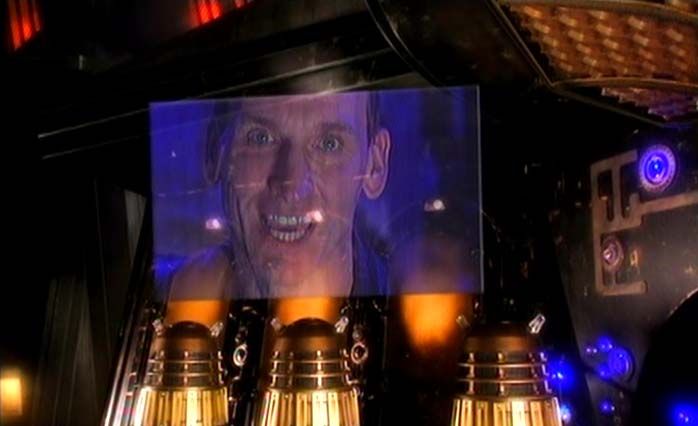
This group, ruled by the Dalek Emperor, managed to fall through space at the end of the Great Time War, and His Majesty has been harvesting humans to create his new Dalek Army, ready to invade and destroy Earth.  The Doctor, however, will have none of that: he tells them he's going to rescue Rose and destroy the Daleks, all without a plan, or weapons of any kind.

The Doctor and Jack land on the Dalek mother ship and rescue Rose, and the Doctor has come up with a way to destroy the Daleks once and for all via a Delta wave, destroying every mind in its path (though that could include the humans too).  However, the Doctor is far too loving to truly threaten the Daleks, until Rose inspires an idea for him...or so we think.  Keeping his pledge to protect Rose, he sends her off to safety, much to her agony, and she returns to London to be greeted by her erstwhile boyfriend Mickey (Noel Clarke) and her mom Jackie (Camille Coduri).  As the Doctor and Jack continue to fight off the Dalek Army, Rose is frustrated about remaining at home, until she hits on the idea of looking into the TARDIS.  Once she manages to do that, she absorbs the energy from the TARDIS, allowing her to go back to the Dalek mother ship.  It should be too late: both Lynda and Jack have been killed by the Daleks, and the Doctor is just out of time.

Once there, she has god-like powers: with a wave of her hands she evaporates the Army and brings Jack back to life, but the intensity of the TARDIS energy is destroying her mind.  With a kiss, the Doctor absorbs the energy for himself, and once back on the TARDIS, the Doctor tells Rose he is changing.  To her horror, the Doctor regenerates into a whole new man (David Tennant).

Right from the get-go Bad Wolf Parts 1 & 2 has a major problem.  Part 1 is dependent on the audience knowing certain things, primarily the three shows being spoofed: Big Brother, The Weakest Link, and What Not to Wear.  If you (like me) haven't seen one or any of those shows, you really have no idea what is going on.  Until Bad Wolf, I hadn't even HEARD of What Not to Wear, so while I understood the gist of the show (and could even guess that the two hosts voiced their robotic doppelgangers), anyone else who wasn't a viewer would feel a bit lost. 

Another issue I had was a bad habit of current Doctor Who that should be called the Rory Syndrome: killing off a character just to find that he/she really isn't dead.  Here, we witness what we think are the deaths of both Rose and Jack, only to find that they aren't really dead or conversely, have been granted immortality.  You can't really build sadness for a character's end if said character doesn't really end.  If I remember correctly, for a moment we thought Rose was dead in Dalek, and while it worked that time I think it didn't go over that well in Bad Wolf Part 1.  What I wondered was if Rose, in her god-like state, can bring life, did she bring back only Jack or everyone else on board?  It would have been possible to have restored all the humans slaughtered by the Daleks (except Lynda, whose death was both tragic and extremely well-done cinematically). 

Finally on the minus side, I kept wondering about how it was possible for the Daleks to survive the Time War but there being absolutely no chance whatsoever of the Time Lords themselves being exterminated.  If Russell T Davies allowed the Daleks to survive, what precludes a small group of Time Lord exiles to have escaped?  Even Aeneas survived the fall of Troy. 

Now, placing our eyes on the positive, some of the acting in Bad Wolf Parts 1 & 2 is among the best of the first series.  Once you get over a lot of the comedy from the warped versions of the various shows, I found Jayner's Lynda to be a sweet, almost naive girl.  If Rose hadn't lived (which would have given the story more depth), Lynda would have made a wonderful Companion.  As stated earlier, her death at the plungers of the Daleks was extremely chilling and brought a real moment of terror and sadness, given she was a very nice person.  Eccleston was, to quote him, fantastic, both when playing grumpy at the Big Brother House and when as a hologram he appears to Rose as part of Emergency Programme One and when at the end of Part 1 he declares his intentions to the Daleks. 

Piper has earned her place as one of the best Doctor Who Companions with Bad Wolf Parts 1 & 2.  In this two-part story watch her transform from the girl who isn't taking The Weakest Link seriously to the terrified girl held captive by the Daleks to the determined woman moving TARDIS and Earth to rescue the Doctor.  Piper has an evolution to her character, and I believe put to rest once and for all the idea that she is just a 'pop star' who was given the gig to get ratings.  Rather, she projects an entire catalogue of emotions: fear, love, courage, all within a very young character.

It truly is hard to determine if Barrowman was playing a character or just being himself as the egotistic Jack.  I know a whole mythos has been built around our Captain Jack, but for my part I've never warmed up to our intergalactic nymphomaniac, so I would make him the weakest link (pun definitely intended).

Joe Ahearne creates some beautiful moments along with getting good performances out of his actors.  When Rose is believed dead, he surrounds the Doctor in black, enhancing the poignancy of the moment.  Visually, when Rose is obliterating all enemies is also a beautiful moment.  The best moment in Bad Wolf is in Part 2 when Lynda is killed (I keep going back to that, but in the silence of the moment, seeing the Daleks outside the Satellite with their lights blinking out what we already know they are saying makes it more chilling). 

I do question whether it was important for Rose to reveal the truth about her and her father to Jackie, figuring that maybe this could have remained between her and Pete, but there it is.  I also never figured out why that particular phrase, "bad wolf", was so important.  If Rose just got it from when she destroyed the Dalek Emperor and spread it across time and space, then it didn't originate from her mind, did it.  Right?  Am I missing something?

Well, now we've reached the end of the 9th Doctor's tenure, and we will have a retrospective on him: the best and the worst (yes, there were bad things in Series/Season 1).  However, that's for another time.

Bad Wolf Parts 1 & 2 has some wonderful performances and in a perverse way give me hope that the Time Lords are actually still around: what's good for the Daleks... I had some problems with Part 1, less so with Part 2, which is a switch: normally the first episode is brilliant while the second one falls apart.  It gets point knocked off for suffering from the Rory Syndrome, but on the whole, we can say they cried us a good wolf.

6/10

A 9th Doctor Retrospective

Next Story: The Christmas Invasion

Monday, August 29, 2011

We Miss You Part 1


DOCTOR WHO
 THE LOST STORIES: WILLIAM HARTNELL YEARS

 
The loss of any First Doctor story is still felt by both fans and those interested in early science-fiction television.  The First Doctor actually has managed to come out remarkably intact: out of all his stories, only seven of the twelve missing/incomplete stories have no surviving episodes.  The negative to that is that he is the ONLY Doctor to have stories where there is no surviving footage whatsoever.

 
Almost all other missing Doctor Who stories have either complete episodes or at least clips, but in the First Doctor's tenure the stories Marco Polo, Mission to the Unknown, and The Massacre of St. Bartholomew's Eve have no footage at all.  That would be bad enough, but what makes it even more frustrating is that Marco Polo was SEVEN episodes long and The Massacre was SIX episodes long.  The loss of so many episodes is such a puzzle.

To compound the issue, some of the missing episodes are highly important historically.  Mission to the Unknown is historic in that it's the only story in either classic or revived Doctor Who to not feature any of the regular cast; it is also the only one-episode story in pre-revived Doctor Who (whether you include The Five Doctors as one episode hinges on whether you count a story by how long the episode is, but I digress).  The missing episode of The Tenth Planet (Episode Four) contains the first regeneration in the series' history, making its loss even more sad.

 
Now, we have been able to review a few stories as if they were complete in a roundabout way.  Marco Polo, for example, had a 30-minute condensed reconstruction as a special feature on Disc 2 of The Beginning box set (which had Stories Two & Three: The Daleks and Inside the Spaceship aka The Edge of Destruction).  The Crusade had the audio tracks to Episodes Two (The Knight of Jaffa) and Four (The Warlords) along with the surviving Episodes One and Three (The Lion and The Wheel of Fortune).  Therefore, we were able in Marco Polo to get an idea of what the seven-part story would have been like (I like to think of it as a Best-Of episode), and in The Crusade we were able to reconstruct the missing episodes in our mind, as if it were a radio play. 

Granted, a condensed half-hour version of a three and a half-hour long story isn't the best solution, but it is the best we can do at the moment.  Also, having the audio track at least allows us to follow the overall story.  This is why I elected to review them as full stories as opposed to something like The Daleks' Master Plan or The Celestial Toymaker, where I gave my thoughts only on the surviving episode.

 
Still, having parts of stories doesn't make up for not having them at all.  To me, it doesn't matter how they came about to be lost; it is more important that we keep looking for them but accept that perhaps we will never 'see' them again.  However, fortunately for us, none of the stories are truly lost.

Our dear Whovians in the early days went about recording all the Doctor Who stories on audio tapes.  We are more fortunate than other stories (such as the football soap United!, which has nothing surviving), so we at least have the audio track.  It was this that allowed us to have the reconstruction of Marco Polo and The Crusade, and which gives us hope that the other lost/incomplete stories will perhaps be seen again. 

As I look at what is missing, I have cause for hope.  It is possible to have stories which have complete episodes fully restored with animation.  Such was the case with the Second Doctor story The Invasion.  Out of the eight episodes, only Episodes One and Four were missing.  In order to release it as a complete story, the missing episodes were animated, and the results were quite positive.  The same method of reconstruction will be used in the First Doctor story The Reign of Terror.  That six-part story has only Episodes Four and Five (The Tyrant of France and A Bargain of Necessity) missing, so with some work with animation The Reign of Terror will be complete once again. 

This got me thinking, what of the other lost First Doctor stories?  What stories would be the best candidates for a full restoration?  I'm aware that everyone would want all of them restored (and I'm one of them), but I think we should be a bit realistic.  Let's take a short inventory of what we have and don't have.

MISSING FIRST DOCTOR STORIES:

  • Marco Polo (all seven episodes missing) *
  • The Reign of Terror (Episodes Four and Five) *
  • The Crusade (Episodes Two and Four) **
  • Galaxy Four (all four episodes)
  • Mission to the Unknown (entire episode missing)
  • The Myth Makers (all four episodes)
  • The Daleks' Master Plan (Episodes One, Three, Four, Six-Nine, Eleven and Twelve) **
  • The Massacre (all four episodes)
  • The Celestial Toymaker (Episodes One-Three) **
  • The Savages (all four episodes)
  • The Smugglers (all four episodes)
  • The Tenth Planet (Episode Four)

Well, my suggestions are that Mission to the Unknown and The Tenth Planet be the next candidates to receive the restoration treatment.  In the case of Mission to the Unknown, as the shortest story in Doctor Who it would be the fastest one to completely animate.  I can see how releasing a Doctor Who story that is only twenty-five minutes long might not be cost-effective.  Here's where The Tenth Planet comes in.

Think of it: only one episode is missing, and this story is important in that it is the debut of the Cybermen, one of the most iconic of Doctor Who villains.  Again, I think it would be within the realm of possibility to bring The Tenth Planet out to the public, and take the opportunity to bring Mission to the Unknown out as well. 

The other stories would be harder to restore.  They suffer from not having any episodes known to exist, so they would have to animate all of them.  That would be a great deal of work for them, and I don't know if they would want to go through all that trouble for what could be a low return.  They would have to start totally from scratch, and I don't know if they have the time for such a lengthy endeavour. 

Anything truly is possible, and it would be nice to have the missing episodes brought back from the beyond, so to speak.  However, my view is that only Mission to the Unknown and The Tenth Planet have a realistic chance of having an official restoration.  That of course means that until the release of The Sensorites, the restored The Reign of Terror, and Planet of Giants, my First Doctor retrospective has to come to an end.  I will have a full First Doctor Retrospective once all the stories have been released.

However, I don't feel I can complete it until I know for sure that either The Tenth Planet and/or Mission to the Unknown may yet be restored.  I'm debating whether to have a First Doctor Retrospective of what has been released now, and that was the plan until I learned that The Reign of Terror would be released.  That being the case, I opted to hold back.  However, I won't be waiting for them, so I've decided to plunge forward and move on to The Second Doctor while still bouncing between Doctors Ten and Eleven.

Side note: with my Ninth Doctor retrospective almost complete (and without the burden of missing stories) he will be the first Doctor to get a full retrospective. 

With that, I come to say farewell to William Hartnell, and hoping that we may still see more First Doctor adventures in the future.

* This story has either been restored or given a reconstruction.

** The surviving episodes have already been released.  Nothing prevents there being a full restoration but the chances are small.  For example, we could have an animated reconstruction of The Crusade, but given that we have had the story released, it's doubtful they would go back to it.  The Daleks' Master Plan and The Celestial Toymaker have a majority of episodes missing, so again that would be a great deal of work for an official restoration. 

Monday, August 22, 2011

Doctor Who Story 027: The War Machines


STORY 027: THE WAR MACHINES

Doctor, WHO Is Required? 

The War Machines is a curious Doctor Who story in that it's the first to try to reflect the times in which it was filmed.  Until now, the series hasn't had a Companion that truly appeared to be from our time.  The young Who girls (Barbara and Sara Kingdom being adults) are removed from the late 60s: the Doctor's granddaughter Susan was a schoolgirl, Vicki was a teen from another time, Katarina a Trojan handmaiden, and Dodo was a simple (and simple-minded) Cockney.  However, at last, we get a girl from Swingin' London.   The story itself reminds me of An Unearthly Child: both start well, then in the ensuing episodes the story starts going down. 

The Doctor (William Hartnell) and his Companion Dodo (Jackie Lane) have come to 1966 London just as the General Post Office Tower has opened.  At the top of the tower is the super-computer WOTAN (Will Operating Thought ANalogue).  There, they meet WOTAN's creator, Professor Brett (John Harvey) and his secretary, Polly (Anneke Wills).  WOTAN itself and its creator's desire to link it up with all computers around the world troubles the Doctor.  Unbeknown to them, WOTAN has strange powers of its own, and soon appears to hypnotize Dodo. 

Polly takes Dodo to a swingin' club, The Inferno, while the Doctor investigates his suspicions of WOTAN.  At the club, they meet sailor Ben Jackson (Michael Craze), who is down because he won't be sailing out as he'd hoped.  WOTAN suddenly has got it into its head that humans have reached the limits of their potential, so naturally it has to take over.  Soon, he has conquered the minds of Brett, Security head Major Green (Alan Curtis), and Professor Krimpton (John Cater).  Dodo's mind has also been overtaken by WOTAN, and the computer sends a message to her: bring the Doctor to WOTAN.  As WOTAN puts it, "Doctor Who is required" (more on this later).

Dodo fails to deliver the Doctor to WOTAN, but no matter: WOTAN has decided to build the war machines, robotic weapons that will aid it in its conquest of Earth.  The Doctor becomes highly suspicious of Dodo's odd behavior and on learning of the death of a tramp whom they had encountered earlier at the Inferno.  The Doctor releases Dodo from her spell and she is sent to the country to recover, staying with relatives of Sir Charles Summer (William Mervyn), the head of the Royal Scientific Club and civil servant charged with linking WOTAN to all other computers. Polly is sent to find Professor Brett, but she too falls under WOTAN's spell.  Ben discovers the making of the war machines, is captured but spared to be slave labor.  Everyone making the war machines is so zombified that they don't bother guarding the doors, allowing Ben an escape.  He rushes to the Doctor and Sir Charles, telling them the danger. 

The Doctor then goes with an unbelieving Sir Charles to find the war machines have indeed been created, and are now about to commence their takeover of London, then the world.  Fortunately, not all war machines have been unleashed, with only two actually attacking.  The Doctor manages to disable one and uses it to attack WOTAN itself.  In the end, Polly gives the Doctor a message that Dodo has opted to stay in London, which surprises and slightly displeases the Doctor.  Both Polly and Ben see him enter the police box, wondering what is going on.  Ben has a TARDIS key, and they go in, just as the TARDIS dematerializes...

Ian Stuart Black's script for The War Machines is a story that has a great deal of potential, but as the story proceeds it slowly starts to sink.  First, there is the design of the actual War Machines.  They look a bit like the Daleks' poorer relations.  I thought the War Machines were actually pretty silly and inept in terms of conquering Earth but given that it was a rushed job I cut them some slack.  Second was the actual defeat of the War Machines.  The Army couldn't defeat these tanks with brains (which is what they basically ended up becoming) but the fact that the first War Machine stopped because it was put into operation before it was ready makes me wonder exactly how WOTAN could be considered the Ultimate in Thinking Machines.  It couldn't even think that the machines would require more time or that they actually weren't necessary to rule the Earth. 

Come to think of it, WOTAN is remarkably inept for all its power.  It can control people through some form of telepathic ability (I figure it must produce high-frequency radio waves that can control people's minds), but of all the people it choose to help it capture the Doctor, WOTAN chooses Dodo?  Dodo, bless her heart, is one of the the dumbest Companions the Doctor has ever had.  Granted, there is a logic in choosing the actual Companion to try to lure the Doctor into its sinister web of world conquest, but it really isn't much of a surprise when Dodo is given this charge. 

Somehow, I think it would have been better in my view if she had been an unwitting partner in crime, or at least if the agent's identity had been held back as a cliffhanger.  We could have wondered, if director Michael Ferguson had held back some information (thus we could have wondered if perhaps either of the professors or maybe Polly were the danger) and allowed time for The War Machines to build up.  We plunge into WOTAN's coup in Episode One, and I think it would have worked better for the story if the super-computer had been introduced, then gone mad either at the end of Episode One or throughout Episode Two, then had them seize all the world's computers and attacked man that way (Y2K, anyone?).

This is because, as I found while watching The War Machines, the actual war machines were pretty inept (though the idea of jamming all weapons against it was a good idea).  Oddly, it bears repeating at how poor the results for the actual war machines were once we see them.  Going back to being a poor relation to the Daleks, I think it has something to do with the single eye in their design.  Furthermore, when Ben is menaced at the end of Episode Two, it brought back memories of Barbara being menaced by the title character at the end of Episode One of The Daleks.  I did think if WOTAN had such power over the human mind, why didn't it simply hypnotize all humanity into submission rather than waste time building these silly machines? 

Finally, I thought the worship that WOTAN inspired in its brainwashed work crew bordered on the cult-like, which would be very odd given it's a machine.  This is perhaps a minor point, but it does support my earlier point that if WOTAN had wanted to control humanity, all it had to do was hypnotize them into submission.  If they had gone this route instead of going through the trouble of building the war machines, it would have made the menace more real and dangerous. 

As a side note, there is a strange discrepency in The War Machines.  When the tramp stumbles across the warehouse where the war machines are being built, the system warns of an intruder almost immediately.  However, when Ben brakes into the warehouse, the system doesn't warn them of an intruder until a much longer time.  Even WOTAN needs a tea break I imagine. 

However, I think The War Machines works best when NOT dealing with the science-fiction elements but instead with the human elements.  Polly is an exciting character: a fun-loving girl who loves being young is a breath of fresh air from the dim character Dodo is.  Wills' performance as this cheerful girl who loves a good dance and has great confidence in herself makes her a wonderful introduction.  Same for Craze's Ben: his Cockney sailor is a perfect counterpoint to the more posh Polly.  He has the requisite action-hero credentials (sailors are not wimps), but we also see he has a heart (as when he shows his sadness at what is suppose to be the hippest club in London) and fear (when he confronts the machines). However, Ben is a little dense when not realizing that Polly was under WOTAN's power.

 Of special note is Mervyn's Sir Charles: he plays the civil servant as the typically clueless individual in power, but one who takes things with the usual British non-chalance.  Big machines are threatening to take over the capital, being controlled by a super-computer that can think for itself?  Well, we'll just go over and stop it--job's got to be done so as to not interrupt tea-time. 

Surprisingly, Lane's Dodo is actually rather menacing when controlled by WOTAN.  She plays these scenes not with a sense of urgency but of unnatural calm, making it even more unnerving that someone as dumb as Dodo would be the source of the danger.  In short, Dodo in her final broadcast story, managed to make the character one that provided a form of suspense, even danger.

However, even if Dodo is one of the least popular and effective Companions in Doctor Who history, her disappearance in the middle of Episode Two was a shameful way to have her leave.  She should have been allowed a greater departure than just being shunted off into the countryside. 

I'd like to take this time to address a controversial part of The War Machines.  In Episodes One and Two, WOTAN calls the Doctor "Doctor Who" (as in "Doctor Who is required").  To make things worse, both professor keep calling the Doctor "Doctor Who", which makes no sense since Who is not his name.  This is the first (and as far as I know, only) time the Doctor has been called "Doctor Who" on-screen (not counting in-jokes or titles like Episode Five of The Chase: The Death of Doctor Who, or the Third Doctor story Doctor Who & The Silurians).   This gives us a strange controversy: how can he be "Doctor Who".  The answer to this dilemma is actually pretty easy as far as I can see it.  WOTAN has no idea what The Doctor's true name is.  Being a machine (and thus, not having any imagination), it wouldn't think of calling him "The Doctor" because it isn't specific enough; it would resort to the closest word it could find: an unknown person would be a Who.  Since WOTAN doesn't know his name, it would make sense to a machine (emphasis mine) to call him "Doctor Who".  His minions, meekly following WOTAN's example, would copy WOTAN's phrasing and call him "Doctor Who" as well.  There, problem solved. 

The War Machines, sadly, is the final complete First Doctor story.  In an ironic twist, the only known surviving clips from the next story, the now-lost The Smugglers, are ones that were deemed too unsuitable to broadcast.  The story after that, The Tenth Planet, is incomplete with one episode missing.  Unfortunately, the missing episode is the final episode.  As if that weren't bad enough, that episode is the first one to ever show a regeneration: from William Hartnell to Patrick Troughton.  An important piece of television history was lost (perhaps forever) due to the BBC's shocking lack of foresight.  It is possible that The Tenth Planet will be released with the missing fourth episode animated or somehow reconstructed, so we may still be able to review that story.  However, The War Machines is the last First Doctor story that survives intact (though it took a great deal of work and search to get what we have now). 

Compounding things, the Second Doctor has fared worse in surviving stories.  His first SEVEN stories are incomplete, with his first two stories (the six-part The Power of the Daleks and four-part The Highlanders) having no surving episodes whatsoever and only a few clips.  The first full surving episode of the Second Doctor is Episode Three of the four-part The Underwater Menace.  Two of the four episodes of The Moonbase do survive, and thanks to that and the release of the audio of the missing stories in the Lost In Time DVD, it affords us an opportunity to review The Moonbase as if it were complete (which is what we did for the First Doctor story The Crusade, which has a similar situation).  That being the case, I will have a short retrospective of The Underwater Menace and then a full review of The Moonbase

The War Machines has at its heart, a good idea, but the execution was terribly rushed.  It has the plus of introducing two new and exciting Companions in Ben Jackson and Polly, but on the whole I found The War Machines didn't function very well.

Next Story: The Tenth Planet

5/10