Thursday, May 2, 2013

TARDIS: That Was Easy


STORY 239: JOURNEY TO THE CENTRE OF THE TARDIS

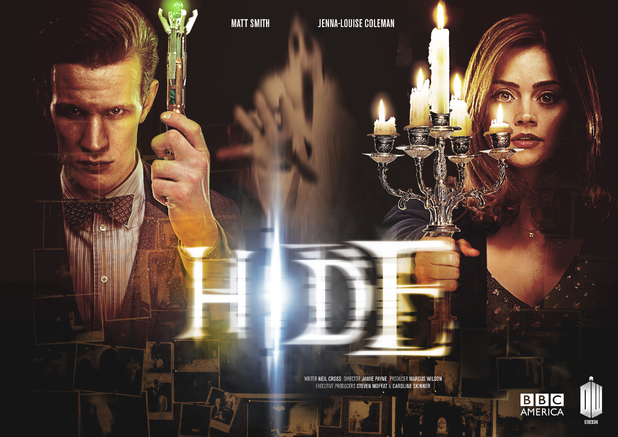
Even in the advert for Journey to the Centre of the TARDIS one can see that Matt Smith's Doctor is not the genius who thought his way out of problems as his predecessors were, but an inept, almost stupid bumbler who somehow manages to sonic screwdriver his way out of difficult situations.  Putting aside the use of one of the most unoriginal title in Who history (wonder where they came up with THAT particular title...) and putting aside that the poster seems to be a take-off of a previous Doctor Who story (the Fifth Doctor story Castrovalva), Journey to the Centre of the TARDIS is a bad story: not in a 'it's a fiasco' style of bad but in a 'it just isn't completely thought out and a massive waste overall' style of bad.  While I did find some things to like, the ending...my God, the ENDING...

The Doctor and his newest Companion Clara (Jenna-Louise Coleman) are in space and he is concerned that Clara and the TARDIS are not getting along.  Therefore, he gets her to drive the ship and puts it in 'basic mode', which means no shields.  Wouldn't you know it...a group of space scrap salvagers just happens to spot this odd thing floating around and decide to grab it at that precise moment?  The scrappers, the Brothers Van Baalen, think it's just junk but a third scrapper, the android Tricky (Jahvell Hall) senses that this latest object is...alive.

The Doctor magically appears outside the crashed TARDIS, but poor Clara is still inside.  The Doctor then tells them he offers a trade: in exchange for helping rescue Clara, he will let them scrap the TARDIS.  However, NuWho First Rule: The Doctor Lies (I can point out he didn't before the 2005 revival, but it's a waste pointing that out).  He tricks the Van Baalens into the 'salvage of a lifetime'...literally, a lifetime of Clara.  To get them to see his way, he sets the Self-Destruct System: first an hour, then on almost a whim 30 minutes. 

Clara, meanwhile, is left to wander the many corridors of the TARDIS, where she finds the library (or wanders in...I can't believe that in the travels the Doctor would be so unchivalrous as to not show her around the place).  She is also aware that something is after her: a strange monster who is within the TARDIS for reasons unknown.


As she wanders around the TARDIS' massive library she comes across a very important book: The History of the Time War.  While glancing through it, Clara makes a shocking discovery: written within the book is...The Doctor's NAME! She sees it and says, "So THAT'S Who," but we don't have much time to worry about 'spoilers'.  The Space Zombies are a'comin' for her.  We soon find that the TARDIS is defending itself after one of the Van Baalem brothers took a bit of the Architectural Reconstruction System, which is what makes it larger on the inside than the outside.

The TARDIS is also taking steps to fight off the forces against them.  One of them, however, isn't the Self-Destruct.  After realizing that the TARDIS is repeatedly recreating the console room and that they and Clara are in slightly different times the Doctor manages to pull her to his time, he casually informs the Van Baalems that, surprise, there WAS no Self-Destruct Mechanism.  He even stops long enough to congratulate himself on his performance.  However, he does realize we DO have a problem: the Zombies and the TARDIS looks like it's about to go kablooey.

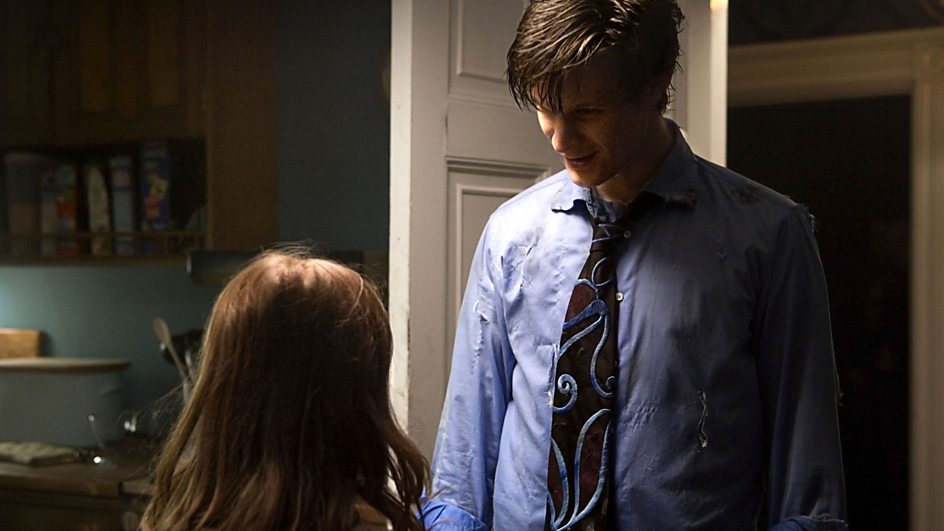
The Doctor knows what the Zombies are but won't tell, and then we find we must go into the center of the TARDIS.  And Clara gets briefly separated from them...again.  She also keeps bumping into previous versions of herself and the Eleventh Doctor, but it's those pesky rips in time.  All this time she is attempting to heal from a burn she got before crashing when she had picked something up and burned her hand, with odd writing on it.

Eventually, we make some shocking discoveries: Tricky is NOT an android, but a human slightly altered and told he was an android by his brothers as a joke and that the zombies are really the burned remains of the Van Baalems...and Clara herself.  They manage to enter into the center of the TARDIS, which is frozen in an effort to stop its destruction.  Finally, the Doctor realizes that there is a rift (or a crack) in time that is causing all this, so if he warns himself and provides a device that can basically reset everything, all will be resolved.  He does so with a grenade-type device where he writes "Big Friendly Button" with the sonic screwdriver and everything was as before...right down to Clara having her memory wiped of what has happened previously, including reading The Name of The Doctor.
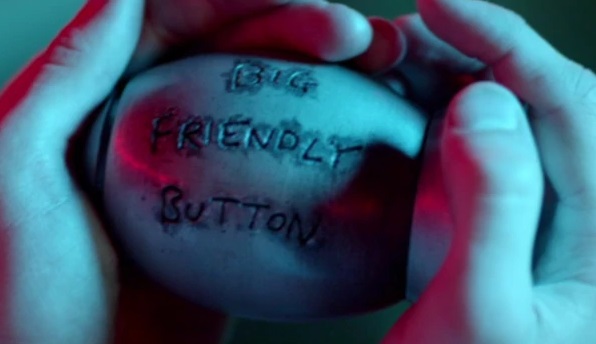
Gallifreyan for Deus Ex Machina...

Do you know what damns Journey to the Centre... for me?  The Big Friendly Button, that's what!  We've had some sorry examples of a Deus Ex Machina, some outside force/source that magically appears at the last moment to save the Doctor from the insurmountable crisis.  The wildly overpraised Cold War had the Ice Warrior army sweep in just as Skaldak was about to push the button (neither big or friendly) and save the world.  Other times either River Song or Madame Vastra will show up and fix things for him because the Doctor is basically too stupid to figure anything out himself. 

However, of all the things that Doctor Who has done to provide an easy way out, having the Doctor literally 'push a reset button' ranks as one of the WORST plot devices in the history of the entire franchise.  I was so appalled at how easy it was for him to get out of everything.  It was a cheap way to solve a dilemma, almost to where it would be a parody if it weren't a Canonical story. 

I also point out that in a sense, pushing the reset/restart button is what Journey to the Centre... repeatedly did.  Stephen Thompson (returning for a second go-round after the shockingly bad Curse of the Black Spot...which stubbornly won't shift from its place as one of the worst Doctor Who Stories of All Time--current standing: Num. 4) has now created something nowhere near as atrocious but instead something filled with total ineptness.  The Doctor basically resets things TWICE: besides the "big friendly button" he also basically informs everyone, "No Self-Destruct System...backfire on you, wasn't I so clever and convincing."  There is something appalling about how smug he can be in his manipulativeness.  Yes, the Doctor can use people, but he doesn't delight in emotionally torturing people...or at least he didn't before. 

By taking the "Self-Destruct System" out of the equation, what little (and I do mean little) sense of urgency was gone.  If the ship isn't going to destroy itself, what then is the rush, the worry of rescuing Clara?  That was already bad enough, but by sending in the "big friendly button" and resetting everything, Journey to the Centre of the TARDIS informed us that it was all a big waste of our time.  Not since Pam Ewing woke up to find her husband Bobby in the shower and thus wiped away an entire season's worth of Dallas storylines because 'it was all a dream' have we encountered a more idiotic resolution to a conflict.

To get out of this situation, all he had to do was 'push a button'.  He even had time, amid all the crises going on around him, to write "Big Friendly Button" on it.  I want people to ponder that and wonder why I have been so hard on Series/Season Seven of NuWho.

However, there are other things wrong with Journey to the Centre... For example, the entire subplot of the Van Baalems and the 'android'.  First, why should we care?  Second, how did the Doctor put two and two together (well, on that point, given how Smith has decided HIS Doctor is going to be an idiot, we should be grateful for small favors...).  However, once we get the 'big reveal', what of it?  Why should we care that these two brothers (to whom we're barely introduced) played a mean prank on the third?  There really is no compelling reason for us to bother, and the episode feels the same: once the 'big twist' is exposed, we all but forget about them.

Imagine how much better Journey... could have been if the 'android' had been the compassionate one and the 'humans' were the mechanical ones, or even if we find out that the situation is reversed.  Now THOSE might have been shocking twists.  However, since they didn't opt for either, well, big deal.

The biggest problem Journey... has involves what is suppose to be the Doctor's greatest secret: his name.  For far too long, The Name of the Doctor has been played to be this gigantic secret, something that might shatter the fabric of time itself.  Now we find that his name is easily available to anyone with a library card.


What's my name?
You'll find it in Chapter 26.

Let's go over this shall we?  In the TARDIS' library we have the book The History of The Time War.  Articles are important. If it were A History... then it would suggest a memoir, but since it has the definitive THE History..., it looks like it was written by someone not there.  The real First Question should be "Who wrote the book?"  We have three options: the Doctor himself, someone else, or someone else with the Doctor's cooperation.  If we go for Option A. or C., then the question must be asked, 'why did the Doctor, who harbors this terrible secret about his name, whom he's shared it with allegedly only one person (River Song...guess Susan Foreman never knew her own grandfather's name) write it down in a book that any of his Companions could easily have read?' One doesn't think that Rose, Adam, Captain Jack, Mickey, Martha, Donna, Amy, Rory, River, or Clara didn't have any down-time between adventures.  A little light reading at bedtime, perhaps?  Therefore, the Doctor's Name, appearing so freely in The History of the Time War, was easily accessible to any of them.

However, if we go for Option B., we come up with an even bigger problem.  This book, if published widely across the galaxy, would have required research, and if in that research someone wrote, "The war ended when (John Smith) triggered a device that destroyed Gallifrey" or something like that, then The Name of the Doctor is no secret. 

No matter how one cuts it, by putting in that little bit in Journey..., the entire effort to build up The Name of the Doctor as some massive mystery (which I would have said was never this galaxy-shattering event showrunner Steven Moffat has insisted it must be) has been effectively rendered moot.  How big of a mystery can The Name of the Doctor be if it can be read by anyone with a copy of The History of the Time War?  A producer MUST have thought that out.  He or she could have pointed out, 'No, The Name of the Doctor CAN'T be literally written down in the book because then it wouldn't be a mystery' and ordered the writer to alter the story.  The fact that this did not happen shows that basically everyone is making things up as they go along.

Sadly, the response to this lapse in logic would be "you don't apply logic to Doctor Who", which is a remarkably cheap and easy way to excuse plot holes and discontinuity errors such as The Name of the Doctor being this terrible secret, one that must never be known...which is in a book.  One HAS to apply logic to any program, especially a science-fiction show.  Not doing so is an insult to the audience.

Truth be told, Journey to the Centre of the TARDIS IS an insult to the audience: you put the characters in danger only to literally just push a button and everything goes back to the way it was: no one save the Doctor remembers anything and it was just as if it never happened.

In terms of performances there really is very little to note.  Smith still can't make the Doctor into something other than a nitwit, particularly with the sonic screwdriver.  He whips it out almost reflexibly but he seems to use it like I would use my cell phone as a light source.  The interplay between the Van Baalem Brothers is uninteresting, and poor Coleman.  We've had good Companions (Sarah Jane Smith), we've had bad Companions (Mel Bush), but with Clara, we've never had such a dull Companion.  The Doctor described her as 'feisty', but that description seems to be applied to all NuWho Companions.  Each pre-Clara Companion had at least something: working-class Rose, medically-trained Martha, chatterbox Donna, belligerent Amy, wimpy Rory, slutty murderous River.  Clara, however, after five episodes still has nothing.  She's just so blank, and I put that less on Coleman than on the character she plays, who is not interesting in the slightest.

However, there are a few good things in the episode.  Coleman has a good line when she says, "Red flashing light...means something bad," and some of the cinematography, particularly within the TARDIS, is quite beautiful.  I didn't even mind that the same cinematography was deliberate obscure to attempt to make the Time Zombies more frightening.  It didn't quite work but I appreciate the effort.  There were also efforts to note Doctor Who's long past: when the console is opened by one of the Van Baalem brothers we can hear voices from previous Doctors (I instantly recognized Susan's voice, and I think I heard the Fourth Doctor).

Again, Journey to the Centre of the TARDIS is not a terrible episode compared to some truly horrifying ones.  I'd rather watch it than say, Love & Monsters or Closing Time.   The bad thing about Journey to the Centre of the TARDIS is that it is completely forgettable and also introduces a major inconsistency that if not addressed by the series/season finale will forever damn the program as something that doesn't have much thought to it.

Just like the Doctor used a "Big Friendly Button" to change the course of history, I have a "Big Friendly Button" to do the same.  It's called a remote, and I would have used it during Journey to the Center of the TARDIS


It was all a dream...


2/10

Next Story: The Crimson Horror

Tuesday, April 23, 2013

Which Witch Is Who?


STORY 238: HIDE

Originally titled The Hider in the House, the Doctor Who story Hide now shares with Rose the distinction of having the shortest title in the franchise's history at a mere four letters long (42 is technically speaking a shorter title, but it consists of numbers).  What was billed as a ghost story really is a mishmash of genres where screenwriter Neil Cross (in his second Who story after the disappointing Rings of Akhaten) appears to have run out of ideas about halfway through, then decided to give it a new setting, and then kept throwing things at the screen to stretch it out.  In a strange turn of events, Hide is different from other Series/Season Seven Doctor Who stories: rather than the story being too short for its running time, Hide is simply too LONG for its running time.  It also has a few plot points that don't make sense when given enough thought, but it is strong on atmosphere (sometimes ridiculously so, but there it is).

Professor Alec Palmer (Dougray Scott) and psychic Emma Grayling (Jessica Rayne) are investigating (or ghost hunting, whichever you prefer) the Witch of the Well, a legendary ghost at Caliburn House in 1974.  Into their investigation pops in The Doctor (Matt Smith) and his Companion, Clara (Jenna-Louise Coleman).  The Doctor, convincing Palmer that he too is with the Ministry, plops himself down to be part of the investigation. This strange figure haunting the place has been been in the area for thousands of years, yet in all the photos she has the same position.  Something spooky is afoot.

There are also things going on within the hunters.  Emma carries a torch for Palmer (which is obvious), but Palmer is reluctant to pick up the sparks.  He feels guilt about his secret work during the War, which he keeps hidden.  The Doctor gently encourages Palmer to reach out to Emma, but unbeknown to him, Emma warns Clara to not trust the Doctor.  "There's a sliver of ice in his heart," she tells Clara.

Not that the TARDIS cares, given how it and Clara just can't seem to get along.  The Doctor quickly sees that the Witch of the Well is really Hila Tukorian (Kemi-Bo Jenkins), a space explorer (something about being a pioneer in time travel...I forget), trapped in a pocket universe which Caliburn House is a gateway to.  The Doctor learns all this while travelling through time on the TARDIS, taking snapshots of the same location, which disheartens Clara, who now sees that to the Doctor, all his Companions are ghosts, disappearing without so much as a how'do.

In any case, the Doctor manages to rescue Hila by travelling through the gateway with Emma's psychic powers enhanced by crystals from Metallis III (last mentioned in the Third Doctor story Planet of the Spiders), but while Hila escapes, the Doctor is trapped.  Clara demands Emma use her powers to rescue the Doctor, but Emma is too exhausted physically and emotionally to do so.  However, there is the TARDIS.  Despite the danger the TARDIS faces in entering the pocket universe and its dislike for Clara Oswald, it goes, and with Emma's psychic powers, brings them back.

Finally, we learn that Hila is Emma's descendant...hers and Palmer's.  We also learn the real reason the Doctor came to Caliburn House: not for the Witch of the Well, but to consult Emma about Clara.  The psychic tells him she's just a girl, nothing more or less.  The Doctor also realizes that the strange figure within the pocket universe was really just searching for its mate (The Monster Demands A Mate!), which is trapped in Caliburn House.  Another sweep by the TARDIS to collect the other monster for a little love fest...

In terms of plot so much of Hide either doesn't make sense or is never explained.  Exactly HOW does the Doctor know so much about Professor Palmer's past?  If Hila has been trapped inside that 'pocket universe' for a few seconds or minutes in her time but thousands of years to us, when does she stop to write "Help Me" on the walls of Caliburn House?  As the Doctor travels through time to collect pictures to figure out how long the Witch of the Well has been there, how did he come to the conclusion that she was this space traveler none of us had ever heard of?  If the TARDIS would be trapped within the pocket universe if it landed there, was it cheating by having it merely fly-in...twice?  Given the TARDIS is harboring a dislike for Clara (for reasons to be revealed later), did the TARDIS basically fly itself since Clara would not have had time to master its controls? Why would the Doctor turn to a psychic (even if she was an empathic one) to solve the mystery of Clara Oswald?  Couldn't he just call Miss Cleo?

One thing that I didn't care in Hide is that we're constantly told about Palmer's past (again, exactly how the Doctor knows all this information we're never told or at least I don't remember being told), but it proves irrelevant to the story overall save for his reluctance to romance Emma.  Palmer is suppose to be a 'haunted' man (pun perhaps intended) but it isn't a major part of the story.


To its credit, Hide gives us all those traditional 'haunted house' motifs (the thunder and lightning outside this massive home) only to pull them away for a quasi-parallel universe.  In those moments when we're given the atmospheric elements of a horror story Hide really gets them all right.  We have the thunder and lighting, the flickering lights, the eerie stillness, even the 'you get the feeling you're being watched' line (which might have come from a Bugs Bunny cartoon). I don't even begrudge them the twist to give the 'ghost' a more scientific explanation (or at least an explanation not grounded in the supernatural).  However, just like Cold War was highly reminiscent of the film Alien, Hide was highly reminiscent of the film Poltergeist.  You have the 'ghost' who is on the other side of bright light, a female trapped on the other side, a rescue to get her which means going into the light, a psychic who is vital to bringing the female to the living side.

Given that the female is their (great-great-great-great-grand) daughter, the Poltergeist comparisons all but tumble out of themselves.

I'm surprised the Doctor didn't say, "This house is clean."

Speaking of, when I saw the Doctor running away from the 'ghost' at the top of the stairs, I was waiting for him to say, "I ain't 'fraid of no ghost," sense he and Clara are in her words, "ghostbusters".  Smith is just a dimwit as the Doctor, and I should just resign myself to his interpretation of the character.  Coleman had a good scene when she finds that Companions come and go for the Doctor, so that's another plus. 

Hide seems so familiar to me...

Hide does have some good things in it. Scott and Raine work well together as the thwarted lovers, doing so much with so little.  Sadly, Jenkins is nothing more than a plot device: once she's rescued she is basically irrelevant, especially since we were given this faux-happy ending of 'having the monster lovers reunite'.  Again, the touches of what is a traditional horror story are there, and it's those little nods to Gothic horror that push Hide a little higher in terms of score.

On the whole, Hide for me seemed like it was throwing a lot without having much to back it up.  Once we got the pocket universe story all the 'horror' elements to what looked like a nice homage to spooky tales of things that go bump in the night shifted and we get a cross between Poltergeist and a rom-com.  I didn't hate Hide, but I didn't love it either. 

Oh, the horror...the horror...   

The TARDIS doesn't like you,
and frankly neither do I...


3/10

Next Story: Journey to the Centre of the TARDIS

Thursday, April 18, 2013

That Sinking Feeling


STORY 237: COLD WAR

I certainly wouldn't have guessed it, not judging from Cold War

I'm told by the most reliable source out there (Wikipedia) that Mark Gatiss is a big Doctor Who fan.  There are even suggestions that he's some sort of genius: he acts (it's Mycroft Holmes in Sherlock everyone!) AND writes (I still hold that The Idiot's Lantern is a good story, Night Terrors is also good, and The Unquiet Dead is in my Doctor Who Top Ten Reviewed So Far).  Gatiss, like myself, may be a big fan of the Ice Warriors, and he may have thought he was doing the Giant Spaghetti Monster's work (I figure he's an atheist) by bringing one of the best Doctor Who monsters back.  However, while The Seeds of Death is also among my Top Ten Reviewed Who stories (sorry, Marky Gat...it's higher than yours), that Ice Warrior story is at least to me, an actual Ice Warrior story.  Cold War on the other hand is an absolute disaster and an insult to what has come before.  After watching Cold War, I got the distinct sense that no one on Doctor Who trusted the traditional Ice Warrior look would be accepted by NuWhovians to whom the show now caters. Therefore, they decided to 'improve' on things and thus made Cold War a case of fixing something that was not broken.

It is the North Pole, 1983.  A Soviet submarine is having mock nuclear launches, and while Lieutenant Stepashin (Tobias Menzies) is more eager to drop the bomb on the capitalist pigs, Captain Zhukov (Liam Cunningham) insists he will not heat up the Cold War.  Meanwhile, aboard the ship is a fossilized figure in ice being brought back to Moscow by slightly dotty Professor Grisenko (David Warner).  One sailor, not willing to wait, starts to defrost the figure, and we know what happens when you defrost a mysterious figure while trapped on a ship...

The sub quickly sinks into chaos (pun intended) and into the maelstrom enter The Doctor (Matt Smith) and his Companion Clara (Jenna-Louise Coleman).  In his typically goofy way, wearing large sunglasses he shouts, "Viva Las Vegas!" before being thrown around and finding themselves in a sinking submarine.  Zhukov and Stepashin are suspicious of the two figures who just appeared.  The latter believes they are American spies (despite their flawless Russian) but the former is not too convinced.  Just when it is needed, the TARDIS vanishes off the ship.


As the Doctor continues to convince the Soviets he is no spy, only he does not realize that there is someone behind him.  FINALLY he finds himself confronted with an old advisory...an Ice Warrior.  He is Grand Marshall Skaldak (voiced by Nicholas Briggs, performed by Spenser Wilding).  He is looking for more of his race, in particular his daughter who was with him before he was frozen in his block of ice.  Despite his best efforts, the Ice Warrior is attacked with a cattle prod.

Now captured, Skaldak telepathically calls for his brothers in arms to come to his aid.  Determined to keep things peaceful, the Doctor sends Clara as an emissary,  but he will not be placated.  Since he has been attacked, Skaldak now can destroy the whole human race.  Given he's on a nuclear sub, he certainly can.  The chains that hold him are a mere nuisance, for Skaldak leaves the safety of his armor to run amok.

Soon Skaldak is on a killing spree, with Stepashin figuratively bonding...until the Soviet is killed off but not before Skaldak decides to kill all humanity with the nuclear weapons aboard.  Skaldak almost kills Clara, then Grishenko but when cornered by the Soviets, he calls his armor to come to him, slips in and is about to push the button.  The Doctor pleads, pleads, for him to show mercy, and oddly, Skaldak does hesitate.  Just then, we find that an Ice Warrior ship suddenly appears...almost as if a God emerged from a Machine to save the day.  The spaceship pulls the sub to the surface, takes Skaldak up and the TARDIS returns as well, having left as a result of the activation of the Hostile Action Displacement System, or HADS.

Doctor Who is an IDIOT!

The disappointment I felt over Cold War is massive.  My first big issue with Cold War is that it plays too close to Alien, in particular with the Ice Warrior outside the armor.  At certain times with Skaldak skulking around quickly (so quickly one couldn't see him) one might almost imagine seeing the Ice Warrior with a tail. 

Putting aside the fact that Cold War in terms of plot and imagery comes close to Alien (the sailors being knocked down one by one by a monster aboard a ship stranded and unable to get any help) we have the actual Ice Warrior himself.  First, Gatiss could not resist the temptation to temper evil by giving him a sentimental motive.  In short, Skaldak misses his daughter.  The Ice Warrior is no longer evil or bent on domination and conquest.  No, he has to a be a wounded soul of sorts.  Even worse, he is a wimp to boot.  For almost all of Cold War, Skaldak is ruthless, dangerous, murderous, not shrinking from going on a rampage.  However, just when he's going to drop the bomb, he hesitates.  Nothing in Cold War or in the Ice Warrior mythos (apart from the Peladon tales where we're told they've renounced violence but which was not addressed here) indicates that some sort of plea would placate his vengeance.

That also bothered me to no end.  To resolve the crisis, the Doctor resorts to all but saying, "Please, Please, Pretty Please".  We have several problems with that.  First, it is far too reminiscent of how he attempted to deal with the Silurians in Cold Blood Parts 1 & 2.  Second, it takes his pacifism to an extreme.  Allow me a digression.

Matt Smith's interpretation of the Doctor has been compared to that of Patrick Troughton: the slightly bumbling but brilliant figure with the bow tie.  While they may dress similarly, that's really where all similarity ends between the two.  For all his clowning exterior the Second Doctor was always brilliant.  That bumbling persona was just for show to put off his enemies.  While never resorting to out-and-out violence the Second Doctor would attempt to defeat his enemies with some kind of weapon.  As far as I remember, he never just went up to a Dalek or a Cyberman or even a Quark and asked them to stop what they're doing.

Troughton would also never rely so heavily on the sonic screwdriver nor would he not realize there is danger behind him.  In short, he appeared to be a bumbler but never an outright idiot as Smith makes him out to be.   Smith and the NuWho staff want to emphasize the Doctor's aversion to violence, which is commendable.  However, it is muddle-headed to think that violence can be resolved merely by asking a murderous antagonist to merely play nice. 

As far as I was concerned, they might as well change the name of the monster from Ice Warrior to Ice Wimperers. 


Again and again I never got the sense I was watching actual Ice Warriors (despite Gatiss' protests to the contrary).  When we saw little glimpses of him outside the armor the animation looked cheap (although they did get a Satanic quality to the red glowing eyes along with Nicholas Briggs' voice work).

Just a side note, but is there ANYONE ELSE whom they could hire to do Doctor Who voices?  Briggs has voiced the Daleks.  Briggs has voiced the Cybermen.  Briggs now has voiced the Ice Warrior.  Is it me or are they cutting corners by getting the same guy over and over again or does Briggs have an exclusive contract to voice every non-human monster from the Classic Era?  Should they ever bring back the Sea Devils, wonder if Nicholas Briggs will be their voice too...

Cold War also did two things with the Ice Warriors that breaks away from what has come before.  First, they never fired their weapon on their arm (which always made a beautiful-looking, even scary, death).  They also de-emphasized the way they would extend the "s" whenever they would speak.  My own theory is that should they have tried to stay close to the original, NuWhovians might have found the end result more laughable than menacing.  All that breathy speaking, Gatiss, Moffat, and director Douglas Mackinnon probably thought.  They wouldn't buy it.  We have to tone down what made the Ice Warriors so unique.  Therefore, at least to me, they weren't REAL Ice Warriors, just aliens in Ice Warrior costumes.

In terms of the acting, it is nice to see Coleman have SOMETHING to do, but nothing in Cold War tells me she is anything special.  For five episodes now she still has not left any impression on me as a great Companion.  Warner didn't do much apart from looking appropriately dotty, obsessing over 80s pop groups.  Even when menaced by the unmasked Ice Warrior I was pulling more for the alien than for the human.  I will say that Menzies did impress me as Stepashin, and that is because he had an actual personality.  He WANTED to attack, he WANTED to take action.  If only Skaldak and Stepashin would have joined forces to take over the ship and launch the weapons, we could have had such a great story.

Finally, I hated the resolution to Cold War.  Again it was nothing the Doctor actually did.  Like the rain/tears in The Snowmen, like the leaf in The Rings of Akhaten, Smith's Doctor appears nearly incapable of coming up with a solution to the problem he faces.  Instead, something outside will come in, in this case the Ice Warrior ship suddenly appearing to whisk Skaldak away.  It was a cheap and easy way to get out of things, and I'm at a loss to understand why so many loved it.

I was amused by one part of Cold War.  When Clara is failing in her efforts to communicate with Skaldak, Grishenko says, "I think he wants to speak to the organ grinder, not the monkey."  Given that in The Spoonheads I thought of the Doctor AS an organ grinder's monkey with him putting out his fez to collect coins, it was a strange thing to see someone 'commenting' on something I'd seen prior.

Now, about the only good things in Cold War was the cinematography (which was appropriately atmospheric) and the sets (which looked completely like a sub).  The costumes of the Soviet Navy were also impressive. 

If it were not for these factors, Cold War would have earned an even lower score than I'm giving it.
Ultimately, one only needs to look at the difference between The Seeds of Death and Cold War to see the difference between a good Ice Warrior story and a ghastly Ice Warrior story. 

Gatisss mussst anssswer for hisss blasssphemy.
He'sss no geniusss....


2/10

Next Story: Hide

Wednesday, April 17, 2013

Leaf It To Clara...


STORY 236: THE RINGS OF AKHATEN

Somehow, the Eleventh Doctor story The Rings of Akhaten managed to actually be...not bad.  The fact that it wasn't a disaster as have so many Doctor Who stories of the Matt Smith Era is indeed something to be celebrated (in my current group of reviews, a shocking SEVEN of the Ten Worst Stories have been Eleventh Doctor stories, with only ten more stories to go before I formalize my First 100 Doctor Who Reviewed Stories So Far Lists--Top and Bottom Ten*).  However, that isn't to say The Rings of Akhaten will ever join the ranks of say something like a similarly vaguely Egyptian-esque titled story: Pyramids of Mars.   Instead, The Rings of Akhaten is something to enjoy for aspects outside the general story (the score, the costumes, the make-up), with the story itself having great potential only to sink into bad form.

The Doctor (Matt Smith) whisks his newest Companion, Clara (Jenna-Louise Coleman) on her first intergalactic adventure.  Unbeknown to Clara, however, the Doctor has basically been stalking her all her short life, determined to find the mystery of The Girl Twice Dead (a little refresher: Clara aka Oswin turned out to be a Dalek in Asylum of the Daleks...and hence, dead, then a Clara Oswin Oswald, Victorian barmaid-cum-governess, died at the end of The Snowmen, and for the moment no real explanation has been put forth as to how she could be three versions...so far...of the same person).  As such, the Doctor has been able to observe how Clara's parents came to meet (a leaf brought them together), their marriage, Mrs. Oswald's early death in 2005, and now to the present.

In any case the Doctor takes Clara to the titled Rings of Akhaten.  These are from what I saw asteroids circling a large sun-like planet.  On these asteroids we find all sorts of aliens waiting for a sacred ceremony.  Here, in a marketplace eerily similar to Tattoine, the Doctor and Clara get separated.  Clara runs into a little girl who herself is running away, a little girl named Merry (Emilia Jones).  The Doctor Who version of Queen Amidala is indeed a Queen, the Queen of Years.  Merry has to sing a song, a lullaby, to placate Grandfather, whom the various aliens hold to be an angry god.  She is worried that she'll get the song wrong and thus be sacrificed.  Clara first tries to get into the TARDIS for the Doctor's help, but curiously the TARDIS won't let her in (wonder why...), but she gives Merry confidence to sing her song.

The concert at first goes well (and it's a lovely lullaby).  Of course, something went wrong, and Merry gets swept away to the Temple to await devouring.  The Doctor and Clara race to rescue her, while all the other aliens just pretty much stare at it all.  There, the Doctor and Clara find a being locked within a glass case who first attempts to take Merry's soul.  The Doctor manages to stop both the monster and the Vigil (a group of masked henchmen) with his sonic screwdriver (more on that later), but in a 'twist' the monster in the glass case ISN'T Grandfather/Angry God.  It is Akhaten itself...a giant ball of light that feeds off memories.  The Doctor at first attempts to save the worlds by presenting his vast memories of pain and loss, but even that is not enough. 

Enter Clara, who presents a leaf.  That's right: A Leaf.  It's not just any leaf; it's the leaf that brought her parents together, the one that is filled all the dreams, hopes, and futures of Mrs. Oswald that will not be because of her early death.  Galactus....I mean, Akhaten, so overwhelmed with the possibilities, implodes.  Back on Earth, Clara lets the Doctor know she will not serve as a substitute for a ghost after realizing he was at her mother's burial, and she goes home, observed by the mysterious Doctor.


Oh, Canada...I mean, Clara...
The Rings of Akhaten is a very pretty episode, but that's really about it.  Neil Cross' debut Doctor Who story comes from the same person praised for the BBC police drama Luther (whose star, Idris Elba, would make a damn-sight better James Bond than the crabby, morose, grumpy Daniel Crab...I mean, Craig).  Not having seen Luther, I have no real way of saying how good a writer Cross is.  However, if Rings of Akhaten is presented as Cross' abilities with science-fiction, he is best suited for crime stories instead. 

I think we should start by focusing on the good things in it.  Murray Gold's score for once is lovely.  The Lullaby Sans Fin is quite a pretty little number, and Jones has a pretty voice (think Charlotte Church before she lost her cuteness).  The make-up work on all the various aliens (as well as the Vigil) is strong and the episode certainly is a beautiful-looking one (the imagery of the Doctor and Clara in silhouette against the burning light of Akhaten is striking).

If it were not for these external aspects, The Rings of Akhaten would be a total disaster as a story.  Let's go over all the issues I found with it. 

First, the threat was never real.  I know Cross wanted to make a shocking twist by not having the monster in the glass case be "Grandfather" but when you're facing down a giant ball of light you have two problems.  One: you can't have a menacing threat emerge from something that doesn't speak and doesn't take much action.  Two: for those of us who have seen Fantastic Four: Rise of the Silver Surfer or know a little bit about it (I'm the former), one just can't get away from thinking Akhaten is a knock-off of Galactus, the menacing world-destroyer shaped like a giant planet.  I simply cannot believe anyone on Doctor Who could have seen that and not have at least suspected a similarity between Akhaten and Galactus.   However, because the actual 'threat' kept shifting AND because one couldn't take the 'threat' seriously, one couldn't worry about whether or not little Merry sang her song or was eaten.


Don't make me use this...again...
Second, we have Matt Smith.  While he can still handle 'grand monologues' well (his little speech in The Lodger was about the only good thing in that story, and I thought well of his monologue in The Big Bang Part I), I finally am forced to concede something I have resisted for the longest time.  The sonic screwdriver for all intents and purposes is now the Citizen Kane of Deus Ex Machinas: the way to end any problem the Doctor faces; rather than think his way out of something, he just whips out his handy-dandy 'magic wand' and presto: problem solved.  It slices, it dices, it opens doors and holds monsters at bay.  At a certain point in Rings of Akhaten, when the Vigil unleash a power source and the Doctor figuratively returns fire, I at least could not help thinking, "my God, it's Harry Potter vs. Voldemort in Deathly Hallows Part II!"  He might just as well have shouted, "Expecto Patronum!" when facing off against the Vigil.

In the Fifth Doctor story The Visitation (if I remember correctly), then-Doctor Who producer John Nathan-Turner ordered the sonic screwdriver destroyed, believing it was being overused to get the Doctor out of any and all situations. JNT got many things wrong during his tenure, but in this case he was absolutely right.  Would that Steven Moffat follow suit, because here the sonic screwdriver did things it really shouldn't have.  Granted, when one has less than an hour to present problem and solve it, the sonic screwdriver is a fast and easy way to get in and out of things, but it just looked so awful and worse, diminished the Doctor's formidable mental abilities.

Third, we have Coleman.  Again, after so many stories with variations on Clara, I am finding her shockingly boring...almost on the same level as Dodo Chaplet or Katarina.  These two First Doctor Companions are usually ranked near the bottom (with the latter not even surviving to two stories), and so far Clara just looks like a dumb girl with no personality.  Another First Doctor Companion, Sara Kingdom, left a stronger impression because she had both a personality and evolved in her only story (The Daleks' Master Plan).  It's already sad to see a Companion be so underused, and even worse to think a whole SERIES/SEASON is being built around HER!

Cause I'm a Rocket Man...

Fourth, we have strange plot points that don't make any sense.  Putting aside the fact that Rings of Akhaten bears unfortunate similarities to Star Wars: A New Hope and The Phantom Menace (even Merry's wardrobe looks like it came from the Amidala Children's Collection), one has to wonder what will happen to those creatures on the various asteroids now that their gravitational hold has evaporated.  One can wonder how the Doctor and Clara can fly so quickly from one asteroid to another without having any difficulty breathing.  One can wonder how no one in the past has apparently failed to figure out the monster inside the glass case was not the actual Grandfather (I wondered about the monks within the Temple...wouldn't they have some idea of what that thing was).

As corollary to this, given that the Doctor has all but been stalking Clara (making him almost a pervert following a little girl), it is amazing, downright shocking to think Clara as an adult has no memories of meeting the Doctor in his long brown coat and bow tie when it's clear she was introduced to him by her mother when a soccer ball went his way.  If we include The Bells of Saint John's prequel, Clara has clearly seen his face before...twice, in fact, and yet his visage rings no bells?  Talk about dumb girl.

Fifth, does it really matter if the little girl doesn't sing her song?  Frankly, I don't think that it's that much of a threat, and because we never get to know Merry we can't muster all that much sympathy for her in her predicament.   At times, Merry came off as a bit whiny (No, you MUST let me die.  You Must, You MUST!), to where I was rooting for Galactus. 

Sixth and finally, here we have another case where the Doctor didn't solve the problem.  I don't think he even really did anything.  Instead, it was the Companion who jumped in to save the day.  That plot device (something that has plagued the Smith Era Doctor Who...imagine Jo Grant coming in to defeat the monster that Jon Pertwee's Third Doctor couldn't!) is already old hat.  However, how to defeat this giant soul-sucking monster?  A LEAF! 
 
A DAMN BLOODY LEAF!!!

Somehow, I can imagine the ghosts of William Hartnell, Patrick Troughton, and Pertwee rolling their eyes at the nonsense that a LEAF saved the galaxy.

The Rings of Akhaten has some good ideas knocking around (the appeasing of an angry God, a giant monster, a far-out world), but it just isn't interesting.   I would recommend watching The Rings of Akhaten with the mute on, enjoying its visual splendor while ignoring the plot or dialogue.    


I'm ACTUALLY beginning to HATE you...


4/10

Next Story: Cold War

* As of today the Doctor Who reviewed stories are: from the Classic Era, every available story from An Unearthly Child to The Ambassadors of Death as well as The Sun Makers, and from NuWho starting with Rose up to The Girl in the Fireplace, followed by The Eleventh Hour onwards.  Therefore, it is not and should not be taken as the definitive list of ALL Doctor Who.  So there's hope that the Smith Era will not be the nadir of the series (Classic and Revived) and that other Doctor Who stories will take the place of the Eleventh Doctor's dominance of the Bottom Ten.  Also, the list is preliminary, so I expect some shifting of stories before I make it official.  However, I don't hold out much hope that the Smith Era will be overrepresented in the Worst and underrepresented in the Best.

Sunday, March 31, 2013

Not Loving Spoonheads


STORY 235: THE BELLS
OF SAINT JOHN

It's difficult to say whether The Bells of Saint John is Jenna-Louise Coleman's debut story as the Doctor's (Matt Smith) newest Companion, given that her character of Clara Oswin Oswald has not only appeared twice before this story (Asylum of the Daleks and The Snowmen) but DIED in both episodes.  With The Bells of Saint John or I choose to call it, The Spoonheads, though, it is the first Clara story where she is the Companion proper.  Now that she has entered the world of the TARDIS, the question is, 'Will it be a return to greatness or a return to form?'  Sadly, it is the latter; rather than being the 'epic' so often promised by showrunner/head writer/Satan Steven Moffat, The Bells of Saint John goes to his old bag of tricks, turning the Doctor almost literally into an organ grinder's monkey.

There is something menacing, dangerous in the Wi-Fi.  If you connect online via a strange gateway, it downloads your soul, trapping you in cyberspace and killing you in the process.  Meanwhile in Cumbria 1207 a Mad Monk (not Rasputin, which would have been a nice twist), is hiding out, waiting for "the bells of Saint John" to ring.  A Brother monk rushes in, and informs the Abbot, who then informs that Mad Monk...one with a painting of a Girl Twice Dead and her final words..."Run, You Clever Boy, and Remember."  It's none other than The Doctor, and the bells of Saint John come from the TARDIS phone, which has the Saint John Ambulance sticker on the door. 

The phone, which is clearly not suppose to work, is a call for technical support from a mysterious woman who got it from 'a girl in the shop', who assured her it was the best help line in the world.  Once he hears her sound out the Wi-Fi password where she's at: RYCBAR123 or Run You Clever Boy And Remember, the DOctor immediately realizes the girl is Clara, the Girl Who's Died Twice.  He must solve this mystery, so off to London he races.

He arrives in his monk's robes only to find Clara A.) has no interest, and B.) asking, "Doctor Who?"  Leaving aside the fact that the Doctor is almost stalker-like in his behavior, a strange little girl suddenly appears.  Clara is confused, then alarmed when said girl not only just repeats whatever she says but literally spins her head, revealing a spoon-shaped head that is 'downloading' Clara.  The Doctor saves her by reversing the download (though not the polarity), which alarms the villainous Miss Kizlet (Celia Imrie).  She quickly tells "The Client" that the one warned about is here.


Tool Rider...
Clara is not too bad off (despite nearly having a plane crash into her, rescued by the Doctor's ability to pilot the TARDIS straight onto it and correcting its descent), and in a coffee shop an incredulous Doctor doesn't believe Clara can actually hack into whoever is stealing people's souls.  Hack she does, and manages to trace it to the Shard (the second tallest building in Europe recently opened to the general public), but what one can do, so can the other.  A horrified Clara finds the Doctor has turned into a Spoonhead, and she has been fully downloaded. 

Now the Doctor must rescue Clara, and he rides to her rescue on his motorbike, which is anti-gravity (thus allowing him to ride up on the Shard's exterior and crash into the nefarious office.  There, he makes a demand: release Clara.  In order to do that, Miss Kizlet would have to download all those she's taken.  Well if that's the case then so be it, because that's not the Doctor...that's the Doctor's Spoonhead!  He forces Miss Kizlet into the program, and with some manipulation the Doctor gets them all out...just in time for UNIT to raid the joint.  However, they were unaware that The Great Intelligence (Richard E. Grant) is revealed as "The Client"... 

While Clara initially turns down the Doctor's offer to go with him, she does say to come back tomorrow and see what she says.   


The First Question: Where's the
Organ Grinder?
At a certain point things go from fun to farce, and with The Spoonheads I think we've more than hit that point.  For me, the death knell in The Bells was when the Doctor rode up the Shard on his motorbike.  I thought this because my mind flashed to the previous Ten Doctors and I thought, "Would ANY of them do something like this?"  Certainly the First and Second would not do anything so patently idiotic.  The Third, a dashing man of adventure, would have applied logic and perhaps used either a helicopter or being more adventurous, a jet pack.  The Fourth, Fifth, Sixth, Seventh, and Eight would likewise not have just ridden a motorbike up the side of a building.  I certainly can't imagine Christopher Eccleston's Ninth Doctor enacting such shenanigans, and while I wouldn't put it beyond the realm of possibility for David Tennant's Tenth Doctor to pull off such a stunt, I find it questionable.  However, with Matt Smith's Eleventh Doctor, this sort of silliness is par for the course (as is his using his beloved fez to solicit change for a coffee, like said organ grinder's monkey).  Steven Moffat, rather than attempt to bother to find a logical way through this dilemma (as all of Smith's predecessors would have), decided the best thing to do was introduce some sort of parody Bond-vehicle to solve the situation.  If the motorbike had been invisible, it wouldn't have been any more idiotic.

The Spoonheads also has some simply terrible moments that are derivative of other Doctor Who stories.  The TARDIS phone ringing when it shouldn't?  The Empty Child Part I.   A malevolent entity using computers and the minds of users for their own nefarious schemes?  School Reunion.  Creepy little children appearing at the top of the stairs?  The Lodger.  The villain sucking people into a viewing device?  The Idiot's Lantern.  Again and again Doctor Who is showing that it has no original ideas, and worse, attempting to pass off the 'mystery' over the Companion as the BIG story rather than anything with the Doctor.  Last season, it was All About River: her identity, death, and transfiguration.  Now, it is Clara Oswald, who adopted the nom de guerre Oswin from "Oswald for the Win...Os-Win" (when hacking into The Great Intelligence's mainframe).  We've seen it all already, and whatever entertainment value the show once had is not almost completely lost.

That goes for our newest Companion.  Jenna-Louise Coleman is a pretty girl, and I'm sure a very nice one.  However, in her third debut story (no, that is not an oxymoron) Clara Oswald was actually rather boring as a character.  Whether it is her character as written or Coleman's limitations as an actress is far too soon to say.  However, I frankly didn't care one bit about her plight or her altogether.  I liked Rose Tyler, got to know her in her debut.  I got to know Amy Pond in her debut...wasn't thrilled by her but at least she had some semblance of action to her (or at least Scottish belligerence).  Clara Oswald, on the other hand, seemed a bit dull.  There's this vague idea that she wants to travel but why should I care?  Also, when she's not dim she appears a bit smug: a bad cross between screamer and brat.

The same can't be said for Matt Smith's Doctor.  I don't find him boring...I just find him stupid.  Whereas the Doctor once was the smartest being in the room, the one who thought his way out of situations, the one who could be counted on to save the day, Smith's Eleventh Doctor is the one you can count on to be goofy throughout.  If necessary he can be called on to be serious, but for the most part Eleventh just behaves like a clown: no wit, no clever plan, no sense of anything other than a lunatic who can barely function in society.  The Doctor is a joke (only he isn't aware of it).  Whether it's appearing in a monk's habit or commenting on how much HE likes hearing people say, "Doctor Who?" (despite that joke having been more than pounded into the ground, that joke has now reached the third level of Hell) or riding up the second tallest building in the European Union on his anti-gravity motorbike, too much time and attention is being given over to show how goofy and silly The Doctor can be, not on how smart or brave he should be.

As a side note, despite Moffat's decision to give this story the more lofty title of The Bells of Saint John, the more appropriate title should really be The Spoonheads, namely because said 'bells' (those from the TARDIS) are actually immaterial to the story itself.   Once "the bells" have run (which begs the question of whether a monk was stationed next to the TARDIS to ensure said bells were heard...one never knows how often the phone rang with no one hearing it), "the bells of Saint John" are never mentioned again.  The only reason I can think of for the title to be thus is because the more accurate title The Spoonheads was too silly...even for Moffat. 

Moffat, however, couldn't resist taking a few jabs at people.  Clara looks at a book of one of the children she's watching, and asks the child what her favorite chapter is.  Ten is her favorite, she replies.  Clara then says that "Chapter 11 is the best; you'll cry your eyes out".  If anything, Moffat can never be subtle...clearly Eleven being our 'favourite' is something he's desperate for fans to believe, and isn't it always Moffat's declarations that almost every story will have us crying? 

Mr. Moffat, I have yet to shed a tear...save for when I think when Doctor Who was actually good, inventive, smart, and fun: all things your bastardization is not.

Of course, not everything in The Spoonheads was terrible.  Imrie played the part well (even if she did come across as a mix of Series Six's Madame Kovarian and The Idiot's Lantern's The Wire), and the idea of something collection souls is not a bad one.  I do note a good exchange between The Doctor and Clara.  When she asks something like shouldn't he know the future, he replies, "I can't tell the future.  I just work there."

However, for me, The Spoonheads was boring.  Even the big reveal of The Great Intelligence taking on The Snowmen's Dr. Simeon's image (or is it the other way round) proved less shocking and more, "...and?"  I just don't care what big mystery Clara has.  I don't even care how this 21-century London girl ended up as both a Victorian governess AND a future astronaut/human Dalek.  The Spoonheads is not this epic I was promised...it's just another dumb, silly, sad parody of a show I once loved but now I merely endure.  Alas, Doctor Who... 

Ultimately Steven Moffat has gone from "Don't Blink" to "Don't Click".          


For God's sake PLEASE stop
embarrassing yourself.

2/10

Next Story: The Rings of Akhaten

Saturday, March 2, 2013

Radiating Success. Doctor Who Story 053: The Ambassadors of Death

STORY 053: THE AMBASSADORS OF DEATH

The Ambassadors of Death is another long story (seven episodes long) and one that has a twist on the 'invasion from outer space story' which Doctor Who was caught in now with The Doctor (Jon Pertwee) stranded on Earth and no way to leave on the TARDIS.  Again I think that at seven episodes it is a bit too long, which makes the wrap-up of the story even more strange given how quickly it went.  However, The Ambassadors of Death had a great deal of action and carried the plot remarkably well to make it another excellent addition to a very impressive debut season for Pertwee's Doctor.

Recovery 7 has been sent off from the British Space Programme to find out what happened to Mars Probe 7.  The latter ship was carrying two astronauts back from the red planet but nothing's been heard from them for seven months.  Astronaut Van Lyden (Rick Felgate), having reached Mars Probe 7, has locked the ships together, but then an ominous sound emanates from the ship, and Recovery 7 similarly goes off line.

The linking up of Mars Probe and Recovery 7 was being broadcast live, and among the viewers is The Doctor and his Companion Liz Shaw (Caroline John).  The Doctor isn't all that interested in the actual space travel (though the missing astronauts safety does concern him).  Rather, he's still tinkering with the TARDIS, still trying to get it to work even after the Time Lords disabled it after forcing his regeneration at the end of The War Games.   That sound alarms the Doctor.  He's heard it before and he fears for everyone.  He and Liz rush to the BSP, which has been under UNIT's protection.

Brigadier Lethbridge-Stewart (Nicholas Courtney) convinces Professor Ralph Cornish (Robert Allen) to use the Doctor's help.  At first Professor Cornish isn't eager for the Doctor's help but quickly sees his importance.  That sound the Doctor tells them is a message, with someone on Earth is sending replies.  Now the question is who and why.

After a battle at the warehouse where the messages were being sent we find that General Carrington (John Abineri), who had been on the Mars Probe 6 expedition, has been sending the messages.  There are more machinations in this tale: Dr. Taltalian (Robert Cawdron), part of the BSP, is involved in trying to cover up the goings-on regarding the missing astronauts.  The Recovery 7 does return, but in a strange twist there is an attempt to steal it, which is foiled by the Doctor.  However, once the capsule is forced open it is empty.

There were three figures inside, but they were taken by a group of common criminals.  These figures, presumed to be the missing astronauts, are a strange group.  They won't remove their space suits and require radiation levels that would kill people.  The criminals have Lennox (Cyril Shaps), a former colleague of Liz's to help with the radiation, and they soon take Liz herself to help them in this nefarious scheme.

The astronauts also are able to kill just by touching someone.  The Doctor tells everyone that they are wrong in this respect: the figures in the spacesuits are NOT the missing astronauts.  Eventually the Doctor has to do something he had not done on the series: fly a spaceship to get to Mars and find out what has happened to the three astronauts.   He does find them, alive and well, but they believe they have returned to Earth and have been held in quarantine for a very long time. 

The Doctor discovers the three spacemen are ambassadors who are being held prisoner by someone who fears them.  The Doctor promises to return the Ambassadors unharmed in exchange for the astronauts.  However, the Ambassadors are being used to provoke a war.  General Carrington has feared these creatures and will unveil them to the world, hoping that they inspire such panic that the world will have a 'preemptive strike'.  The Doctor and the rescued Liz arrive in time to stop him, and with Carrington arrested, and the promise is kept: the Ambassadors will be returned with the astronauts in exchange.

The Ambassadors of Death is the result of many hands working on it.  While sole writing credit went to David Whitaker, it was written by Trevor Ray, Malcolm Hulke, and script editor Terrance Dicks with Whitaker's story serving as a springboard.  Perhaps that is why it is both so long and a bit sprawling.  For example, the idea that Carrington is involved in all this is pretty clear from Episode One, but this plot thread is not really picked up until Episode Seven and rather rushed through.

However, despite the length and vastness of Ambassadors of Death holds together remarkably well.  The story provides great twists and excellent cliffhangers.  Each one of the endings is thrilling and filled with tension.  In fact, Ambassadors of Death plays less than a science-fiction story and more of a spy thriller, particularly in Episode Three when Liz is chased and captured. 

As a viewer I never sensed that the story lagged or wore out its welcome.  Instead, it kept building on each episode and flowed extremely well.    

    
What was incredible about Ambassadors of Death is that the special effects are on the whole quite advanced.  In particular are when the truck transporting the ambassadors changes appearance.  It's done so smoothly that one would think it was done today.  Sometimes the effects didn't work (whenever the Ambassadors struck down someone the big splotch that appeared was slightly comical). 

Ambassadors of Death also had a great series of action pieces that makes it more thrilling.  Episode Two in particular had an extended action scene involving helicopters and aerial assaults that seem to be almost from a movie rather than a television series.  In Episode Three, when Liz is attempting to outrun the thugs sent out to capture or kill her (while wearing a very 60s outfit), we get quite a tense and exciting sequence.

Moreover, The Ambassadors of Death has a great intelligence to it.  In fact, it's almost prescient to how fear and paranoia of 'the other' leads people to do irrational acts.  Carrington isn't evil: his actions aren't motivated by hatred towards the aliens but by fear of them, especially since he saw a fellow astronaut killed by them (even if he refuses to accept that it was an accidental killing since the ambassadors didn't realize their touch was deadly to humans).  In short, the ethical questions Ambassadors of Death asks about whether Carrington's plan was evil is one that makes audiences think as well as keeping them entertained.

We should remember that General Carrington and Sir James Quinlan (Dallas Cavell) were not acting out of hatred towards them.  They truly believed the ambassadors were harbingers of doom and their actions were motivated by a sense of 'moral duty' as Carrington often stated.  They thought they were doing what was best for the planet, so they cannot really be called evil.  However, they were basically using the Ambassadors to start some war, so they were not good.

One of the highlights of Ambassadors of Death was Dudley Simpson's score and the cinematography.  Certain shots (such as when the Ambassadors appear to be coming out of the sunlight itself) are remarkably beautiful.  However, an oddity in the score was in Episode One: the music when Recovery 7 is linking up to Mars Prove 7 sounds almost oddly romantic.


One thing that does make Ambassadors of Death slightly comical is the actual title cards.  It was great to play around with the title sequence, but seeing "The Ambassadors" appear, then "OF DEATH" not only be larger font but accompanied by slightly more dramatic music within the Doctor Who theme makes it almost comical.  Ambassadors of Death also has a slight disadvantage of keeping poor Liz Shaw in mini-skirts and an awfully large hat, as well as slightly pushing her off to the side.  Granted she is shown as being capable of understanding a lot of what the Doctor was doing (and doing some of it in French no less) but one wonders why she had to wear something almost skimpy to show she was a brilliant scientist.  Finally, the actual leader of these ambassadors was clearly the work of make-up artists working with a limited budget; while not awful, not the most convincing either.

Still, these really are quibbles to a story that while long flowed well and kept building a sense of excitement throughout its seven episodes.  We got great treats (at one point Pertwee's Doctor used one of the 'funny voices' Pertwee was known for), and a great performance by both Pertwee as the daring and dashing Doctor of action and Courtney as the loyal right-hand man Lethbridge-Stewart.  We even saw briefly John Levene go from Corporal to Sargent Benton.  The Ambassadors of Death had twist upon twist that keeps on riveted, and on the whole is a fantastic story in what appears to be the Dawn of A Golden Age for Doctor Who.

These Ambassadors will always receive a full welcome in any Doctor Who fan's home.

9/10

Next Story: Inferno

Tuesday, February 26, 2013

De Pompadour of Love

STORY 175: THE GIRL IN THE FIREPLACE

It is only with the benefit of hindsight that I see that with The Girl in the Fireplace, Steven Moffat would eventually plagiarize...himself!  Now, before we get to that, I feel it best to state openly that it has been several years since I last saw GIF.  In fact, I hadn't seen it since its premiere (as with most of Season Two), and at the time I thought it good but not as great as other critics proclaimed it to be.  Certainly having The Doctor (David Tennant) be a major part of the life of a historic figure is nothing new, and even the setting of France isn't new (two First Doctor stories, The Reign of Terror and The Massacre of St. Bartholomew's Eve aka The Massacre are also Franco-centric with the former being within the same century as the events in GIF).

I am trying to keep my growing anger at Steven Moffat (who wrote Girl in the Fireplace) from clouding my view of the episode.  I was successful up to a point: while Girl in the Fireplace has some good ideas rattling around it, in a strange variation of timey-wimey spacey-wasey I found myself constantly referring to an episode from the future because I found a surprising number of similarities between GIF and another story (but much more on that later). 

There is an attack at Versailles, with robotic beings running wild.  A beautiful young woman runs to a fireplace and calls for The Doctor.  Meanwhile, The Doctor and his Companions, Rose Tyler (Billie Piper) and her quasi-boyfriend Mickey Smith (Noel Clarke) have arrived on an apparently empty spaceship.   The spaceship appears to be functioning despite a total lack of a crew.  Among the things they find is a chamber which is 18th Century French, which is rather curious.  The Doctor takes a peek and finds it looks straight into a bedchamber, where a little girl named Reinette (Jessica Adkins) is surprised to see a man in her fireplace.  She's more surprised when with a turn of a secret knob he spins into her bedroom, and triply surprised to find there is a monsters in her room.  It make a ticking sound, and the monster looks like a clockwork man in period costume and a mask, but it does not attack her, stating she is not ready.

The Companions, meanwhile, search the ship and find strange things within: a camera that is a literal eye, and a human heart pumping the machinery.  Meanwhile, the Doctor keeps popping in and out of Reinette's time, next seeing her as a young woman (Sophia Myles).  It is now he discovers that she is none other than Madame De Pompadour.  Instantly she realizes her 'imaginery friend' is not that at all, and he appears smitten with our Gallic Gal.  The Clockwork figures still menace both her and Rose & Mickey, at one point capturing them and threatening to make them a literal part of the ship.  The Doctor comes into all this, obviously after having a bit of a bender at Versailles (and having invented the banana daiquiri a few centuries early). 


What do you mean 'people won't take me seriously?'
The mystery as to why the Clockwork Men have been pursuing Madame De Pompadour is still unsolved, but Rose (who again has taken a dislike towards the French royal courtesan) has been sent to warn Madame that in five years her time (a few seconds or minutes their) the Clockwork Men will be ready to take her head.

Now comes the time, and Madame De Pompadour, having been taken prisoner by the Clockwork Men along with His Majesty King Louis XV (Ben Turner) is ready to face her fate.  Just then, The Doctor bursts through a mirror along with Arthur, a horse that has been wandering the spaceship after inadvertently wandering into it from the gardens of Versailles.  He manages to defeat the Clockwork Men but he knows there is no way for him to return to his Companions.

However, a great fortune befalls the Doctor: Reinette had her childhood fireplace brought to Versailles.  Unbeknown to her, she had brought a portal to the spaceship which allows him to return.  He asks Reinette if she'd like to go with him to touch the stars, and she eagerly agrees, rushing off to pack.  When he returns, he finds a despondent Sun King, who is seeing her coffin being ridden out of Versailles.  The Doctor receives a note from her, stating that she has been waiting for him but fears he never will.  The Doctor goes back to the spaceship, never knowing the real reason why the Clockwork Men pursued our Reinette...the now-abandoned ship was the S.S. Madame De Pompadour.

As I've stated, this was the first time I had seen The Girl in the Fireplace since it was first broadcast.  I have found that a good to great story is one loves watching over and over again.  Classic stories like The Aztecs, The Tomb of the Cybermen, and from NuWho The Unquiet Dead are still stories that I enjoy no matter how often I see them.  GIF won't rank there because despite the praise and awards it has earned,   it has too many things from Doctor Who stories past and future that end up playing a bit like a retread or remake-in-the-making.

Certainly Moffat has a great idea there: the idea of monsters of the future 'haunting' a figure from the past.  I, however, can't shake the feeling that the story could have been much better if an outside antagonist had been at the center of the attempts on Madame De Pompadour's life rather than a mere malfunction by the Clockwork Men.  What great fun we could have had with Rose & Mickey being caught up in the intrigue and decadence of the ancient regime. 

However, there were things in GIF that I flat-out didn't care for.  The first was Myles' performance as Madame De Pompadour.  The real Madame was a woman of refinement, great intelligence and elegant charm, one who held great sway over the monarch.  As portrayed by Myles, she was a simpering, rather blank and vapid woman.  This De Pompadour never struck me as being a woman of elegance or powerful intellect.  Instead, she seems to just be waiting around to satisfy the King's passions or the Doctor's fascination. 

The second is something that occurred to me while watching The Girl in the Fireplace.  It came early on whilst I was making my notes.  It was a simple, little thing, at first of no great importance.  However, once it got stuck in my head, I suddenly had an awakening...not of the Kate Chopin variety (I'd be thrilled), but instead of the "Madame Curie has discovered radium" variety (metaphorically speaking of course). 


"Imaginary friend to Reinette (similar to Raggedy Doctor)", the note read.  That was all.  Nothing more.  However, out of that one note came a shocking series of similarities between The Girl in the Fireplace and The Eleventh Hour that I am genuinely shocked no one has commented on them before.  As I kept watching, I began to wonder whether we were going through the same thing.  While it may be possible that the similarities between The Girl in the Fireplace and The Eleventh Hour are mere coincidences, there seem to be an inordinately large number of them to casually dismiss.

  • The Girl in the FireplaceReinette meets the Doctor for the first time as a little girl.
  • The Eleventh HourAmy Pond meets the Doctor for the first time as a little girl.
  • GIF: There is a monster in Reinette's bedroom.
  • EH: There is a monster in Amy Pond's bedroom.
  • GIF: Mickey & Rose are observed with a long expandable eye (the device created by the Clockwork Men).
  • EH: Amy & Rory are observed with a long expandable eye (the Atraxi taking the shape of it).
  • GIF: Reinette grows up thinking the Doctor was her "imaginary friend".
  • EH: Amy Pond grows up thinking the Doctor was her "imaginary friend". 
  • GIF: Reinette was The Girl in the Fireplace.
  • EH: Amy Pond was The Girl Who Waited.
  • GIF: The Doctor asks Madame De Pompadour if she'd like to travel with him, telling her to pack her bags.  She does but when he returns what he thinks is mere moments turns out to be years, and arrives too late (De Pompadour dying right before he finally arrived).
  • EH: The Doctor asks Amy Pond if she'd like to travel with him, telling her to pack her bags.  She does but when he returns what he thinks is mere moments turns out to be years, and arrives too late (she is a grown woman who needed therapy to convince herself "The Raggedy Man" was not real).

The Girl Who Waited...NOT!
Here we have about the only difference in story structure between The Girl in the Fireplace and The Eleventh Hour (starring The Girl Who Waited).  Moffat could not change history: De Pompadour died at 42, so having the Doctor come after her death solved the dilemma of having a well-known historical figure just disappear.  Amy Pond, however, is a different kettle of fish fingers and custard.

One wasn't able to join the TARDIS because of death.  The other wasn't able to join the TARDIS because she grew up, but now we have a wild continuity error that all but damns Steven Moffat.

From The Eleventh Hour onwards, Amy Pond (who after her marriage became...Amy Pond, having apparently married a man who started out as Rory Williams but ended up as Rory Pond) was "the girl who waited", the little girl who grew up angry at her 'raggedy man' for leaving her waiting outside after promising to take her to the stars.  Her anger was a motivation in her time with the Doctor.  As far as we (and she) knew, the Doctor had left her waiting outside her house and she had never really gotten over it. 

HOWEVER, we find that at the end of The Angels Take Manhattan, the Doctor had indeed returned to little Amy Pond that morning.  I'll grant that it's a beautiful moment (little Amy's face lighting up beautifully), but if he DID go back, then why would she have thought of him as A.) the Raggedy Man when Matt Smith's Doctor would have appeared perfectly dressed (rather than in David Tennant's rags), and B.) why would she harbor such resentment against her "Raggedy Man" when she would have known perfectly well that he would return in twelve years. 

It's a storyline that ultimately makes no sense.  It is frustrating to see two seasons virtually wiped with one 'cute' scene. 

End of Digression. 

I should also mention that we had Reinette at one point ask, "Doctor Who?", which appears to be a running gag with Moffat, using it as a source of comedy.  We also have Reinette's request that the Doctor 'dance' with her.  Curiously enough, the second part of the two-part The Empty Child (The Doctor Dances) was written by...Steven Moffat. 

Coincidence?

There are certain things to like about The Girl in the Fireplace.  The costumes were pretty.

As I kept watching though, I couldn't imagine Sophia Myles' interpretation of De Pompadour to be that of the clever, witty, brilliant courtesan.  Instead, she seemed to be a bit dim and more infatuated with The Doctor than with the Sun King.  The way out for the Doctor left much to chance.  One wonders what would have happened if Reinette's old home had burned down before she became the official mistress at Versailles, or if the movers had damaged something.  It was all a little too convenient.  Also curious to me was that, despite using human body parts to keep the spaceship going, the Clockwork Men seemed oddly hesitant to actually start tearing Rose and Mickey apart for spare parts. 

Yes, it's a clever idea of having the Doctor pop in and out of a young woman's life (like we'll never see THAT again), but despite the praise I found The Girl in the Fireplace a bit cold and rather fast-moving, with a threat that never quite built up to the level it could have.  I still think it would have been better to have had the Doctor and Companions land straight into Versailles, where a much-amused Madame De Pompadour (and a slightly less-amused Louis XV) entertain the couple and save them from whatever menace is after them.

C'est La Vie...

1721-1764
Je suis désolé.  Je suis tres désolé...


4/10

Next Story: Rise of the Cybermen Parts One and Two (Rise of the Cybermen/Age of Steel)