Friday, August 30, 2013

A Tale of Two Seventh Seasons


CLASSIC DOCTOR WHO SEASON SEVEN VS.
NUWHO SEASON SEVEN: A COMPARISON


By happy coincidence I finished reviewing the seventh season of Classic Doctor Who at the same time the seventh season of the revived Doctor Who finished.  In another curious twist, I also reviewed the first time both Classic and NuWho tackled parallel universes in Inferno and Rise of the Cybermen Parts 1 & 2 respectively.  On another post I will tackle how the Classic and Revived Who worked with that premise, but for now I will turn my eyes to Season Seven.

Classic Who's Seventh Season, which was Third Doctor Jon Pertwee's debut season, consisted of four stories: Spearhead From Space, Doctor Who & The Silurians, The Ambassadors of Death, and Inferno.  With the exception of Spearhead From Space at four episodes of twenty-five minutes (or around an hour and forty minutes), all other stories were seven episodes long (or almost three hours long).

Here are the scores for Classic Doctor Who Season Seven:

Spearhead From Space: 10/10
Doctor Who & The Silurians: 10/10
The Ambassadors of Death: 9/10
Inferno: 10/10

Average Score: 9.75

Now let us look at the Seventh Season of NuWho, which is Matt Smith's third and final season.  Going by the official count, including the Christmas Special, we have fifteen episodes, ranging from forty-five to sixty minutes.

Here are the scores for Revived Doctor Who Season Seven:

The Doctor, The Widow, and The Wardrobe: 4/10
Asylum of the Daleks: 3/10
Dinosaurs on A Spaceship: 4/10
A Town Called Mercy: 3/10
The Power of Three: 3/10
The Angels Take Manhattan: 3/10
The Snowmen: 2/10
The Bells of Saint John: 2/10
The Rings of Akhaten: 4/10
Cold War: 2/10
Hide: 3/10
Journey to the Centre of the TARDIS: 2/10
The Crimson Horror: 3/10
Nightmare in Silver: 1/10
The Name of the Doctor: 3/10

Average Score: 2.8

What could account for such wild discrepancy between these two Season/Series Sevens?  There are some factors to take into consideration.  First off, Classic Who was not dependent on having story arcs.  We go from the Autons to the Silurians to the Ambassadors to the parallel universe with nothing apart from the characters themselves to tie any of the stories together.  NuWho, conversely, revels in long story arcs which sometimes don't end up making sense or are hammered into the stories.  We've seen long story arcs since Doctor Who was revived, from "Bad Wolf" in Season One to last year's "Death and Transfiguration of River Song" and this season's "The Impossible Girl" storyline.  That's just how NuWho is working now.  It now has to have season-long story arcs, rather than an independent series of adventures. I may not care for it but there it is.

Second, Classic Who had much longer to work with stories.  If one attempted to work a Classic Who story to Revived Who's standard operating procedure, we would have three-episode stories.  Though plausible, it would be difficult to put in everything in The Silurians into a one-episode story.  It also might have made something like Cold War or Nightmare in Silver better if it had been allowed to go beyond the rapid pace of a fifty-odd minute show (though personally, I highly doubt something as abysmal as Nightmare in Silver could have been improved if it were given the running time of Lawrence of Arabia).  As an addendum to that, we should remember that this is the first NuWho season that had no two-part stories, so we have to take that into consideration.

Still, there has to be a reason why no Revived Who Season Seven story managed to get even a 5 (which would make it average) while Classic Who Season Seven failed to make it a Perfect 10 only once (and that was by the thinnest of hairs). 
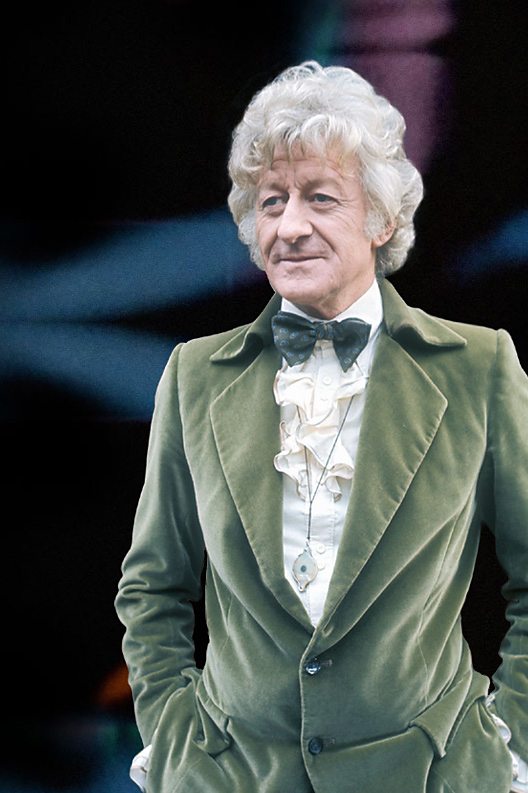
He wore bow ties
before bow ties were cool.

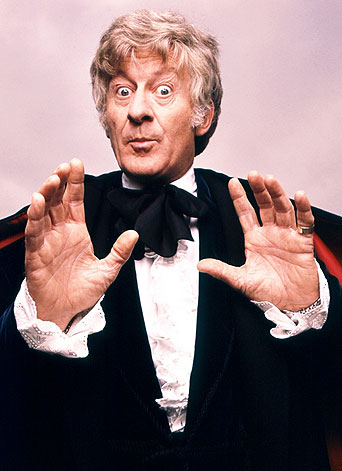
I think the first reason Classic Who Series Seven succeeded while Revived Who Series Seven collapsed is due to the Doctors themselves.  Classic Who had a lot riding on its seventh season.  As the debut season for a new Doctor, the Third Doctor was starting fresh.  Pertwee could shape the Doctor any way he wanted, and in fact the producers had hired him in part because pre-Who, he was known as a light comic actor (or as one DVD special feature put it, as "an eccentric cabaret performer").  Who producers hoped that Pertwee would work in the funny voices he was known for in the radio show The Navy Lark, and make the Third Doctor even lighter than Patrick Troughton's Second Doctor (the Cosmic Hobo, as he was nicknamed) had been.

Jon Pertwee, however, immediately rejected this idea.  Instead, he shaped the Third Doctor as a man of action, one who faced dangers head-on and was above all else, serious.  Many times Pertwee spoke of his costume, in particular of the cape with which he wanted to convey to children the image of the wings of a mother hen protecting her chicks.  Pertwee was always conscious of the Doctor being a hero, not through use of force but through the use of the mind.  He also said that one could never 'send it up' or spoof Doctor Who within an episode (MAYBE during rehearsals, but not on-camera).  There could be humor in Doctor Who, but the Doctor himself must never be an object of ridicule.  If one sees the Third Doctor and/or his stories, you always see that both were playing it straight; never dull, just with seriousness.

This is something that I can't say about Matt Smith's Eleventh Doctor.  Any Doctor who 'lays down backing vocals' in a rap song for no discernible reason stands to make fun of the character, to not take things seriously, to turn him into a joke.  Smith's Eleventh Doctor has been described to me as 'child-like', but the more I see of him the more I don't think of him as 'child-like'.  I think of him more as 'imbecile', barely able to function in society, a danger to himself and others.

His costume was the subject of endless fascination...with him and him alone.  "Bow ties are cool."  "Fezzes are cool."  Wandering around with a bow tie, a fez, and a mop...these aren't the actions of someone I would consider rational, let alone heroic.

Side note: on a couple of occasions the Third Doctor DID have to dress up in a silly costume (once as a cleaning lady I believe) but it was made perfectly clear that he did it for a perfectly logical reason (to disguise himself and get inside someplace undetected), and both the Third Doctor and Pertwee always hated when he had to dress up in these guises, feeling it made the Doctor look slightly ridiculous.  One can only imagine what he would think of 'fezzes and Stetsons'...


What an ugly face,
I mean, fez...
Eleven's goofy dance at Amy and Rory's wedding in The Big Bang Part 2, his perpetual befuddlement at just about anything, his calling Rory's father "Mr. Pond" (which eliminates the oft-heard excuse that he thought Rory took on Amy's name because he thought she was the dominant one...so dominant that Rory's DAD took his daughter-in-law's name too? I think not), his jumping on the table and declaring himself "Mr. Clever" in Nightmare in Silver...these actions look like those of either a clown or a flat-out bonkers figure, not someone I could rally around or look on as 'heroic'.


You'd never catch Jon Pertwee/The Third Doctor 'talking Baby', going on about his fezzes, jumping up and down screaming about his 'Golden Ticket', or asking for same-sex marriage equality for horses...

Even worse, Eleven is quick to defer to others: he defers to River in the piloting of the TARDIS (a particularly sore point w/me, given that the 'whooshing' sound exists for all TARDISes despite the foolish 'joke' about 'the parking brake'), he lets Madame Vastra and Jenny take on a greater role in their stories to where, in The Crimson Horror, THEY rescued HIM rather than vice-versa. 

Third would never have allowed his Companions this kind of leeway.  In fact, many conflicts emerged between the Doctor and The Brigadier BECAUSE didn't see eye to eye.  The respect was there, but their different worldviews were what gave the show drama.  Conversely, it's Eleventh's willingness to let others take charge (to coin a phrase, let the Doctor 'leads from behind') that makes his stories rather daft.

The Third Doctor had a strong antiestablishment streak, a bit of a rebel, but one who cared about his Companions and friends.  The Eleventh Doctor is mentally unstable, unaware of basics of human existence (such as how marriages work), but he cared about his Companions and friends.  Some things never change...


She's smart.
He's smarter.
No flirting.
One thing that IS different in the relationship between Doctor and Companion.  Pertwee was very clear: in one of his last interviews he said there was never any hint of romance between the Doctor and his Companion(s).  The Doctor was very fond of his Companions, but fondness, Pertwee said, was quite different from desire.  Smith, on the other hand, has almost ALL of his Companions in fits of erotic mania.  Granted, this is a carry-over from David Tennant: Rose was in love with him, Martha was in love with him, Captain Jack was in lust for him, and with Smith, Amy tried to rape him, and River...that's a whole other topic.

In Classic Who's Season Seven, Companion Liz Shaw expressed no sexual yearnings for The Doctor, only respect for his abilities (a respect that was mutual).  In NuWho's Season Seven, can we say the same about Clara? 

When you are with the Third Doctor, you knew he was the smartest person in the room.
When you are with the Eleventh Doctor, you knew he was the dumbest person in the room.


Second, it is the stories themselves.  The Third Doctor stories tackled very deep subjects, such as the fear of 'the other' in The Silurians and The Ambassadors of Death, and the dangers of preemptive strikes in the former.  The stories they told were not just fantasy/adventure/science-fiction stories (although they were all that).  They could be read as allegory, speaking of greater concerns that could not be addressed openly. 

I look at Spearhead From Space.  It's a fast-paced story that builds beautifully and is filmed with the brilliance of a feature film (since it was filmed by a film crew owing to a television strike, it does have that cinematic quality).  However, if one sees Episode Four during the actual Auton invasion, we can see that although money was spared, what one can imagine can be quite terrifying in and of itself.  When the Autons are killing bystanders in the streets, it can be read as almost prescient about random acts of violence or even terrorist acts.  Though not graphic it is still a terrifying sequence.

Eleventh's stories, conversely, are hampered by their fixation on A.) the Companions being the primary focus, and B.) the story arcs from which there can be little to no deviation.  If you look at every NuWho Series Seven story, there is nothing there that can be called 'deep' or allegorical. 

I suppose if you want goofy adventure stories a la Dinosaurs on a Spaceship that's fine.  There is nothing wrong with fun, goofy adventures.  However, even within the stories themselves, there is little internal logic to them, let alone a logic that can hold the long story arcs NuWho goes for.


He's stupid.
She's trigger-happy.
Twenty year age gap in real life.
A Love Story for the Ages...
Take Cold War for example.  From the Troughton story The Ice Warriors onwards, it was established that the Ice Warriors were basically what you saw...'Martians' who spoke with elongated 's' sounds and looked like somewhat lumbering figures.  Now, we not only get the 'last of their kind' tripe (something we've seen far too often) but they are really tortoise-like, their shells covering something that looks like a shallow rip-off of Alien. 

Even worse, we get more pleas to 'feel' for the Ice Warrior because he's sad he's all alone, and a remarkably lazy Deus Ex Machina (a group of hereto unknown Ice Warriors can sweep the lost Ice Warrior away at the last moment).  And WHO exactly was taking pictures aboard a secret Soviet submarine which could find their way from the vast Russian archives to a website to allow those annoying kids to discover their nanny Clara was a time traveler? 

TEARS defeated the Snowmen? 
The Doctor managed to ignore River Song (or her hologram) until he managed to stop said hologram from slapping him?
The Doctor manages to ride a motorcycle up on the OUTSIDE of a building?
The Doctor keeps saying, "Doctor Who?" when the Dalek Oswin erases all their memories of him?

Adventure stories are one thing.  Insulting the audience's intelligence (in particular those who know the show pre-Rose) is another.

I think that for me the reason Classic Who Series Seven is brilliant and Revived Who Series Seven is abysmal is due to a few factors.  Classic Who took things seriously.  Revived Who does not.  Classic Who had an intelligent hero.  Revived Who has a certifiably insane man.

Above all else, Classic Who Series Seven has well-written stories that are deep and (special effects aside) still hold up.  NuWho Series Seven has a massive budget but allows its visual wizardry to drown out anything cohesive or logical.  In short, Revived Who's Seventh Season is the Seinfeld of Doctor Who: they are episodes about nothing.  This, above all, is why I think Classic Doctor Who Season Seven was a smashing success, and Revived Doctor Who Season Seven was a complete disaster.

River Song a Sex Symbol?
Don't make me laugh...

Wednesday, August 21, 2013

Television WILL Rot Your Brain


STORY 177: THE IDIOT'S LANTERN

The Idiot's Lantern might be thought of as a euphemism for television: the bright glowing thing that lowers your intelligence.  I could say that certain Doctor Who episodes do just that (River Song-centered stories, anyone), but The Idiot's Lantern is not that.  Instead, The Idiot's Lantern is a fast-moving, well-crafted story brought down only by stabs at kitchen-sink drama.

The Doctor (David Tennant) and his Companion Rose Tyler (Billie Piper) are all set to go see Elvis on The Ed Sullivan Show.  Being the Doctor, he gets the time and place wrong (making his pompadour hair all the more noticeable).  No need to worry: they've arrived in time to see the coronation of Her Majesty Queen Elizabeth II in 1953.  The desire to see the Coronation live has led to a run on the new television sets.  Magpie's Electronic Shop has an unbelievable offer: television sets for five pounds.  FIVE POUNDS!  It's a steal.

And of course it is, for Mr. Magpie (Ron Cook) is being forced to do something wicked by The Wire (Maureen Lipman), who will use the television to take over the world.  Having escaped execution by converting into electronic wavelengths, her plan is to capture enough people's minds to take on a physical form and thus continue her reign of terror.  It seems that whenever a person has been taken, their face disappears.  The only thing connecting them is a new television set, purchased at Magpie's...

In this Coronation Street-world is the Connolly family: brutish father Eddie (James Foreman), his long-suffering wife Rita (Debra Gillett), Grandmamma (Margaret Booth), and bright young man Tommy (Rory Jennings).   Tommy chafes under his father, and while Tommy trusts the Doctor and Rose, Eddie would rather keep family secrets just that.  Chief among them: the lost face of Grandmamma. 

Still, she is discovered and Operation Market Stall sweeps her away to where others in similar situations are in.  The Doctor and Rose are determined to solve this mystery, which leads them back to Magpie's.  There, the Wire is discovered, but not before Rose herself has been converted.  Now the Doctor has a motive to bring this to an end.  Realizing that the Wire will use the Coronation's vast audience to wreak havoc, the Doctor with Magpie's help must now stop the broadcast...even if he must make people think he's The King of the Belgians.   He manages to defeat and capture The Wire on tape (which will never be played), and the long reign of Good Queen Bess can commence.

We learn that the informant of who has been ratting out The Faceless Ones is the evil Eddie.  Tommy stands up to him and Rita throws her bully husband out.  While the nation celebrates a Second Elizabethan Age a somewhat despondent Eddie begins to go.  The Doctor and Rose persuade Tommy to go to him, for after all, Eddie IS his father.

 I do wonder whether writer Mark Gatiss was working out some of his personal issues with the Connolly subplot in The Idiot's Lantern.  The bright and eager son who has a verbally (perhaps physically) abusive father and terrorized father...could Tommy be a substitute for Marky?  Gattis was not alive at the time of the Coronation, and it is speculation on my part, but I figure there has to be a reason why we have a fixation on the domestic front when it feels like its the only thing that pushes the episode down.  It all smacks of second-rate soap opera material, and I wonder why we couldn't have a regular, even pleasant, family at the center brought to terror by having Grandmamma erased. 

This subplot is just dull, and to be honest I felt Foreman's performance as the brutal Father Dursley (excuse me, Connolly) was so over-the-top it bordered on cartoonish.  Similarly Gillett's Rita was a stereotypical abused wife, though at least she had her moment where she stood up to her husband was well played.  Even Booth's Grandma was a bit clichéd. 

I also found the name-dropping of Torchwood to be endlessly annoying.  I have never been enamored of either the obsession of Russell T Davies for his creation (really, does it have to be mentioned in every Doctor Who episode) or for using Doctor Who to push for a spin-off (especially since I have never been enamored of Captain Jack either). 

Finally, I wasn't too thrilled that The Idiot's Lantern relegated Rose to not just a damsel-in-distress but also almost irrelevant.  By pushing her to the sidelines, especially after she put it together before the Doctor, it takes away from the point of Rose: the tough, bright girl who longs for adventures.  How much adventure can she have if she is rendered faceless and useless?


There were, however, other things that pushed up The Idiot's Lantern for me.  If one saw it as almost a spoof of television itself I thought it worked well.  While The Wire herself was not a particularly great villain, I thought Lipman's performance was quite good.   Jennings is also good as Tommy (much better than Gattis' material).  Tennant was excellent throughout the episode: from frivolous and fun (and yes, the hair was good too) to filled with anger and righteous fury (especially when attempting to rescue Rose, which as we know is what he does...rescue girls stuck in television sets).  Finally, the tension that builds when the Doctor races to save Britain from the Wire as she soon starts sucking the Coronation's audiences (intercut with actual Coronation footage) was well-handled. 

On the whole The Idiot's Lantern was better than I remembered, but not as good as it could have been (especially the Connolly family issues taking up too much space).  Still, it is worth sitting comfortably for... 

7/10

Next Story: The Impossible Planet Parts 1 & 2 (The Impossible Planet/The Satan Pit)

Sunday, August 18, 2013

The Fire This And Next Time. Doctor Who Story 054: Inferno


STORY 054: INFERNO

The Doctor (Jon Pertwee) has a terrible dilemma: he is stuck on Earth with no way out.  He is now in the unenviable position of having to wait for things to happen rather than take charge.  However, he is making the best of it, working as the 'scientific advisor' to the United Nations Intelligence Taskforce (aka UNIT) with his newest Companion, Dr. Liz Shaw (Caroline John) and under the protective (and at times, antagonistic) gaze of Brigadier Lethbridge-Stewart (Nicholas Courtney) who can be called something akin to the Doctor's friend.  So far things are going rather well, but what if everything the Doctor knew about those around him was thrown in disarray?  What if he found himself in a world both similar and unfamiliar, where those closest to him turned to be the most dangerous?

Inferno, the first Doctor Who story that dealt with paralle universes, is at seven episodes (or around three and a half-hours) a long story to which conclude Series/Season Seven, but it that time it is a breathless and wild run, filled with action, adventure, suspense, some astonishing acting, a thoughtful plot, and even a few moments of romance and comedy.

The Doctor is asked to come look at the Inferno Project, an effort to drill straight on through to the Earth's core, which in theory should provide vast supplies of cheap energy.  The project, overseen by UNIT, is headed up by Professor Stahlmann (Olaf Pooley) a cranky, short-tempered, cantankerous man who will bridge no dissent.  Over his objections, project director Sir Keith Gold (Christopher Benjamin) insists on bringing in Greg Sutton (Derek Newark), an oil rig expert.  Sutton warns against going in further, and while Stahlmann's assistant Petra Williams (Sheila Dunn) slowly sees his side the bad professor will not budge.

The Doctor is also interested in Inferno, or particularly the nuclear power it is using, as a way to get the TARDIS to dematerialize and allow him to overcome the time/space travel embargo the Time Lords have imposed on him since he was exiled to Earth at the end of The War Games.   The Doctor still gives out warnings as to the potential danger of the Inferno Project, but no one will listen.  However, the Doctor has problems of his own.  In a desire to regain control of the TARDIS, something has gone horribly wrong and he travels 'sideways' in time (as a side note, we see that Doctor Who beat Lost in the 'sideways' department by a good thirty years), forcing him to enter a parallel world where he meets people who are similar to those he knows but who are not like them either.

For example, the Brigade Leader Lethbridge-Stewart is a fascist ultra-militaristic figure who stamps out all opposition.  Section Leader Shaw, while still highly intelligent, is also a brute who believes might makes right.  The biggest change is that of Platoon Under Leader Benton.  On our world, Sergeant Benton (John Levene) is a very nice, sweet, almost innocent fellow who despite being in the military never seemed capable of harming anyone.  That isn't the case with the Platoon Under Leader, who is ruthless, uncaring, and extremely violent.

On this Earth, the Inferno project is much further along.  The Doctor desperately warns them of the danger, but again he is not only refused but seen with suspicion by everyone else except a growingly curious Liz. The parallel Stahlmann is determined to stop the parallel Sir Keith from interrupting the work.  Here, it involves getting Sir Keith extremely lost, but tragically is killed off screen.   Here, we do reach the Earth's core, and disaster strikes.  Reaching the Earth's core unleashes all the volcanic fury, which means the Earth becomes a molten mass which would destroy the world.

While the parallel world is collapsing, things on our world are going along as scheduled, so we know what is going to happen unless the Doctor can manage to go back to our Earth AND get there before it was too late.

Will he be able to do both?  He's the Doctor, what do you think?

As it so happens, when he does manage to escape the collapsing parallel world and return to ours, the Doctor finds that things are not exactly like on the other world.  Sir Keith for example, IS involved in a car accident, but he survives.  With this, the Doctor realizes that history is not inevitable.  The Doctor is able to stop the Inferno project, while even in this reality it is too late to save Professor Stahlmann by being turned into a monster as a result of the ooze emerging from the Earth's core.  At least it isn't as bad as on parallel Earth where Stahlmann turns many to monsters, including Platoon Under Leader Benton.

Inferno ends with Petra and Greg, who have formed a bond, going off together and the Doctor managing to move the TARDIS console a few seconds into the future and a few yards outside his garage.  Despite having called the Brigadier a pompous idiot, he humbly has to ask for help in retrieving the console from the rubbish heap its landed on.

Inferno was stretched because the original Don Houghton script dealt only with the drilling story and it was felt that it would not be enough to sustain a seven part story.  As such, we got the parallel storyline, which to be honest never felt thrown in but was integrated beautifully.  By giving us a parallel universe we get two things that a more direct story would not:  first, we would have seen that what happened in that world could happen in ours (giving us a frightening sense of foreshadowing) and two, we had a chance to see the regular cast go out of their comfort zones and give us a range that had not been tapped.


Because we have gotten to know the Brigadier, Liz Shaw, and Sergeant Benton in the preceding stories, seeing them in Inferno is quite a shock.  Rather than the pleasant and kind figures we've been with, almost a family to The Doctor, we see cold, ruthless, murderous figures.  Of the three, it is Levene's Benton who shines the strongest.  Inferno is John Levene's finest hour as an actor on Doctor Who up to now (and perhaps in all of his time on the show).  His transformation from the pleasant, genial sergeant to the brutal Under Platoon Leader is a revelation, one where he slips into both characters so brilliantly one can see either of them as real.  Levene has a third transformation, into a Primord (the Wolfman-like monsters), and when he is taken down by the other Primords is a terrifying sequence.

Courtney and John in the dual roles are also top-notch, the former more brutal than his counterpart, and in the case of the latter, her growing shift from mindless military cog to one who questions whether what is going on is right is, in her final Who story, a wonder to watch.

As for the guest stars, I thought Newark and Dunn played their parts excellently, where the growing affection in our world matched the more established romance in the parallel world.  They didn't have to play as if they were lovers or falling in love, but with pauses, glances, and the dialogue, we learn all there is to learn.  Pooley's Professor Stahlmann (how many times are professor the villains on Doctor Who?) was curt and unpleasant, which was correct, making him unlikeable and thus perfect for the part. 

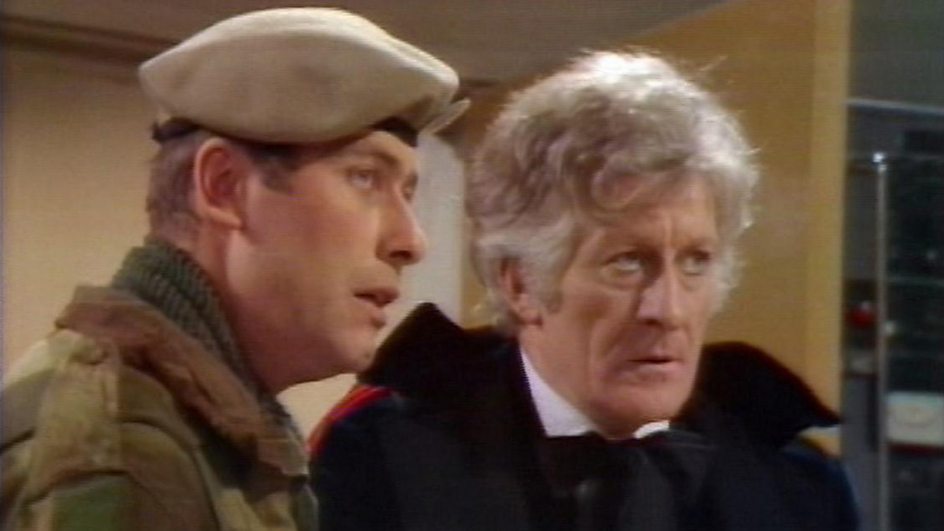
In regards to Pertwee, he proved in his debut season of which Inferno was the conclusion that he basically now OWNED the part.  He managed to rattle off some amusing lines, such as in Episode Two where Stalhlmann dismisses the one computer that warns of danger with the line, "That computer is oversensitive.  Its data is unreliable."  To which Pertwee's Doctor retorts, "You talk abou that thing as though it was your maiden aunt."  Pertwee brought a sense of seriousness to Inferno in both worlds, of a figure who knew what he was talking about and grew impatient when those who didn't kept getting in his way of saving them all.  Pertwee manages to be funny, clever, and rational.  He can be funny without being ridiculous (something which sadly not all his successors managed...Smith...).  Throughout Inferno, Pertwee never makes light of the situations and remains totally convincing as the Doctor, showing he does have compassion for even those who haven't. 

In Episode Five, he shouts, "Don't touch him, Brigadier," momentarily forgetting that he is NOT the Brigadier he (and we) know, but the cold and ruthless Brigade Leader.  This gives us a glimpse into the humanity of the Doctor.    When he does return in Episode Seven, he snaps at whom he calls "Brigade Leader", and I continue to marvel at how good Jon Pertwee was as The Doctor.

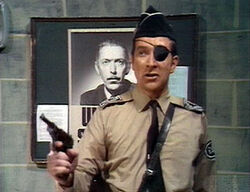
Houghton's script not only manages to take wild turns with the alternate universe storyline, but even manages to poke some fun at some Who conventions.  When in Episode Four the Doctor is brought into the Brigade Leader's office for questioning (and the sight of the Brigade Leader/Brigadier swiveling to reveal an eye-patch is stunning) he demands to know who he is.  He replies "The Doctor."   I'll bet a million pounds someone like a Steven Moffat would have jumped at the chance for a "Doctor Who?" bit, but Houghton instead has the Brigade Leader say, "Doctor.  Doctor WHAT?" which is much more clever.  Upon informing the Brigade Leader that he doesn't have a counterpart in this world with, "But I don't exist in your world," Lethbridge-Stewart replies, "Then you won't feel the bullets when we shoot you." 

What remarkably clever writing, both in terms of story and dialogue.


Oh, Really?

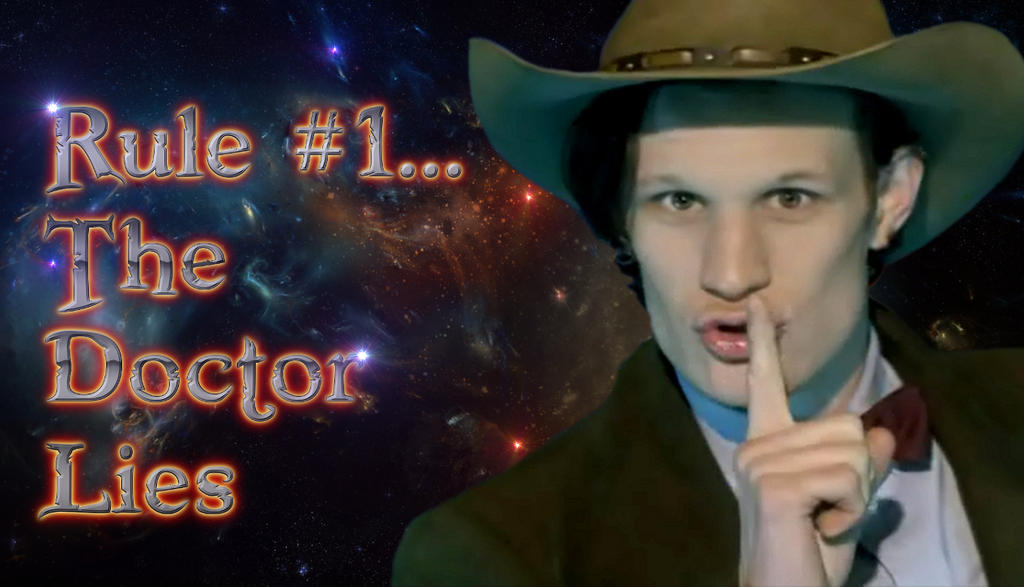
One thing I would like to point out here is how Inferno contradicts long-established NuWho thinking with regards to "Rule Number One: The Doctor Lies."  In Episode Four he attempts to convince Section Leader Shaw of who he is.  She doesn't believe him.

"If you told us the truth, there might be some hope for you."

The Doctor replies, and I quote,

"Your counterpart in the other world would tell you that I'm not in the habit of telling lies, Elizabeth." (Emphasis mine).

He certainly wasn't lying when he was telling those in the parallel world who he was, so we can establish that he wasn't lying about not lying.  This might be one of the reasons why NuWho, in particular the Smith Era, has been such a let-down.  MY Doctor doesn't lie, but a whole generation repeats the mantra, "The Doctor Lies.  The Doctor Lies."  No, he doesn't, and any suggestion that he does has to be erased.  I reject it because A.) it's not true and B.) it serves no purpose.  Yet I digress.

What also works with Inferno are the special effects (the sequence of the parallel Earth being destroyed being quite effective and terrifying), the music, the stunt-work...it's more for a search in what DIDN'T work, which is impossible. 

Inferno is a brilliant close to what has to be the best Classic Doctor Who season so far.  A story that is remarkably fresh after over thirty years (think fracking), great performances by the cast, a thrilling adventure, a parallel storyline played with intelligence, and even moments of romance and comedy all make Inferno one of the best Third Doctor stories so far.  Inferno is in a word, brilliant. 

One might say, even, illuminating....

10/10

Next Story: Terror of the Autons

Saturday, August 17, 2013

Lost in Cyber Space


STORY 176:
RISE OF THE CYBERMEN PARTS 1 & 2
(RISE OF THE CYBERMEN/
THE AGE OF STEEL)

*Author's Note: all Two-Part NuWho stories will be collapsed into one title and one review.  As such, the overall story is baptized Rise of the Cybermen Parts 1 & 2.  If referring to a specific episode I shall use either Part 1 or Part 2 to signal whether I'm referring to Rise of the Cybermen or The Age of Steel.

You have a long history to work with on Doctor Who.  You have legendary villains and monsters that have become iconic.  The Daleks certainly are the most famous of the Doctor's foes, but hot on their heels are the Cybermen.  NuWho has brought the Daleks back to menace the Doctor and his Companions so it seemed fitting to have the metal monsters make a comeback. 

The two-part story Rise of the Cybermen is the first to feature the precursors to the Borg, but they aren't your father's Cybermen.  Tom MacRae's screenplay for this two-parter has the Cybermen coming from an alternate universe, which has its pluses in that it does away with having to maintain some continuity with the Classic series Cybermen stories from The Tenth Planet onwards.  Its minuses: it will lead to thorny issues in terms of continuity within NuWho itself as time goes on, but that is for another time.

Part I: Rise of the Cybermen

The Doctor (David Tennant) along with his Companions Rose Tyler (Billie Piper) and her boyfriend Mickey Smith (Noel Clarke) are travelling through time and space when an explosion in the TARDIS causes it to enter a parallel world.  However, the TARDIS is outside the Time Vortex and the damage is just too great.  They may have to stay in this world forever.  This world, however, is similar to their own.  Rose and Mickey have doppelgangers of sorts, and Rose's father Pete (Shaun Dingwall), far from being dead, is not only alive but extremely successful, marketing a health drink with the tagline, "Trust me on this".  The Doctor tells Rose this ISN'T her father and to stay away, but of course she won't listen.  Mickey won't listen as much either, sensing that in this parallel universe, his late grandmother may be alive and well.

Can you tell I'm CRAZY?

As it happens, John Lumic (Roger Lloyd Pack), head of Cybus Industries, has been engineering a secret army made up of 'reprogrammed humans'.  The Preachers (as in 'the Gospel Truth'), a group of rebels, have been attempting to bring down this organization.  By sheer coincidence, when Mickey is visiting his alternate granny (and having a chance to stop her from falling down the stairs, what killed her in his world), Jake (Andrew Hayden-Smith), one of the Preachers, finds Mickey and takes him.  Seems he bears a striking resemblance to Rickey, the leader of the rebellion.

The Doctor and Rose crash the Tyler's lavish party.  Rose discovers her alternate figure...is a literal dog.  Here, Lumic unleashes his deadly army...The Cybermen.  The Cybermen are in their minds Human Point Two, with everyone in the world be receiving an 'upgrade'. 

Part II: The Age of Steel

The Doctor recognizes the Cybermen and knows he cannot stop them there and then.  Fortunately, Rickey/Mickey and the rebel alliance arrives, helped by a mysterious inside man known as Gemini who has been tipping them off about Lumic's activities.  As it is revealed, Gemini is none other than 1 Percenter Pete.  Now it is up to the Doctor to stop Lumic's mad plan to 'upgrade' the world and make everyone a Cyberman.  Rickey has been 'deleted' (read, killed) in the chaos, and we have now three groups breaking into Cybus Industries HQ.  One group consists of the Doctor and Mrs. Moore (Helen Griffin), a member of the Preachers who has lost her family to the Cybermen.  Group Two is Jake and Mickey (the latter finally forcing his way into the action after being a wimp in every episode).  Group Three is Pete and his 'daughter'. 

Group Three does find Jackie, or the Cyberman who once was Jackie Tyler (to the other Tyler's horror).  The Cybermen have staged a coup of sorts, deciding to take things into their own hands.  One of those results is that Lumic is now the Cyber Controller, receiving an 'upgrade' of his own.  Mrs. Moore is killed and the Doctor captured, but not before discovering an emotional inhibitor within each Cyberman.  If this is destroyed, the emotions within the emotionless Cybermen will destroy them all.  Mickey and Jake manage to destroy the tower sending messages to the population that brought them to the factory via earpieces (a bit like Bluetooth) sending them screaming out of there.  The emotion inhibitors are also destroyed, as is Lumic.

The Doctor, Rose, and Mickey return to the TARDIS.  Fortunately for them, a little light within the TARDIS is still functioning, so with some time it had enough power to reactive everything and get them out of the alternate universe.  Mickey, however, decides to stay on and take Rickey's place to continue the struggle against Cybus.

It's a curious thing that despite having two hours to tell its story, Rise of the Cybermen feels extremely rushed, almost frenetic in its story; as such, no one ever truly stops to wonder exactly not so much what is going on but why something is going on. 

Take Lumic for example.  What exactly is his motive for his Cyber Army?  It might be for having him walk again, and while that might be a bit cliché at least he would have had some reason for his mad plan.  The fact that he wants to because he just wants to seems to be a non-starter.  Another question I have involves the population's earpieces.  Are they compulsory?  It seems like everyone had them, but what if a person didn't want it?  As such, they wouldn't be under the Cyber-spell.  People can easily remove them (I imagine they don't sleep with them), so I kept wondering about those who would either reject them or not use them as much.  Would they fall prey to upgrading?  I figure that once Lumic's Cyber-Army had control of the world, they would fall prey, but again, why did Lumic not bother with the Preachers' meddling?

Finally, and this might be odd, I wondered what exactly were Lumic's plan post-conquest?  That age-old question of what a mad scientist does when he achieves his dream of world conquest remains unanswered. 

Going further into the 'rushed' business, the identity of Gemini seems to come out of thin air: oh, Pete is Gemini almost just because Pete is there.  We never get a suggestion that he is involved in some sort of revolution, we never hear the Preachers getting some kind of message from an inside source, and if memory serves correct we never get a sense that there WAS an inside source at all.  This is contrary to the parallel Rose's identity. 

I can't help thinking that it might have worked better as a story if we didn't find who (or what) Rose's replacement was until later in Part 1.  It would have given both Rose AND the audience something of a surprise (and a chuckle).  I also think it would have worked better if the Revolution had been properly introduced rather than just almost thrown in there, especially when one considers how much time was spent on Rose's somewhat whiny need to see her dad...yet again.  Given we'd spent an entire episode on this, what exactly was the need for her to basically do it again?


I'm going to touch on another aspect of Rise of the Cybermen that displeased me the second time round.   We're told that the TARDIS is basically stuck in this parallel universe, no way out.  Then, almost out of the blue, we get a little light of ours to give us hope.  Shades of the fireplace from The Girl in the Fireplace (a convenient way out of a particular time)?   IF the Doctor had said it needs a certain part or material that might be found in Cybus Industries, THEN we might have something, but the 'little light to lead us home' business fell flat.

In terms of performances, I think Dingwall came off best since he now had to play a variation on Pete Tyler.  He actually managed to pull of the "I'm Gemini" bit much better than it comes off on paper, and his farewell to his 'daughter' was moving. 

As a side note, Rise of the Cybermen aimed to be one of those NuWho episodes that sets fans to crying with its constant plugs at emotional heartstrings-pulling (Mickey's grandmamma, Mrs. Moore's family, the farewells between Rose and Mickey).  Fortunately, I don't cry at Doctor Who.

Clarke's performance was interesting.  He had to play two characters and aimed to play Rickey as a tougher, grittier person than the inept wimp Mickey.  I don't think he quite pulled it off but he gave it as good a go as possible.  Piper's Rose is who came out of it the worse.  Her Rose, who started out as this tough and adventurous sort, here came off as whiny (I want to see my Dad!  I want to fix their marriage!  I...I...I am going to cry at every street corner!)  I found her annoying, which is a strange departure from the Rose I first met. 

Tennant still does well as the Doctor, and Camille Corduri's Jackie Tyler was good but not all that different from her doppelganger.  Lloyd-Pack's performance as Lumic I thought wasn't menacing but downright comic.  His gruff voice and wild-eyed look made him look ridiculous rather than dangerous.  It was a bit too hammy and laughable for me to take seriously, bordering more on spoofing Dennis Hopper's Frank Booth in Blue Velvet than on a mad genius.  I'm surprised he didn't ask for his Mommy...

If there are some good things within Rise of the Cybermen, it is the visuals.  The initial invasion is quite effective and tense, and the 'upgrading' of the humans in Part 2 is equally frightening.  However, that is not enough for me to feel that, on the second viewing (the first since the two-parter premiered) I could not muster as much enthusiasm as I had the first time round.

Finally, let me address the issue of continuity.  IF this is a parallel universe where they cannot cross into 'our world', what will become of the Cybermen should we see them again?  They can't be from the parallel world (unless they somehow do manage to 'cross over'), but will the Cybermen who will menace the Doctor in the future (should that ever happen) be the ones from Mondas as first seen in the First Doctor farewell story The Tenth Planet?  Since I suspect future Cybermen will look like the ones from this parallel universe, there is a lot to be answered.

Visually splendid but frantic and rushed, Rise of the Cybermen Parts 1 & 2 simply could have been better.  We could have reintroduced these iconic Doctor Who monsters in a better vehicle.  Yep, the Cybermen still are a muddled affair: sometimes appearing in some of the best Doctor Who stories and sometimes the worst Doctor Who stories.  Rise of the Cybermen Parts 1 & 2 falls somewhere in the middle.

In the end, I suggest we reboot rather than upgrade or delete...  

Say "Cyber-Nara"...


5/10

Next Story: The Idiot's Lantern

Sunday, August 4, 2013

Who Are You?

Born 1958
(before Doctor Who premiered)


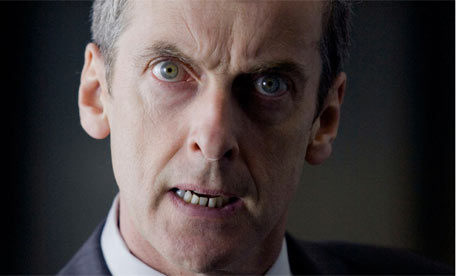
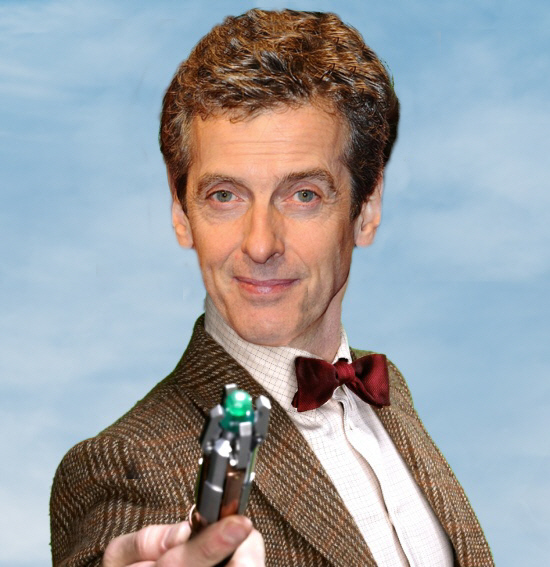
Well, at long last we have the 12th Doctor: Peter Capaldi.  Curiously, he is referred to as the 12th Doctor, which makes for a strange turn given that in The Name of the Doctor, we had "John Hurt As The Doctor".  Therefore, if you count him, we already have TWELVE Doctors, making Capaldi perhaps technically the Thirteenth Doctor. 

If this is the case, then we have a problem.  The Fourth Doctor story The Deadly Assassin established that a Time Lord can regenerate only twelve times.  The whole story hinged on the idea because the Master, on his final regeneration, was determined to live on.  The Sixth Doctor's season-long Trial of a Time Lord established the Valeyard, the villain of the piece, was himself a dark version of the Doctor between his twelfth and final (ie. his thirteenth) regeneration. 

Again and again we have the series pre-Rose establish that there can be only twelve regenerations.  Still, since when have such matters as continuity and logic ever stopped NuWho? 

As I understand it from NuWho fans, "You don't apply logic to Doctor Who."  I think you don't apply logic to NuWho fans, but I digress.

Sadly for the Master, that Legendary Legend of Legendness River Song wasn't around to bail his butt out of this particular situation (or ALL situations if we judge by the Smith Era).  I can make a strong argument that River Song cannot regenerate because she is human and the idea that a non-Time Lord regenerating is an impossibility.  I know the story is that because her parents Amy & Rory WILLIAMS (not Pond, sorry NuWhovians) schtupped in the TARDIS their sperm and egg were exposed to the Time Vortex and thus their child, conceived by the Power of the Holy TARDIS, was able to regenerate.  It also gives an out for more Doctors as River "gave up her remaining regenerations to The Doctor" (again, an impossibility).

It was pointed out to me that in The Five Doctors, the High Council offered the Master a new regeneration cycle, so transference is possible.  However, it was the High Council who made the offer, not some psychopathic slut. 

In any case, let us turn not to the 12th (for now) Doctor, but to the Doctor Who Live: The Next Doctor special.  Has there ever been such a grandiose entrance to a fictional character? 

Yes, I watched it, but I found it all rather tawdry.  It was once a very simple thing: an actor announced he was leaving, there was a search, then a press announcement and conference for the newest Time Lord.

Oh, but we couldn't have THAT for today, now could we?  We turned this into an EVENT, a spectacle, something tantamount to the Second Coming. 

Tease, tease, tease... 

Finally, when the announcement was made, as could be expected, fools made their views known.
Wrote someone on Capaldi's Wikipedia entry:

"He is to be the Twelfth Doctor in Doctor Who. Bummer."

So much for Wikipedia being the fount of all knowledge.  It was quickly edited out to a more professional tone, but still amusing.

It's a curious thing that at 55, Capaldi ties the First Doctor (William Hartnell) for being the oldest actor to play the Doctor.  This time, the oldest actor to play the Doctor follows the youngest actor to play the Doctor (11the Doctor Matt Smith being 27 when his tenure began). 

I have no idea who Peter Capaldi is, which is both good and bad.  I said the same thing about Matt Smith, and ended up HATING his take on the Doctor (goofy, grinning idiot who did nothing but whip out his handy-dandy sonic screwdriver to solve anything...or turn to River to fix it for him). 

I learned he is no stranger to Doctor Who.  He had already appeared in The Fires of Pompeii, but this is not a hindrance.  Colin Baker appeared in the Fifth Doctor story Arc of Infinity in a prominent role only to go on to be the Sixth Doctor, so anything can happen.  Curiously, the show never addressed his similarity to the character of Maxil in that story...

In any case it is too soon to speculate how good or bad he will be.  I like the idea that they went older and for a relative unknown rather than say a Rupert Grint or Skyfall's Ben Whishaw.  Maybe if one gets an older actor the character can be serious again. 

Dear God I hope the character is serious again...

Well, nothing to be said about Peter Capaldi as the 12th (or 13th) Doctor until the Christmas Special.

I wish him well, and pray he doesn't screw it up like Matt Smith did. 

Let Us Pray...

Saturday, June 8, 2013

A Very Important Announcement


Today I will be starting a summer semester for a Master's Degree in Library Science.

As a result I fear I will have to cut back on my blogs, so from now until August I may not be able to post as much as I would like.

However, knowing me the opposite could happen and I may be posting more. Sometimes when I have a lot of work I do more of other things.

In any case I'm writing this to let you, the reader, know why I may appear to be inactive and silent for the next couple of months. I will take one or two breaks to complete the Superman Retrospective at Rick's Cafe Texan, but on the whole I think I will have to put my pen down for a while.

I hope to be back here with you real soon.

All the best,

Rick

Tuesday, June 4, 2013

So Long, Farewell, Auf Wiedersehen, Goodbye...

The Eleventh (For Now) Doctor:
"I've done enough damage.
My work here is done..."

It is now official: Matt Smith will be leaving Doctor Who in the 2013 Christmas Special, and I say...

LET THE DOOR HIT YOU
ON THE WAY OUT!

This little blurb won't be about who will replace Smith (I'm not keen on a woman...I reject the idea of Time Lords being hermaphrodites).  Instead, I want to take up a few minutes of your time to issue my own thoughts as to how Smith's interpretation of the Doctor has led to the virtual collapse of a once-brilliant show into a sad parody of itself.

In many things, the decline of Doctor Who is not all Smith's fault.  The writing, in particular Series/Season Seven, has been dreadful.  I look over Smith's tenure from The Eleventh Hour to The Name of the Doctor, and the highest score he has earned has been an 8/10.  This occurred four times (The Eleventh Hour, Amy's Choice, Cold Blood Parts 1 & 2, and Night Terrors, with The Doctor's Wife inching towards an 8/10--currently undecided).  However, Series/Season Seven of Doctor Who, starting at Asylum of the Daleks all the way down to The Name of the Doctor, has an average score of 2.6. 

Let me repeat that: the average score for the last 14 episodes is 2.6!

AVERAGE!

In his entire tenure, the average Smith score has been 3.9...OK, let's round up to 4. Minus the "50th" Anniversary Special and the Christmas Special (his final turns as the Doctor), the Eleventh Doctor stories as a whole couldn't even get to above average. 

Incidentally, the lowest Smith score?  Try 1/10, which occurred amazingly four times as well (The Curse of the Black Spot, The God Complex, Closing Time, and Nightmare in Silver). 


Somewhere, a village is missing
its idiot organ grinder monkey...
Conversely, the five other Doctors whose stories I've reviewed (First, Second, Ninth, and the first seasons of the Third and Tenth) have all except for Ten managed at least one 10/10 story.  In each of their tenures there was at least ONE brilliant story that will rank among the greatest Doctor Who stories of all time.  Smith's Era sadly does not have any that will be so lofty.  

I have completed (though not finished formally reviewing) the seventh season/series of the Classic Doctor Who, which was Jon Pertwee's debut season.  Want to know his Series/Season Seven average score?

9.75.

So, to recap:

Seventh Series/Season of Classic Doctor Who Average Score: 9.75
Seventh Series/Season of Revived Doctor Who Average Score: 2.6

As I said, the writing has pretty much damned the Smith Who Era to being an abyss of silliness.  Nonsensical story arcs that focused more on the Companions (It's All About AMY!  Series/Season Six revolved around River Song: her Death, Transfiguration and Wedding!  Series/Season Seven was about Clara "The Impossible Girl"!) than on the Doctor.  The Doctor at times being sidelined to give River or the same-sex bestiality of Silurian Madame Vastra & her Cock-ney chambermaid Jenny the spotlight.  Any issue the Doctor faces being resolved most of the time by flashing the sonic screwdriver (it slices, it dices, it cures non-humans of toxic baths.  If there was a problem/Yo! Sonic Screwdriver'll solve it). 

Matt Smith is an actor who was given a part to play and I'm convinced he played it to the best of his ability.  However, my anger is directed towards how Smith interpreted the Doctor.

The Eleventh Doctor was not someone who actually solved any dilemma he found himself in, at least not with what is suppose to be his keen mind.  Eight times out of ten he would whip out his handy-dandy sonic screwdriver and use that to fix the issue.  The other two times?  Well, either the Companion (usually River) would jump in to resolve the issue, and/or the situation would work itself out with little to no help from him.

How else to explain RAIN/TEARS bringing down The Snowmen?  

Instead, Smith portrayed him as a bumbling idiot, someone more interested in his bow ties and fezzes than in saving lives.  His goofy dance at Amy and Rory's wedding (right down to him waving his arms above his head in synchronicity) still haunts my nightmares.  Rather than be a man of action or intelligence or warmth (like the Third, Fourth, or Fifth Doctor respectively), the Eleventh was one who not only behaved but appear to think like a child.

A side note: Smith may have thought he was taking inspiration from the 'Cosmic Hobo' the Second Doctor was, but we always knew that his slightly bumbling persona was a front to fool his enemies.  The same couldn't be said of the Eleventh.  While the Second Doctor may have been lighter than the First, you'd never see HIM riding a motorcycle up a building as Eleven did in The Bells of Saint John.  Now that was just stupid (something none of the Doctor until Smith was). 


EPCON 2012:
Nice kid, but probably never seen
any Doctor Who pre-Rose...
The Eleventh Doctor truly at times didn't seem to realize or understand what was going on.  For example, when River "lands the TARDIS without the familiar whooshing sound", he is told it is because "you leave the parking brakes on".  He could argue that HE'S been flying the TARDIS for hundreds of years and should know what he was doing.  He could state that previous Companions who could operate the TARDIS better than he (namely, fellow Time Lord Romana) had similarly landed it with the whooshing sound.  He could even point out that other Time Lords (The Master, the Rani, the Meddling Monk) all had TARDISes that made the exact same sound. 

Instead, he somewhat meekly, like a two-year-old, just pouts about how he likes that sound.  In effect, he's being shown up and being portrayed as an imbecile who isn't as smart as his Companion.

Even worse, NuWho fans like young Brandon here will accept this as Canon without even bothering to discover that said whooshing sound was there deliberately.  Instead, should they ever attempt to watch anything from An Unearthly Child to Survival (or the Doctor Who television movie) all they'll think is, 'Silly Doctor.  You've left the parking brake on.'

(However, if they listen to other Time Lords' TARDISes, they may wonder why ALL of them 'leave the parking brake on, so there yet may be hope).


Leaving aside the fact that A.) River was given this bit to show how much smarter she was than the Doctor and B.) this 'joke' was quickly forgotten since the whooshing sound is still around, Smith's entire interpretation of the Doctor does something dangerous: it opens the character to becoming an object of ridicule than of admiration.  One can't take seriously a lead character who grins like an idiot, wears funny things just because the mood strikes him sans rhyme or reason, and especially is shown to not be the smartest person in the room.

I imagine that few NuWho cosplay participants would appear dressed as the First-Third Doctors because whatever their flaws, one could take them seriously.  The Fourth's scarf is too tempting to resist, but besides that what do most Who cosplay figures dress like?  We get plenty of Tenth Doctors (the outfit is pretty easy) and Eleventh Doctors (after all, aren't we all suppose to laugh at the man with the bow tie, fez, and mop). 

EPCON 2012:
Nothing River would enjoy more
than a little girl-on-girl action...
This is one of my big beefs with what Matt Smith did with the Doctor: he turned him into a joke.  Our heroes are suppose to be people/beings we take seriously, whom we can rally round for protection and wisdom.  What kind of protection and wisdom can come from someone who in Nightmare in Silver jumps up and down like a child screaming about his Golden Ticket?  This childish behavior of the Eleventh Doctor is one of the things that I looked upon with anger.

I stand by my position that Smith started out well, but soon degenerated into a joke.  He was goofy.  He was deferential to others to almost solve the problem for him.  When all else fails, use the sonic screwdriver. 

There are just so many awful moments with Smith's Doctor.  There was the time he suggested he was attempting to seduce roly-poly Craig Owen in Closing Time, the episode where our rotund hero said of his defeat of the Cybermen, "I blew 'em up with love".   There was the time when facing off against pirates in The Curse of the Black Spot he seemed almost giddy at meeting pirates rather than in the danger they posed for him and his Companions.  What about when he pulled out a lightsaber-type thing from the front of his pants versus Rory's flashlight/torch (allowing Rory to complain that "the Doctor's was bigger than his") in Vampires of Venice.  Then when the Doctor burst out of the cake at Rory's bachelor party and babbling about the 'nice girl' that had been inside said cake in same episode. Then there was when he crashed through the chimney and began again babbling on about "Jeff" (aka Santa Claus) in A Christmas Carol. 

It was Smith's inability to make his Doctor into someone who A.) was serious in any way and B.) intelligent in any way, who was more a bumbler and perhaps insane that made his Doctor a simply dreadful figure.

You can have a funny Doctor.  Patrick Troughton's Second Doctor has his recorder, but he didn't rely on either the screwdriver or his Companions to solve the problem.  Tom Baker's Fourth Doctor was unabashedly eccentric, but he also was deadly serious when the situation called for it.  The Doctor, until now, wasn't a goofball.  He just played idiot...Smith's Doctor IS Idiot.

Now that Matt Smith is leaving Doctor Who (presumably for greener pastures and bigger stardom), I for my part am so glad he's going (and wish he could take Steven Moffat with him).  I started out as a Smith defender, but seeing him turn the Doctor into a joke, into a blithering buffoon (the fezzes, the River-fixation, the "But My GOLDEN TICKET!"), into someone who inspired more irritation than inspiration, I found myself not only hating Matt Smith but actually hating the Doctor and Doctor Who. 

Matt Smith was only part of the problem.  With him gone I pray that we will return to a Doctor who uses his intelligence rather than his screwdriver, who relies on his Companions but does not defer to them, who can be light but can also be serious.

In short, I want MY Doctor back, not this clown...

Good-bye, Smithy-boy.  And may the next regeneration be better than the insufferable one you turned out to be...

EPCON 2012
At least he dealt with
River Song only once.
Lucky guy...