Saturday, February 23, 2013

Smith & Lesson


STORY 174: SCHOOL REUNION

School Reunion is the first time NuWho has acknowledged it had a long backstory before Rose, and it does so by bringing in the Gold Standard of Classic Who Companions.  It's a curious thing that the first time I saw School Reunion (at its premiere), I was thoroughly enchanted, but after a second viewing, I can't keep up the enthusiasm for it I had when first I saw it.  While School Reunion is a great acknowledgment of the promise and perils of being the Doctor's Companion, and while it also is a great story for kids that tap into all the fears and fantasies they have, in this case perhaps making things a little less obvious might have worked wonders. 

The Doctor (David Tennant) is working undercover as a physics teacher while Rose Tyler (Billie Piper) is a cafeteria lady in a school where strange things are going on.  They were first alerted to this by Rose's bumbling boyfriend, Mickey Smith (Noel Clarke), who figured that UFOs around the school area and new math teachers along with a jump in student's intelligence was suspicious (hacking into the Torchwood Institute files  helps).  The new headmaster, Mr. Finch (Anthony Head) is quickly established as a monster, but exactly what kind is a little bit mysterious.

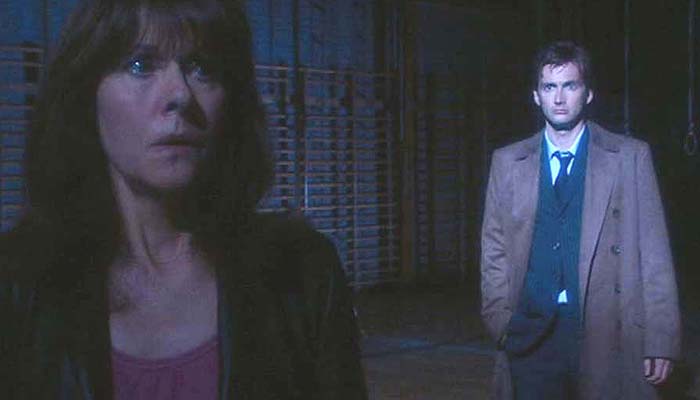
Still, one can't argue with success.  The school scores have jumped, and the Doctor/Rose/Mickey trifecta have traced it to the chips (or fries to us Americans), that most of the kids eat.  This increase in student scores attracts the attention of the press.  Enter investigative journalist Sarah Jane Smith (Elisabeth Sladen).  The physics teacher known as John Smith barely contains his glee at Miss Smith's appearance, but she isn't interested...until she comes across a big blue police box while entering the school at night.  Instantly she realizes that the Doctor is here, and Sarah Jane and Doctor Number 10 reunite.

Still, no time for gentle moments: there's a mystery to solve.  There is also, as Mickey puts it, "every man's nightmare: the Mrs. and the Ex".  It is immediately clear that Rose dislikes, neigh, detests Sarah Jane, seeing herself as The Doctor's first...The Doctor doesn't seem too involved with Rose's jealous streak, telling her that "I live.  Everyone else dies," explaining why he cannot maintain Companions for long.  He has a lighter moment when he finds K-9, the old robot dog that he gave to Sarah Jane in the only Doctor Who pre-Rose spinoff K-9 & Company.  K-9, once fixed, finds that the oil used in the chips is from the Krillitanes, a species that conquers worlds and takes elements from the various creatures they conquer to their own.

Mickey is displeased to find that he is being relegated to the background ("I'm the tin dog", he finds himself saying when Sarah Jane asks what his involvement is to the Doctor).  Rose is displeased to find herself in a competition for the Doctor's affection (even if it is a competition in her own head), and Sarah Jane is displeased to find herself facing her past.  Throw in Mr. Finch and his fellow Krillitanes, who are displeased to find the Doctor interfering in their plans to take over Earth.  They want to break the Skasas Paradigm: the God-Code (or Theory of Everything) that will allow them to rule over all galaxies and time.   They have been tapping into the children to get their imaginations to help them in this endeavour, with the oil & chips increasing intelligence.

In the end, the only boy who never eats the chips due to health issues, one Kenny (Joe Pickley) helps the Doctor and Companions Past & Present blow up the school, though it causes K-9 to sacrifice himself.  The Doctor does something he has not done with Sarah Jane before...say good-bye.  However, he also says hello to Mickey as a full-fledged Companion.  He asks to travel with the Doctor, and while Sarah Jane encourages the Doctor to take him on (he always needs a Smith around, she tells the Time Lord), Rose sounds less than thrilled.

Finally, the Doctor leaves, but he leaves a surprise: a new K-9, with whom Sarah Jane can travel to new adventures of her own...

There were and are still many things to admire in School Reunion.  First is the most important fact: School Reunion ties NuWho (for better or worse) with Classic Who.  Toby Whithouse's script firmly establishes that the Doctor Sarah Jane worked alongside with (Jon Pertwee's Third and Tom Baker's Fourth...not counting One, Two, and Five from The Five Doctors) has been regenerated into David Tennant's Tenth (Ten for Tennant...whatever are the odds).  He immediately recognizes her, she immediately recognizes the TARDIS, and he comments how he's regenerated a half-dozen times since last they saw each other. 

I also thought Whithouse's script worked well if one thought this Doctor Who story was geared more towards children.  School Reunion taps into all those curious fears kids have about their teachers being monsters.  It also has some wonderful moments of dialogue.  At one point Finch tempts the Doctor (like Satan tempting Jesus after His forty days in the desert) by telling him that by helping him break the Skasas Paradigm he could bring back all those who've died.  Sarah Jane is also vaguely tempted by Finch's suggestion that she can be young forever, never grow old or die, always be with the Doctor.  While the Doctor appears to be softening to this line of reasoning, it is Sarah Jane who sets him straight.

"Pain and loss, they define us as much as happiness or love.  Everything has its time and everything ends," she tells them.  With that, the Doctor immediately destroys the mass computer and begins his final take-down of the Krillitane.

Whithouse also comes close to vulgarity.  As K-9 starts shooting lasers at the Krillitanes, Finch (who opts to remain human), tells them, "Forget the shooty dog thing," which I found shockingly risque for a children's/family show.  Whether this taps into Classic Who fans who are divided over K-9 (I fall in the "Love" side of the "Love/Hate" debate) I cannot say.  I like to think Whithouse was having a bit of fun with K-9's divisive mark on the fanbase.
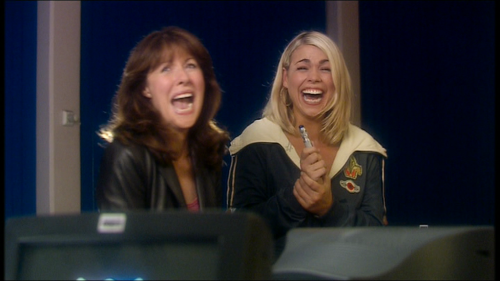
As a digression, I wonder whether the rivalry between Rose and Sarah Jane was prescient over the fierce feud within the Whovian community as to whether the Classic or NuWho is A.) better and/or B.) connected to the other.  The one-upsmanship between Sarah Jane and Rose as to who was more important was slightly amusing.  I say slightly because while watching this interplay between Piper and Sladen, two thoughts occurred to me.

The first is that Rose's reaction was highly irregular to both her character and to Companions in general.  I note the few times Companions crossed paths: The Five Doctors and The Two Doctors (The Three Doctors featured no Companions from The First or Second Doctors Era).  In both stories the various Companions got on quite well and were cooperative.  Here, Rose's instant jealousy marks a negative turning point to Rose's character.  In short, she is a bitch.  Sarah Jane was perfectly civil, friendly, even generous to the Doctor's newest Companion, while Rose's hostility was apparent immediately.  Further insulting Sarah Jane by stating that "rationing had just ended when she met the Doctor" was also just cheap.  I couldn't believe that someone who up to now had been rather generous to all beings could turn around and become so selfish and cruel.  Rose showed kindness to a DALEK for Heaven's sake!  How could the same person who showed compassion to the monstrous killing machine suddenly turn around and be so dismissive of someone who hadn't shown her any hostility whatsoever? 

Rose in short, came across as a horrid little girl, the jealous girlfriend when up to now she had been just a nice working-class girl.  It also suggests that she has fallen in love with the Doctor (setting up a situation that is sadly being replayed over and over in NuWho, with future Companions Martha Jones, River Song, and Amy Pond all suffering from a Doctor-fixation, with only Donna Noble escaping this "I want to sleep with the Doctor" business).  Her reaction to Mickey joining only seals the deal, and we now wonder whether Rose should continue to rank high among Companions given her growing obsession with having the Doctor all to herself (and incidentally, stringing Mickey along).

The second thought, more insidious, is that Whithouse and director James Hawes are resorting to a rather backward view of women as possessive, jealous, and petty (especially when it comes over a man).  I realize there being a desire to have some sort of tension between characters to build up conflict, but I wonder in retrospect whether it was good to have them basically fight over a man.  The conflict could have come from approaches to solving the issue, but instead it devolved into a The Boy is Mine scenario that was only missing Brandy & Monica singing in the background.  This made both Sarah Jane and Rose look rather foolish and neurotic women (which I would argue is not within either character).

However, there are as I said things to admire.  I found Head's performance excellent: he knows how to project menace without being over-the-top.  It is also wonderful having Sladen come back, and she is clearly stepping right into character as a Companion who doesn't scream every few minutes. 

There are also great themes being tackled: the idea that the Doctor eventually abandons or is abandoned by his Companions, the cost of loss, the reunion of the Doctor and Sarah Jane.  All wonderful things to see.  It's unfortunate, however, that the moments between the Doctor and Sarah Jane are undercut by either Rose or Finch and their actions.  It also is bad to see Mickey again reduced to this imbecile.  He can hack into top secret websites but can't figure out K-9?

Again and again I wondered why the reveal of Sarah Jane was made so obvious.  It would have worked wonders to see Sarah Jane just appear before the Doctor rather than see that she was about to come investigate all the goings-on at the school.  I wondered whether NuWho fans who have no idea about Classic Who would even understand who Sarah Jane or K-9 were.  There was never any attempt to explain her importance to Rose (or NuWho fans by extension) and while I knew what was going on I figured that anyone who started watching Doctor Who from Rose onwards would be confused as to who this woman and the tin dog were.   Her appearance would (and probably did) confuse people who like Rose Tyler, never figured the Doctor travelled with anyone else.  These NuWho fans pay lip service to Doctor Who's long history, but if they were honest they'd tell you they flat-out don't care about anything that happened between An Unearthly Child to Survival (or Doctor Who: The Movie aka The Enemy Within depending on who you ask).  That being the case, Sarah Jane Smith's importance to Doctor Who is only relevant in terms of what she does with David Tennant and future Doctors, not what she did with any Doctor prior to Christopher Eccleston.

That basically means that School Reunion would be touching to Classic Who fans, but NuWho fans would be less impressed to not impressed at all, and thus one loses some points for the reuniting of two icons from this legendary series.    

At first, I was so enchanted by Sarah Jane Smith's return to Doctor Who that I was convinced that School Reunion would rank among the Greatest Who Episodes of All Time.  I still have great fondness for it, and think seeing The Best Companion of All Time is wonderful.  However, after a second viewing I've lost some of that lovin' feeling for School Reunion.  There are good moments, even great ones (what child at some point hasn't fantasized about seeing their school go kablooey), but in this case, School Reunion lost a little the second time round. 

Class Dismissed.
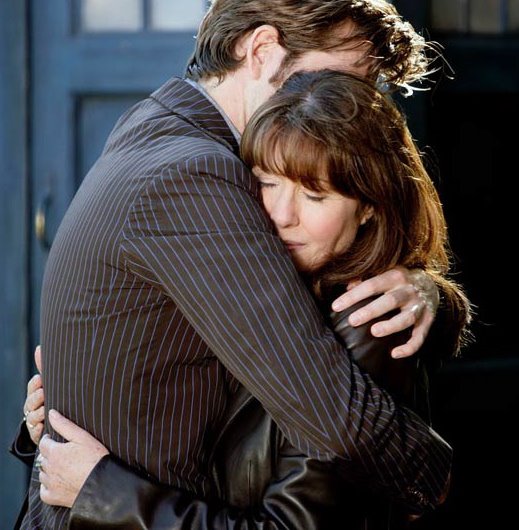
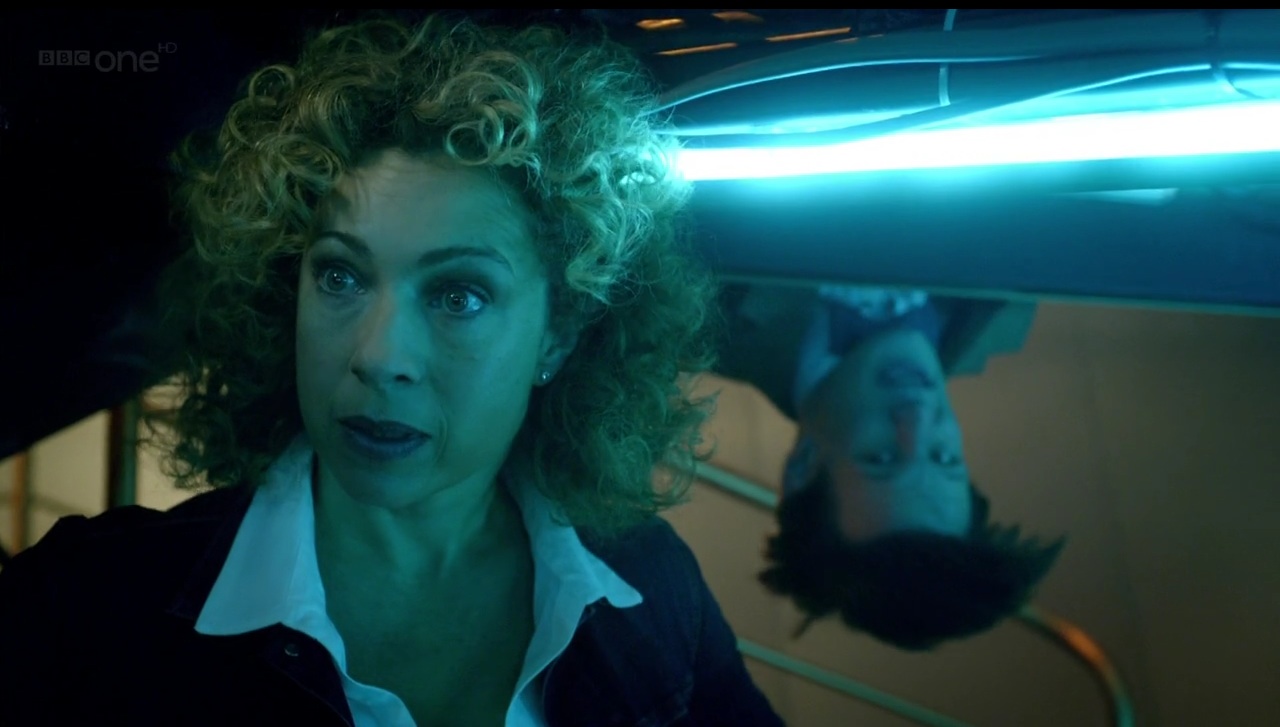
Forever Our Sarah Jane...
   

7/10

Next Story: The Girl in the Fireplace

Wednesday, December 26, 2012

Frosty's Revenge


STORY 234: THE SNOWMEN

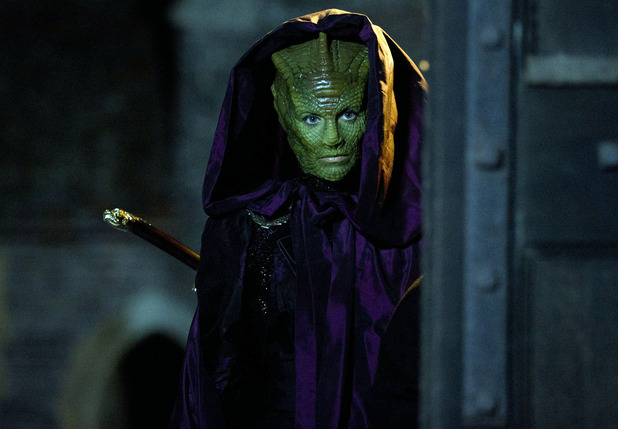
The Snowmen is perhaps the best pilot for a spin-off I've seen, given that the secondary characters of lizard-like alien Madame Vastra (Neve Macintosh) and her Victorian-era human lesbian lover Jenny (Catrin Stewart) are infinitely more important than the former lead character of The Doctor (Matt Smith).  The Snowmen has the return of the Great Intelligence, which is a villain not from the mind of writer/producer Steven Moffat (which must come as a shock to his sycophants) but from the Yeti stories of the Second Doctor era: The Abominable Snowmen and The Web of Fear.  What it doesn't have is the need for the Doctor.  In many ways, the Doctor seems to merely be in the way of the Vastra/Jenny/Sontaran Strax (Dan Starkey) fun-and-games.  In short, for all it's worth he might as well have remained up in his cloud.

It's 1842 and a little boy is making a snowman.  He's a solitary little chap who thinks the other children are 'silly'.  As it happens, the snowman thinks so too...and tells him so.  Soon we go fifty years, and little Walter has grown to the sinister Dr. Simeon (Richard E. Grant).  He is the servant of the Intelligence or Great Intelligence (voiced by Ian McKellen), who is none-too-subtle about who he is (given the bad doctor's calling card literally reads G.I.). 

We then get a look at ye olde Victorian wench Clara (Jenna-Louise Coleman), who is puzzled by the sudden appearance of a snowman.  The passing wanderer cares not about this phenomena, but our persistent serving-wench jumps on his carriage and asks those immortal words, "Doctor Who?"

The Doctor tries to get Clara to forget they met via a Memory Worm (I suppose those devices from Men in Black weren't available), but that comic Silurian Strax keeps making a right mess of it.  The Doctor doesn't care about anything, least of all Clara Who...which leads her to reply "Doctor Who".  She however, manages to follow the Doctor up to his Castle on a Cloud...or TARDIS on a Cloud...but runs off before he finds her.

Our Clara all but magically changes from ye olde Victorian bar-wench to the veddy proper Victorian governess Miss Montague.  She watches over two children, Digby (Joseph Darcy-Alden) and his sister Francesca (Ellie Darcy-Alden...wonder if they're related).  Francesca has been having nightmares about her previous governess, who drowned in the pond (emphasis mine) coming back to punish her on Christmas, which is that very night.  Digby suggests she needs a Doctor...

With that, Clara returns to where the TARDIS on a Cloud was, shouting for him.  Coming upon this odd scene is Jenny.  Clara tells her she needs to speak to the Doctor, to which Jenny replies, "Doctor Who?"  Jenny then takes her to meet the star of The Snowmen...


...and they have a most interesting conversation where Vastra puts her to The One-Word Test.  What is that one word that will bring the reclusive Doctor out of retirement to save the world?  Vastra tells him that One Word, which reawakens him from his enforced metaphorical slumber...

POND!

I suppose technically the fact that the estate's pond remains solidly frozen while everything else has thawed is what Clara was referring to...or IS IT?  The Doctor goes to where Clara works and quickly things happen: the Ice Governess comes alive to terrorize the children, the Doctor finds things exciting again, the Companion dies (sort-of), the Great Intelligence tries to win but can't, something outside the Doctor saves the world, Doctor bids farewell to Clara and at her funeral realizes that the same Clara Oswin Oswald was the SAME Oswin from Asylum of the Daleks!  She's The Girl Whose Died Twice (wonder if she's related to Rory Pond...Williams...Whatever).  We end in present-day where a girl not unlike Clara/Oswin is wandering that same graveyard.  She's not afraid of ghosts.  Now the Doctor has a mission: to find this girl.


He's With Stupid
   
The plot of The Snowmen was described thus by my DVR: 'Though saddened by the loss of his companions (sic), the Doctor helps a young governess battle a frosty menace".  I don't know if they were intentionally or not trying for a pun but I took it as unintended comedy.   For myself, while I did find some good things within The Snowmen, it's just another in the sad and sorry disappointments of the Moffat-Smith Era I have endured.

Let's start with the dominance of the secondary characters.  For the first half of The Snowmen the Doctor isn't a player in any of it.  I know it's because he is now a recluse, but because of this the slack has to be picked up by Vastra, Jenny, and Stax: three characters the NuWho fans have inexplicably gone mad for (why secondary characters who were in River's Secret Part I: A Good Man Goes to War for less than fifteen minutes are suddenly iconic I know not) but who basically take over the story.  That perhaps might be forgiven if there was anything good about them, but there simply isn't.  Again and again I am puzzled why so many NuWhovians appear to be celebrating same-sex bestiality.  Madame Vastra is a know-it-all (hints of River Song), Jenny is basically a tart, and Strax...well, poor Strax.  Poor, poor Strax.

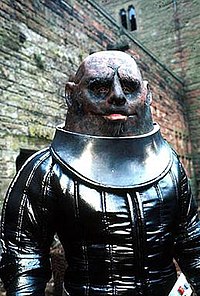
The Silurians were once a feared enemy of the Doctor.  Making their debut in The Time Warrior (which also was the debut story of Elisabeth Sladen's Sarah Jane Smith), they became fierce foes to the Doctor, even having managed to invade Gallifrey itself in The Invasion of Time.  However, now this once proud warrior species has been reduced to comic relief, a figure of ridicule more than menace.  Strax, more than any other Sontaran, has shifted the image from that of a committed foe to that of a dimwit who doesn't quite get the social manners of humans or any other species. 

Perhaps that's what NuWho fans want, but somehow it doesn't ring true.  It turns things into a joke when perhaps the Doctor might have called for a Sontaran's fighting ability, especially one that is willing to help him.  The entire scene between Strax, the Doctor and Clara goes on for far too long and is nowhere as funny as Moffat or Smith think it is.  Comedy is OK so long as it adds something to the story or grows out of it (example: The Romans).  Given that it was neither, the whole sequence should have been cut tremendously.

Going on to Madame Vastra and Jenny, I still fail to comprehend why their relationship (one of the most twisted in Doctor Who history) is so beloved.  We can't quite leave aside the fact that it's a lizard involved in a sexual relationship with a human.  However, we'll try as apparently Jenny is so in love with Vastra that she doesn't seem to mind that her 'wife' drinks human blood.  When Clara and Vastra meets, she doesn't straight-up say she's drinking blood but intimates as much.  We can also leave aside the idea that it is impossible for these two to be married in any legal sense of the word: WHO would marry them, HOW?

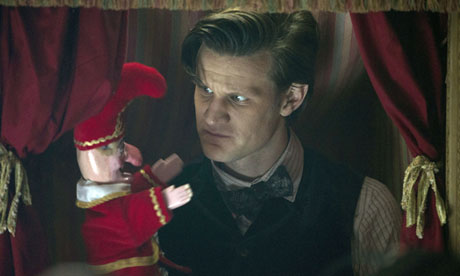
The thing about Vastra and Jenny is that they simply aren't interesting.  Other than the fact that it's a Silurian in Victorian London hooking up with this slinky Cockney, they don't appear to be clever (the mystery of the snow having been solved off-screen) or particularly important to the story.  Instead, they do serve the purpose of drawing attention and time away from the Doctor.  It was his show once, and once HE would have been leading the case.  Now, he's reduced to being Punch (and a bad one at that).

There are moments of astonishing stupidity in The Snowmen that boggle the mind as to how they would have released it the way it was broadcast.  We already have this "Doctor Who?" business that by now should be retired.  There were four, FOUR uses of something a child might find amusing but that is by now simply tiresome, even silly.  However, for sheer unintended (we hope) laughter, we have to go to when the Doctor and The Great Intelligence meet.

We begin this with the G.I. saying, "Danger.  Danger.  There is danger here".   Hearing, "danger, danger", I did expect for the Great Intelligence to call out for Will Robinson.  Perhaps Lost in Space wasn't as popular in the U.K. as it was in the U.S., but it still sounds odd at the least to hear "danger, danger" ringing out throughout the cavernous institute Simeon is at.

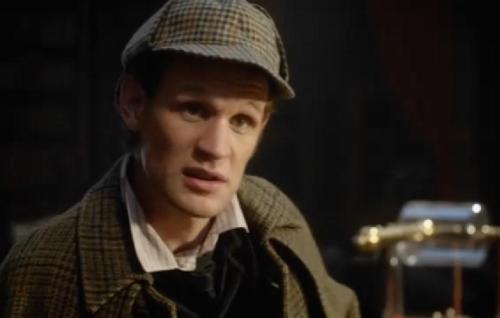
To add an even more bizarre (or perhaps self-serving) element, we have the Eleventh Doctor doing what he does best...look foolish and not taking anything seriously.  Simeon's manservant rushes into the laboratory saying that he has a caller...Sherlock Holmes.  In comes in Matt Smith, complete with pipe, dazzling us with that Moffat-Smith humor we've come to detest.


Making things even worse is Moffat/Smith's penchant for deliberately trying for laughs when the situation doesn't call for them.  When the Great Intelligence confronts the Doctor about not being from this world, the Doctor's reply is "takes one to SNOW one". 

I don't hear a rim shot.

There isn't anything wrong with having a Doctor unafraid: the Fourth would offer jelly babies to his adversaries.  However, there is laughing at the face of danger and being downright stupid.  Smith's Doctor constantly crosses that line by A.) ceding the spotlight to others (be they River or Vastra) and B.) by appearing to not realize that he is facing a serious threat...well, perhaps when you're being menaced by snow and ice, maybe not so much. 


The fact that Steven Moffat is also the producer/writer of the updated Sherlock I suppose has very little to do with this get-up.  There is a lot of mentioning in The Snowmen of Holmes and his creator.  Dr. Simeon states that Dr. Doyle has more than likely based his stories on Vastra and Jenny (changing a few things of course).  This doesn't seem likely given that the first Sherlock Holmes story, A Study in Scarlet, was published in 1887 (a full five years prior to the events in The Snowmen) and despite all claims to the contrary Madame Vastra and Jenny are never actually seen investigating anything, let alone using reason or logic to deduce the mysteries they investigate.  Furthermore, what we think of as the Sherlock Holmes look didn't originate from the stories themselves, so the deerstalker cap and cape seems a bit anachronistic. 

Of course, I could speculate that Sherlock has some homoerotic undertones in the Holmes/Watson relationship in the same way Vastra/Jenny celebrate their own unholy union, but then again, that is speculating without having all the data.

Regarding the guest stars, it seems that an opportunity was lost when they gave Grant and McKellen little to do.  What a great twist it would have been to find that Dr. Simeon wasn't the brains of the operation, but it was an old foe.  Grant looked menacing, I'll give him that, but like the Doctor never played a major role in the entire scheme. 

Now, let's move on to some good things in The Snowmen (and there are).  The interplay between Vastra and Clara is good: the former's directness matching the latter's, their one-word series of interviews well-played thanks to director Saul Metzstein (not often I say that...Pond Life, anyone).  As for Coleman, she was strong as the Victorian working-class/posh girl, though I personally wish that she had been strictly one or the other.  The reasons as to why this Cockney was masquerading (successfully so) as a governess we know not, and we could have dispensed with that angle. 

I also note that Clara has the same Doctor problem almost all NuWho Companions have: she's got the hots for him.  They've only met and in the middle of all this chaos she goes and gives him a passionate kiss.  Why?  Well, no time to answer that: we've got an Ice Governess to fight, one who keeps shouting, "That's the way to do it," and who frankly isn't terrifying (although Clara's death was sad...illogical that her body would have remained beautiful after falling thousands of feet, but sad nonetheless). 

One thing that perhaps IS frustrating is that now we have this puzzling mystery as to who Clara is.  She dies in The Snowmen (rather gruesomely and needlessly I thought) and Oswin (who is suppose to be the same person) dies in Asylum of the Daleks.   We already get there is a connection when Clara comments on how much she likes making soufflés, and the Doctor establishes that Oswin and Clara are one and the same.  That on the surface appears impossible: how does a Victorian end up serving on a spaceship?  How it will be resolved will make or break this season.

However, here again we have a Companion-centered story rather than a Doctor-centered story.  This is something I don't understand and which has plagued the NuWho since Rose: whether it's about Rose Tyler or Donna Noble or River Song or Amy Pond or now Clara Oswin Oswald, when are we going to return to stories about the Doctor?

There was a lot of comedy in The Snowmen (screaming maids, Strax's continued befuddlement, the Sherlock quasi-crossover), there were nice sets.  What for me The Snowmen didn't have were: a successful resolution (really, crying saved the day?  Nothing the Doctor did?), a shift away from the Doctor to Vastra/Jenny/Strax, a comical villain (when the Ice Governess came out, I thought they were being attacked by Mrs. Butterworth), and nothing that would interest me from revisiting The Snowmen.

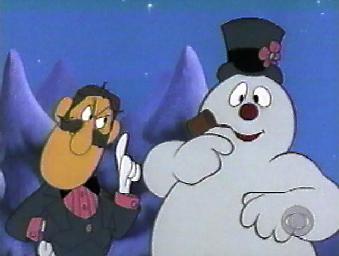
Truth be told, I'm finding Doctor Who to be losing its magic.  Perhaps they can borrow that old silk hat from Frosty...       

Dr. Simeon Instructs His Minions...


2/10

Next Story: The Bells of Saint John

Thursday, December 20, 2012

Doctor Who Story 050: The War Games

STORY 050: THE WAR GAMES

The Longest War...

If it weren't for the fact that the twelve-part The Daleks' Master Plan has several episodes missing, The War Games would be the SECOND-longest Doctor Who story in existence, coming in at a whopping TEN episodes.  Since The War Games is complete, it means that this story is about four hours and fifteen minutes long if one were to watch it in its entirety from beginning to end.  Some epic films like Lawrence of Arabia and Ben-Hur aren't that long.  The War Games isn't just famous for being the longest surviving story in Doctor Who history.  It also is the first story to mention the Doctor's own people (The Time Lords), the last black-and-white Doctor Who story ever made and the farewell performance of Patrick Troughton as the Doctor himself.

The War Games is a massive tale, but it really isn't until Episode Eight that exhaustion finally sets in, which is to its credit.  Oftentimes some past (and future) Doctor Who stories would wear out their welcome long before the story ends, and The War Games doesn't escape the "maybe it's TOO long" problem that plagued the series until a four-part story became the norm for Classic Who.  Fortunately, writers Terrance Dicks and Malcolm Hulke managed to not make The War Games feel as padded out as it ultimately became, and did manage to overcome some problems not of their making.  The end result is a remarkably fast-paced, well-acted story that added new ingredients to the Doctor Who mythos that would be important in the stories to come.

The Doctor, along with his Companions Zoe (Wendy Padbury) and Jamie (Frazer Hines) find themselves in the trenches ofWorld War I.  Soon, they are taken prisoner by the British.  General Smythe (Noel Coleman) believes Jamie is a Scottish deserter and Zoe and the Doctor spies.  Lady Jane (Jane Sherwin) and Lieutenant Carstairs (David Savile) do not believe it. 

However, strange things are going on.  Smythe is able to hypnotize everyone under him, and he is reporting via advanced technology to a mysterious group.  Furthermore, Lady Jane and Carstairs always get the sense that something is blocking their memory, and there is the case of a literal fog that has some power over everyone.

The Doctor and his Companions manage to escape, but then to their utter amazement find they have run straight into a Roman battalion, then to an American Civil War battle.  They soon discover that they are not in World War I.  In fact, we're not even on Earth.

We find out beings from another world have been kidnapping humans out of their own time to form a super-army.  The War Chief (Edward Brayshaw) has given them the power of time travel.  Reason being he is of the Doctor's own race, whom we discover are the Time Lords.  Some of the kidnapped warriors have discovered they are being used, and form a resistance that so far has been only a minor nuisance, but with the Doctor's help they soon all link up, bringing the aliens, especially their leader the War Lord (Phillip Madoc) to the brink of being defeated.

After ten episodes the War Chief is defeated (killed by the very aliens he had been aiding) but victory for the Doctor comes at a high price.  All this time the Doctor had been basically avoiding detection from the Time Lords, but because he could not take all the abducted back to their own time he needed to call upon the Time Lords for help.   Now that he's been found at last, the Time Lords do manage to return everyone to their right place, but because he has interfered with matters on other worlds (the equivalent to Star Trek's Prime Directive), he is to be punished.  His two Companions are returned to their own time, remembering nothing of their adventures with the Doctor save their first (even Time Lords can't erase all history) and the Doctor himself will be both exiled to 20th Century Earth and be forced to change his appearance.

The War Games is an epic in terms of its length, but the great success of The War Games as a story that holds together goes primarily to its two writers: Terrance Dicks and Malcolm Hulke.  Originally a six-part story, the story following it for some reason was not made.  The orders came from above: make it now ten episodes long.  That Dicks and Hulke managed (for the most part) to make the added War Games episodes seem to be part of the story is a credit to their collaboration and talent.

I say 'for the most part' because it is only when we get to Episode Eight that not only do we get a sense of exhaustion (both in viewing and story-wise) but the introduction of a new character, one Arturo Villar (Michael Napier-Brown), a stereotypical Mexican bandido.  Throwing him into the mix just seems to be a way to add a new dimension to a story that is slowly running out.  I can largely overlook the cliched way Napier-Brown played Villar (not a lot of British people can play Mexicans convincingly, even when they lay on a 'Mexican' accent).  However, I am reminded of that old Cousin Oliver Syndrome: the adding of a cute kid to give a series new life.  While this isn't the same thing, it is in a similar vein: adding a new character to give a story new life.  That was a flaw.

Another flaw is in the entire idea that the War Lord, not the War Chief, was the real brains of the operation.   As good as Dicks and Hulke were in crafting the story, I can't get the notion that again, we had a lost opportunity with the antagonist.  The main conflict was always between the War Chief and the Security Chief (James Bree), with the War Lord playing only a minimal role in the hijinks.   

However, some parts of The War Games are quite effective, even chilling.  In particular the end of the story; the Doctor has lost his two Companions, who sadly will barely remember him or all their adventures.  He then is forced to 'change his appearance' (the term 'regeneration' having yet to be invented), and the final few moments, with a at turns defiant and frightened Doctor desperately trying to stop the changes as he slips further into the void, is downright chilling. 

I also think that The War Games has a subliminal message about the foolishness of war, in particular how these 'masters of war' manipulate the troops.  I don't think it was a coincidence that the ones who communicated with the aliens were the Generals while their subordinates were almost completely unaware of how they were being used as cannon fodder to then be used to conquer the galaxy.  The heroes are 'the Resistance', those soldiers who are refusing to play these 'war games'.   

Leaving aside the political aspects of The War Games (which can be read into the story but which if existent are mercifully subtle and don't interfere with a good science-fiction concept), let's focus on some extraordinary bits within this massive story.  Chris Hayden's editing was seamless, especially in Episodes 2, 9, and 10 when we get thrilling and genuinely shocking twists: the World War I group rushes straight for a Roman legion! the Time Lords slow down time itself! the Doctor is sent into the void!  Complimenting Hayden is Dudley Simpson's score, which enhances the tension and twists in all these moments.  

The performances from the guest stars are equally well-crafted.  In NuWho, Castairs would have been considered a Companion (one with a spin-off attached as all NuWho guest characters are inexplicably tagged with spin-off fever).  However, Savile gives Carstairs a full range, from the decent-chap style of British drama to that of a man fighting for his life and sanity.  Jane Sherwin's Lady Jane Buckingham is equally strong as the woman who does her best to outwit these aliens.  Truth be told, I don't know if we saw enough of her (especially after Arturo Villar popped into the picture) but given both the length of The War Games and the fact that women tend to be demoted it isn't a surprise she was left to 'nursing'.   While Bree's Security Chief was excellent in his clipped and haughty manner, I'd argue that Breyshaw's War Chief was a bit over-the-top (neither the Fu Manchu mustache or the Nehru jacket helped, by the way).  Despite this, David Maloney directed both his guest stars and the regular characters in a near-spotless way to where on screen they almost never lagged or looked as if they didn't belong.

Maloney put both the acting and technical elements together so well that one rarely notices that The War Games is extremely long.

Finally, I think that we did have a bit of a lost opportunity to expand on the Doctor Who world when we gave the Time Lords themselves only one episode.  Granted, it's later that we get all that Gallifreyan machination and conspiracies that we all love, but they did come across as these remarkably boring quasi-deities.  Anyone would have run away from them.

I can't say that The War Games is too long because through its four-hour running time it held my interest and managed to hold up under its massive weight.  Very few stories can last six episodes or more and stay interesting (almost all Dalek stories and perhaps The Invasion or The Seeds of Death, maybe The Ice Warriors being exceptions up to this point in Doctor Who's history).  While I can't say The War Games is too long I will say that it is a bit stretched out.  That's not a particularly bad thing: The War Games does hold your interest for most of the story but one wonders whether we had some lost opportunities by not delving into the Doctor's home world or putting more focus on the conflict between the War Chief and the Doctor.  Minor things, perhaps, but still things to consider.

Still, on the whole The War Games is an intelligent and clever story with great twists and shows that a long story can work, even if at times it veers close to breaking.


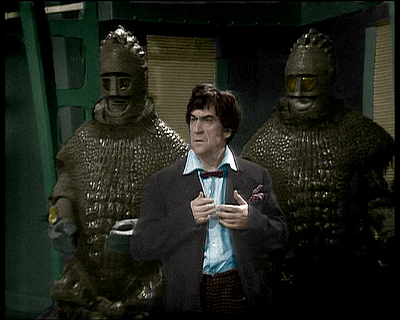
Trust me, compared to other Doctors,
this look is pretty sane...

9/10

Next Story: Spearhead From Space

Thursday, November 29, 2012

Doctor Who Story 049: The Space Pirates


STORY 049: THE SPACE PIRATES

Pirate Copies...

There is something almost perverse in that the only surviving episode of The Space Pirates exists in two places. One is a 35mm film print, which was preserved only because it was the first BBC program ever placed on film (which explains why said episode, Episode 2, is the only one surviving).  Then there is a rare instance of a video recorder being used on The Space Pirates.  Would you believe it...it is the EXACT same episode!  That means out of the six episode story, only Episode 2 remains for us to enjoy.  Enjoy, however, may be too grand a term for it, because even in that one episode, The Space Pirates looks like a slow and dull adventure made slower and duller by its length.

The Space Pirates lives up to its billing: it's about pirates in space.  That in itself is a bright idea, and Robert Holmes, in his second Doctor Who screenplay, at least presents the notion as instructed.  However, The Space Pirates is more a 'Western in Space' than a pirate story, complete with crazed prospector.  These touches, along with others, sinks The Space Pirates to mediocrity.

The TARDIS materialises in Earth's future on a space beacon just before it is attacked by pirates. The Doctor (Patrick Troughton) and his Companions, Jamie (Frazer Hines) and Zoe (Wendy Padbury) find themselves trapped in a sealed section of the beacon. It is blown apart and flown to where the pirates will plunder it of the precious mineral argonite. They witness a conflict between the pirates and the Interstellar Space Corps, led by General Hermack (Jay Mack) and Major Warne (Donald Gee).

The ISC are convinced that the pirates' mastermind is an innocent yet eccentric space mining pioneer named Milo Clancey (Gordon Gostelow), while their true leader is a man named Caven (Dudley Foster). Caven has a secret base on the planet Ta. He is assisted by Madeleine Issigri (Lisa Daniely), daughter of Clancey's ex-partner Dom, who - unknown to her - is now his captive.

When Madeleine discovers Caven's full treachery she helps to bring him to justice. The time travellers are given a lift back to the TARDIS by Clancey in his rickety old ship, the LIZ 79. *

Even in the surviving Episode 2 we see what makes The Space Pirates a weak Doctor Who story.  Namely, the Doctor and his Companions are basically irrelevant to the story.  Minus the Doctor's efforts to bring the broken-off section of the spaceship closer to the piece where the TARDIS is (which given the length of the story, he obviously was going to get wrong) they played no part in the episode itself.  In fact, if you cut their scenes, you would have had a whole new story that might have worked as a separate series. 

The NuWho fans are fond of demanding spin-offs for every Tom, Dick, and River that appears as a guest star/character  (getting their wish with the Captain Jack Harkness spin-off Torchwood).  The Space Pirates gives us a roundabout vision of what a potential Doctor Who spin-off might have looked like.  For all the length of The Space Pirates, one could easily have written the travellers out of the story without being part of anything. 

Granted, it's pretty difficult to make that argument without being able to see the other episodes, but the synopsis is pretty Doctor-lite.   I'd argue that if you removed the main characters you don't affect the overall flow of the story.  That being the case, it makes it hard to imagine that a story where the Doctor is almost irrelevant would be a good to great Doctor Who story.

Even that perhaps could be forgiven (although intensely difficult to do so).  The Space Pirates unfortunately suffers from other factors.  The decision by director Michael Hart to ask his characters to appear as if they were in a Western (particularly with Gostelow's "hillbilly in space" Milo, which makes him look a pickax and dance short of Walter Huston in Treasure of the Sierra Madre) turns this almost into farce.  Another space crew member, Technician Penn (George Layton), was allowed to have shaggy hair and a mustache that made him look like a lost Beatle.

One poor decision was in the costumes, which in terms are grand and almost comical (the space helmets themselves being a source of unintended laughter).  Dudley Simpson's score was on the plus ambitious, but curiously the vocalization that opens each episode of The Space Pirates makes it sound far too grand for the story its telling.  One thing that is in retrospect amusing is that The Space Pirates with that vocalization predated Murray Gold's NuWho score which similarly echoes a female vocal in space.

One final note: Robert Holmes' script makes mention of a 'mind probe', and I have no way of knowing whether Terrance Dicks subconsciously drew from The Space Pirates or Holmes himself when he turned 'the mind probe' in The Five Doctors into one of the most famous (or infamous) lines in Who history...but we'll cross that bridge when we get there.

One complaint I continuously make is that with the possible exception of Dalek stories, long Doctor Who stories (those that are longer than four episodes) simply can't maintain the stamina or interest of an audience.  The Space Pirates at six episodes appears to be another case of the story being far too long for the tale that it's telling.  Even if it were to be rediscovered I doubt The Space Pirates would be all that popular.  Still, it would be nice to have more lost episodes found, even if it were something as weak as The Space Pirates.

* My thanks to TARDIS Wikia for the plot synopsis. 

3/10

Next story: The War Games

Thursday, November 22, 2012

Doctor Who Story 048: The Seeds of Death


STORY 048: THE SEEDS OF DEATH

Ice Warriors Capades...

The Ice Warriors are not familiar to many Doctor Who fans. I imagine perhaps even those who followed the Classic series may not have seen the stories that featured our literal 'beings from Mars'.  They only appeared in four Who stories (The Ice Warriors, The Seeds of Death, and the two Peladon stories: The Curse of Peladon and its sequel, The Monster of Peladon...the latter being a rare sequel in Classic Who).  Since then, the Ice Warriors have been absent from Doctor Who and have yet to appear in the NuWho.  That is a real shame, because the Ice Warriors were quite effective in the fright department, and their second story, The Seeds of Death, is a simply brilliant story: cinematic in scope, with great performances, climatic cliffhangers, and an intelligent script.

The Earth has come to rely on T-Mat, a method of sending people and materials virtually instantaneously from one point to another by using the Moon as a relay point.  You could send food or yourself from New York to Canberra within seconds.  However, there is something evil afoot: the Moonbase (not to be confused with an earlier Second Doctor story called The Moonbase) is now been taken over by a mysterious force, and it isn't until near the end of Episode One that we discover it is the Ice Warriors.

Meanwhile, back on Earth, T-Mat's inexplicable failure is frustrating its engineers, in particular the T-Mat Controller and second-in-command Gia Kelly (Louise Pajo), who is both extremely efficient and extremely irritated that anything could have gone wrong.  However, no one could foresee that the Moonbase was now in enemy hands.  The Ice Warrior's leader Slaar (Alan Bennion) has either killed or forced the crew to do his work.  One, Phipps (Christopher Coll) has managed to escape the Ice Warriors, while Fewshan (Terry Scully) has become their terrified accomplice in betraying the planet.

Due to T-Mat's popularity with governments, there is no alternative method of reaching the Moonbase as the crisis grows, that is except for one.  Old Professor Eldred (Phillip Ray), who now runs a private Space Museum, is the only one who has both the knowledge and the machinery to launch a rocket (which by this time is seen as obsolete).  The professor, who is bitter over having his rockets replaced by T-Mat, at first refuses to help, but is persuaded to do so, thanks to three people who happened to have entered his museum.

The Doctor (Patrick Troughton) and his Companions Zoe (Wendy Padbury) and Jamie (Frazer Hines) soon undertake the dangerous mission to the Moon to both find what's going on.  While they're in space, Fewsham has repaired T-Mat, but it's just a way to lure Controller Kelly to the Moon.  Now the nefarious plot thickens.

The Ice Warriors have decided to launch an invasion of Earth using T-Mat to transport their seeds to the planet.  These seeds will have two effects: it will reduce the oxygen levels (killing off the humans) and make the planet hospitable for their own species (they cannot stand heat being from the cold planet).  The Doctor, after recovering from an exploding seed of death, manages to return to Earth.  Unfortunately, so has an Ice Warrior, who is now on the rampage, with the seeds killing everything that comes their way.  The Doctor discovers a way to defeat the seeds, and the invasion is misdirected to approach the Sun (killing the invasion fleet).  With Slaar the only survivor of the Ice Warriors' invasion force, the heat on the Moonbase kills him, and the travellers escape unnoticed.

As I watched The Seeds of Death, I could not help marvelling at what a well-paced, well-acted, and beautifully-photographed story it was.  I have found that very few four-episode plus stories work.  They tend, with the exception of Dalek stories, to feel stretched out.  Even the previous story, while brilliant, felt one episode too long.  Not so The Seeds of Death.  At six episodes the story never felt either rushed or padded.  This is due to two factors: the script and the directing.

In regards to the latter, extraordinary credit should be given to Michael Ferguson.  The visual style of Seeds of Death is extraordinary.  He created a look that was almost cinematic and that stand up against almost anything NuWho has come up with.  There is a great visual flair in the story, starting from Episode One when we get the point-of-view (or POV) of the monsters.  The decision to withhold the reveal of the villains until the end of the episode was a brilliant one.  Again and again Seeds of Death has a great visual style that reflects an ambition that pushes the story to new heights, in particular in the Second Doctor's era.  Each episode has an arresting moment of beauty, from overhead shots of the Ice Warrior looking through a storage room for Phipps to when Slaar confronts Fewsham before a lighted screen to when Zoe and Jamie are avoiding another Ice Warrior at the Weather Control Center.  Rarely has a Doctor Who story been so cinematically shot to where it would be beautiful just to look at.     

However, The Seeds of Death also has brilliant performances.  Pajo is brilliant as the ever-efficient, ever-professional Kelly, someone who wants to be appreciated for her accomplishments, not dismissed for being a woman.  It's a credit to her acting talent that before the end of Episode One she is not thought of as a beautiful and bright woman but as a bright, even strong person.  I'm glad the story suggests the sexism she must endure (in Episode One her superior compliments her on her talent and beauty, which she chooses to simply ignore).  Scully's Fewsham is equally brilliant as this frightened and cowardly man who might not want to work for the Ice Warriors but who is too scared of dying to fight them.  That doesn't mean that when he does finally have a moment of courage and sacrifice himself for the planet, it doesn't move one emotionally.  Despite all the evil he did, I empathized with him and felt genuine sadness at his end.

In a smaller role, Coll's Phipps played his part beautifully: a bright but frightened man, doing what he can to survive but knowing he is great peril.  Same goes for Ray's Professor Eldred, who is both bitter and pleased that his rockets are now being embraced rather than dismissed.  None of the guest stars faltered in their characters, whether courageous or cowardly, whether fearful or forceful. 

Going on to the leads, I don't think the leads have had a finer hour acting-wise.  Troughton shows his Doctor to be both serious and comical (who wouldn't at least smile as he flusters his way out of the attacking foam) and Hines' Jamie also shows that he is fiercely loyal and protective for him and Zoe.  However, it is Padbury that clearly runs away with it.  She never makes Zoe's superior intelligence something to dislike in her because she always mixes her smarts with a sweetness that shows she's not being bossy, just brainy.  However, the cliffhanger at Episode Five is where Padbury excels. 


She has been caught by the Ice Warrior in front of the screen after she manages to start raising the temperature and is facing certain death, with only Fewsham in any position to help her.  She screams in total terror for him to help her, this man she doesn't really know and whom we know has never helped anyone else save their lives.  The abject horror and terror she displays (even as her face is partially obscured by the lights, with only her voice to project the emotions) is a chilling and terrifying moment. 

In regards to the second thing that makes The Seeds of Death simply brilliant, while the credit is given to Brian Hayles,  script editor Terrance Dicks also wrote part of the story (uncredited).  Whoever ultimately put Seeds of Death together, each episode ended brilliantly.  Besides the aforementioned Episode Five cliffhanger (truly one of the best in the series, perhaps in all of Doctor Who--Classic and NuWho), each cliffhanger does make one wonder, 'what's going to happen next?'  Even the opening to each episode, with the beautiful shots of the Earth and the Moon accompanied by Dudley Simpson's incidental music, had us in suspense (and again were beautifully photographed and edited).

I also think that the special effects still hold up remarkably well given the story is pushing fifty years.  Granted they might look not as sharp as things today, but whenever the Ice Warriors kill someone the visuals and music are shocking and so excellently put together.

I will be a bit nit picky by pointing out one or two things that didn't quite hold.  I wondered exactly how it was possible that the Ice Warriors didn't notice the rocket landing at the Moonbase.  We also have a bit of running down corridors, something that would soon become, excuse the pun, a running gag on Doctor Who.  In fact, I wondered whether that whole concept started in The Seeds of Death

Finally, let me address one of the most notorious moments in Seeds of Death.  When the Doctor manages to escape into the Weather Center he slips from all the foam.   Poor Wendy Padbury plainly starts laughing and while she continues the scene to its conclusion one can clearly see the smile on her face and the desperate efforts to control her laughter.  In this case, I'm cutting Padbury some slack since I doubt anyone would have been able to control themselves, and actually Padbury did better because she didn't draw attention to her reaction. 

Overall I found The Seeds of Death far more thrilling than I thought I would.  The pacing is brilliant, the acting is superb, the story holds your interest, the monsters effective, the visuals are stunning.  Given that there are only two stories left in the Second Doctor's tenure, it is hard to believe that they could come close to topping The Seeds of Death.


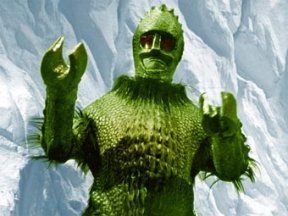
I'd be excited if they were to return to Doctor Who, but then I remember they'd be coming back to this...

Now, WHICH one's the lead and WHICH one's the guest star again?


10/10

Next Story: The Space Pirates

Saturday, November 10, 2012

Doctor Who Story 047: The Krotons

STORY 047: THE KROTONS

Something to Kroton About...

The Krotons is not held in high regard by Doctor Who fans, primarily because of the title characters themselves, who are seen as terrible monsters/robots.  However, after watching The Krotons for the first time, I think that this is a case of failing to see the forest for the trees.  The Krotons is the first Doctor Who story written by Robert Holmes, who was to become a true Who Icon, creating some of the most legendary Doctor Who stories of all time.  I'll grant that the actual Krotons themselves were pretty weak, but the story itself is overflowing with innovative ideas that should merit reexamination and reevaluation. 

The Doctor (Patrick Troughton) and his Companions Jamie (Frazer Hines) and Zoe (Wendy Padbury) have landed on an unknown planet.  No sooner have they landed than they find themselves involved in the affairs of the planet itself.  The Gonds, the humanoids on the planet, have for a thousand years given their brightest young people to "join the Krotons", their benevolent dictators.  No one has ever seen the Krotons themselves, and the young people given to join them are never seen or heard from again.  To join the Krotons is seen as a great honor, but one of the Gonds, Thara (Gilbert Wynne), angrily questions why they have to go.  His motives are more personal: his beloved Vana (Madeliene Mills) has been selected.  He urges revolution, but the Gonds won't rebel.

Of course, we already know what happens to 'the chosen ones': the emerge onto the wasteland and are promptly evaporated.  The space travellers, having landed on the wasteland, find that a man has already been vaporized and that fate awaits Vana.  She is rescued in time but her mind is terribly affected. 

Now with Thara outraged, there are rumblings of revolution, then outright attacks on the Learning Hall.  Here, the machines the Krotons provided long ago have not only given them what little knowledge they have, but have allowed the Krotons to find the Gonds' best and brightest.  This mini-Gond Spring raises the ire of the Krotons, who demand they stop.  The Doctor and Zoe, geniuses both, soon become the Krotons' ultimate targets.  Zoe, due to naivete, takes to the machines and is selected.  The Doctor then must take the tests and be selected himself.

They are submitted to the tests but manage to escape.  A concerned Jamie goes after them, but the Krotons quickly realize he is not a "high-mind".  Soon, the Gonds are split: some like Eelek (Philip Madoc) are for full revolution, while their leader and Thara's father Selris (James Copeland) urge that they must acquire knowledge if they are to defeat the Krotons. 

We discover that the Krotons nefarious plans: they need the Gonds' intelligence to keep them functioning.  Once they take their intelligence, the selected Gonds are eliminated.  With the Doctor and Zoe, they now have the ultimate ability to leave the planet.  Eelek (Philip Madoc) who has lead a virtual coup, cuts a deal with them: in exchange for leaving the planet, he will hand over the two "high-brains".   The Doctor is able to deduce that the Krotons can be destroyed with sulphuric acid.  The Krotons are defeated and the Travellers slip silently away, off to a new adventure.

   
There is no getting around it: the actual Krotons are junk.  Terrance Dicks (a Doctor Who legend himself who served as the script editor) always commented that while the Krotons looked menacing they couldn't do anything: not walk, not attack, not really useful.  Frazer Hines himself said that the Krotons were probably the worst or weakest monsters in his tenure.  There's no doubt that the Krotons themselves appear to be the poor cousins of the Daleks, closer to the Quarks from The Dominators than anything else.  HOWEVER, this is not Holmes' fault, or even that of director David Maloney. 

As hard as it may be, I would ask people to ignore the actual Krotons of The Krotons and instead focus on the story itself, which is both inventive and a throwback to other legendary tales.  While watching the first few minutes (which focus on the selecting of the two youngsters to join the Krotons), I couldn't help but think on H.G. Wells' The Time Machine with the Eloi willingly going to serve the Morlocks.  I also had a quick flashback to The Hunger Games, where we again face a situation where a society must send two people (apparently but not specifically a male and female) to be sacrificed as payment for a failed war. 

The more things change...

I was expecting a disaster while watching The Krotons given its relatively poor reputation, but what I found on the whole was an exciting and well-thought story that mostly overcomes the titular monster's weakness.  Maloney's pacing is incredible: moving quickly from one point to another while at times being almost experimental.  The scene where Zoe and the Doctor are being tortured with brain drain, visually speaking, is almost psychedelic.  The themes of free will vs. predestination expressed by Selris' desire to keep things as they are conflicting with Thara's questioning of the status quo can be seen as symbolic of how often things stay stagnant because 'that's the way they've always been'.  Youth, however, is both being sacrificed to maintain the old order (any hints of Vietnam?) and also the ones that finally rebel against the system.

Yes, I may be reading too much into things, but I think that Holmes' story is deeper, richer, and smarter than it has been credited.  Selris comments when learning of Eelek's plan to attack the Krotons head-on,
"It is not patriotism to lead people into a war they cannot win."


I find that line to be remarkably insightful into modern conflicts, from Hitler's mad idea that he could fight a war on two fronts to Syria's Bashar Assad's determination to remain in power even if it means wiping his own people out of existence.

Holmes, along with Maloney and the leads, deserve credit for also putting in moments of comedy in The Krotons and throwing in some surprises.  A surprise in The Krotons is when the Doctor asks ZOE rather than Jamie to accompany him to the Learning Hall.  The subtle message is clear: it's going to be brains, not brawn, that will defeat the Krotons.  This decision also allows Padbury and Troughton to work as a double-act, something that previous Who stories have not allowed given the wonderful chemistry between Hines and Troughton.   We have comic moments in especially tense situations, as when Zoe and the Doctor appear to argue as to who stands where just before their brains are to be absorbed by the Krotons or when the Doctor finds the Learning Machine more difficult than Zoe did.

The interaction between Padbury and Troughton is brilliant, and high praise goes to the former.  In other hands Zoe's high intelligence could have come off as bratty or arrogant, but she manages to make Zoe more innocent about how her high intelligence might be off-putting.  As far as she knows, she just is intelligent, but her nature isn't one that lords it over everyone, even someone like the simple Highlander Jamie.

Of course, that isn't to say Hines and Troughton still can't get in some funny bits between themselves.  For example, when Jamie is caught beneath the door and the Doctor and Zoe are pulling him out before they can be vaporized, the Doctor can be heard shouting, "Jamie, you're getting fat!" Take a look at this exchange between Jamie and the Doctor when Jamie emerges from the Krotons' cell:

The Doctor: How do you feel?
Jamie: Well...
The Doctor: Good.
     
The Krotons has suffered because the actual Krotons are terrible. However, this is a case of throwing out the baby with the bathwater.  Apart from the actual Krotons themselves, The Krotons is a much more complex and richer story than its been given credit for.  I for one am starting a reevaluation of the story, focusing on the acting and story as opposed to weak monsters.  If one turns away from the Krotons, one finds much to appreciate in The Krotons.

8/10

Next Story: The Seeds of Death

Thursday, November 8, 2012

Doctor Who Story 046: The Invasion


STORY 046: THE INVASION

Who Knew Cybermen Were So Animated?

In The Invasion, we have a bit of a conundrum.  Episodes One and Four of the eight-part story are currently missing.  However, it has been released on DVD intact.  How is this possible?  Animation my friends, and what animation we have.  Somehow, the animated episodes not only work well within the story, they actually enhance it, making it more brilliant.  However, more on that later.  The Invasion brings back the Cybermen in perhaps one of their biggest stories of the Classic Era.   While the length of The Invasion may be a bit too much for the story to hold, on the whole The Invasion pushes Doctor Who to a higher level in almost all departments.

After having the TARDIS restored at the end of The Mind Robber, the Doctor (Patrick Troughton) and his Companions Jamie (Frazer Hines) and Zoe (Wendy Padbury) narrowly escape a rocket launched at them from the Dark Side of the Moon.  They find they have materialized on present (read 1960s) Earth.  Quickly the three are wrapped in a mystery: there's shady and nefarious goings-on involving International Electromatics, a giant conglomerate headed up by the mysterious Tobias Vaughn (Kevin Stoney). 

Soon, we learn Vaughn's scheme: to help the Cybermen invade and conquer Earth!

However, Vaughn has a few tricks up his sleeve.  Ostensibly helping the Cybermen, he really will use them to become sole ruler of Earth.  He has forced scientist Professor Watkins (Edward Burham) to modify a device the good Professor had created.  Originally to help enhance education, Vaughn has it altered to enduce emotion, which would render the Cybermen powerless to him. 

While the Doctor eventually uncovers both Vaughn's scheme and the Cybermen connection, he gets help from an old friend.  Colonel Lethbridge-Stewart (Nicholas Courtney) from The Web of Fear, now upgraded to Brigadier, has also been investigating International Electromatics, heading up a new organization called UNIT: United Nations International Taskforce.

Eventually, the Cybermen do invade, and with the combined efforts of UNIT and the Doctor & Friends (including Professor Watkins' niece Isabel, played by Sally Faulker), they and their ally Vaughn (who when learning the Cybermen will not make him Earth's ruler turns against them, giving his life in the struggle), they Cybermen are defeated.

Again, I should point out that The Invasion at eight episodes is a very long story, and I think an episode too long.  At Episode Eight we are introduced to some sort of Doomsday Bomb that will destroy Earth should the actual invasion be a bust.  Perhaps I was distracted but I don't remember that ever coming up in the discussions, and to my mind it seemed like Derrick Sherwin had to throw in one last thing to justify there being at least one more hurdle to overcome.

To my mind it seems once the Cybermen are actually defeated, throwing in this last-minute danger from almost out of nowhere is almost superfluous.

However, this last-minute action is only a slight flaw in a brilliant story.  The Invasion is an important Doctor Who story in many ways.  First, it introduces a long-standing group that will be vital as the series continues: UNIT.  As the show would expand, UNIT's role would also grow.  The Invasion therefore is the first to feature not just UNIT, but the character of The Brigadier, who would go on to become a true Doctor Who Icon (as opposed to that horrid rammed-in character of River Song).

Speaking of River, The Invasion is a textbook example of how to integrate characters from other stories right.  In the school of 'everything old is new again', we see that Classic Who, at least during the first six seasons, did what NuWho is doing now: it has characters making return appearances.  Take Professor Travers, who appeared in The Abominable Snowmen and The Web of Fear (the two Yeti stories).  He was scheduled to return again in The Invasion, but Jack Watling proved unavailable, hence the new character of Professor Watkins (although it's clear that Professor Travers was suppose to appear, given the Doctor & Companions went looking for him).   The Invasion also brings back Lethbridge-Stewart from The Web of Fear.

Note that in each case, there was a logical reason to bring back the characters.  Travers/Watkins were scientists who had expertise in the plot, and Lethbridge-Stewart provided the military muscle to take on the threats.  NuWho unfortunately gets wrapped up in its own newly-created mythology by bringing back characters (like Winston Churchill and especially River) and throwing them into the story whether their appearance makes sense or not or are even necessary.  It also wraps the episodes together, rather than have the individual stories tie in with a character or two.  The Invasion has characters we've already seen, but it stands on its own.  In other words, one doesn't have to have seen The Web of Fear to follow The Invasion

This can't be said of NuWho, where if you watch The Angels Take Manhattan first you might be puzzled as to who the central character is or River's relationship with anything involving the plot.  If you next watch River's Secret Parts 1 & 2 (A Good Man Goes to War/Let's Kill Hitler), it becomes more confusing, let alone if you catch any other River-centric episodes (of which I'd argue there are far too many).  Classic Who had references and characters from previous stories, but they were integrated into the new stories and didn't have to have watched the first story because it was independent from the second.  NuWho at times becomes one long story with several episodes rather than various independent stories that it becomes convoluted.

Yet I digress.  The Invasion is brilliantly acted, in particular by Stoney's Vaughn, who keeps a mostly calm and chilling portrayal of a brilliant and evil genius. Stoney had a delightfully wicked manner to him, in particular whenever he said, "Packer" (Peter Halliday) when calling his dim-witted muscle or taking him to task whenever Packer bumbles his tasks (which is quite often, so much so one wonders why Vaughn didn't just shoot him).  When Stoney does rage, it becomes more terrifying because he keeps so calm, almost delightful, in his manner that when he does break it becomes full-on fury.

Even when he changes sides to help the Doctor, it wasn't any appeal to his humanity (given he was part-Cyberman himself, a brilliant and shocking turn), but because of his own megalomaniac motives.  It was a bright idea to not make Vaughn a sympathetic character but to keep him basically evil but who joins the Doctor's fight in the last minute for logical reasons.

Faulkner's Isobel is a great guest star, and it's nice to see Zoe get a girlfriend with whom to interact.  Isobel is not a damsel in distress (most of the time), and in fact she too earns points for being the first woman to tell the Brigadier he is a male chauvinist pig (which he was).  However, she also brought some well-needed lightness to her fun-loving Swingin' Sixties Girl, in particular with her flirtations with Captain Turner (Robert Sideway), whom she called Jimmy.

The Invasion is probably one of Troughton and Hines' finest hours as the perfect Double-Act of Doctor and Companion.  Individually they were great (Troughton's comic moments seemed perfect for his Doctor, while Hines' more man of action fit in with the story), but together they had a great rhythm to where they created moments of adventure and comedy throughout the story.  Padbury's Zoe was one who knew she was brighter than everyone around but she wasn't arrogant, but rather endearing, even childishly determined (as when she would not be defeated by a computer). 

One thing that needs commenting on is Don Harper's score.  At times, the music is quite cinematic, almost sounding like a gangster-film score enhancing the tension.  The cinematography is likewise brilliant.  Douglas Camfield put all these elements together in a masterful way to where The Invasion plays like a feature film. 

In particular are the actual scenes of invasion.  The quick cutting of the population coming across the Cyber Army and the scenes of the Cybermen marching in front of St. Paul's Cathedral is terrifying and brilliant.

Finally, let's move on to the animated Episodes One and Four.  Truth be told, The Invasion is so good that one doesn't even notice when it goes to an animated form.  The animated episodes themselves are so well rendered that the revelation of the Cybermen in Episode Four is actually more terrifying in the reconstruction than in the recap in Episode Five.  The animation is beautifully rendered and makes one wonder whether the other lost stories like The Evil of the Daleks or The Myth Makers couldn't be brought back with animation.

If it weren't for the Doomsday Bomb at the last minute The Invasion would probably be perfect.  Still, the fast pacing, the brilliant acting, the moments of comedy (such as when the Doctor stops to pose for Isobel's picture while everyone else goes after the Cyber Army) and the smooth integration of UNIT and the Brigadier into the Doctor Who mythos: it all works; this is one of the best Second Doctor stories available, even with the missing episodes that with the animation isn't incomplete anymore.    

9/10

Next Story: The Krotons